

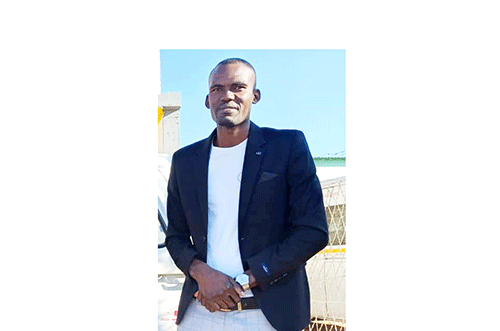

Lahja Nashuuta
Alli Mushoko, Head of the Social Sciences Department at Suiderhof School in Windhoek, says serving in public service is not about perks, but about the desire to groom young people into becoming productive citizens.
“Teaching is sacrifice, but it’s also love,” he reflects. “It’s about consistency and resilience, and it’s about believing in children even when they don’t believe in themselves.”
When Mushoko graduated from the University of Namibia in 2015, he imagined a future in the corridors of justice. Becoming a prosecutor or a criminal investigator was his dream—a way to serve his nation with pride and uphold the law.
But life had other plans. That same year, he joined the Namibian public service—not in law enforcement, but in education.
Today, Mushoko is a committed public servant. He teaches history, civics, geography and social awareness, preparing learners not just for exams, but for life.
Asked about the significance of social sciences, Mushoko explained: “Social sciences are about understanding who we are as a society. It’s about teaching children to think critically, to question, to respect diversity, and to imagine the future they want to build.”
From the very beginning, Mushoko approached teaching as more than just a job. To him, every lesson is an act of service, every learner a citizen-in-the-making.
“I may not wear the badge of a criminal investigator,” he says with a smile, “but I investigate young minds—finding their strengths, uncovering their potential, and guiding them to make the right choices.”
Being a public servant
Like many who choose government careers, Mushoko was initially drawn by the values of service and stability. He acknowledges that public sector benefits such as job security, medical aid, pensions, housing subsidies, and opportunities for professional development offered a strong foundation.
However, he soon realised that true fulfilment came not from the perks, but from daily interactions with learners, parents, and colleagues.
Still, he recognises the challenges that shadow the public service.
“There’s a lot of hearsay about poor service delivery, reluctance, or a lack of urgency in government institutions,” he admits.
“Often, the problem isn’t that people don’t care. It’s that there aren’t enough strict supervision, accountability, or clear objectives. Without those, even committed workers can lose direction.”
As an educator, Mushoko is determined not to fall into that trap.
“My philosophy is simple: listen, respond, and act. Whether it’s a learner struggling with classwork, a teacher seeking advice, or a parent voicing concerns, I make time. I never want to be the kind of public servant who says, ‘I’m too busy.’ Listening is service in itself,” he maintains.
Roles and responsibilities
In his current role, Mushoko primarily manages the administrative functions of the department. Beyond that, he is also a mentor, a guide, and sometimes even a counsellor.
He insists that leadership in the public sector must be rooted in empathy and availability.
“Citizens lose faith when officials tell them they’re too busy,” he says. “It creates frustration and mistrust. Leadership means being approachable, no matter how small the issue might seem.”
In his department, he practices what he preaches: open doors, open ears, and open dialogue. His guiding principle is that small acts of service add up to national pride.
“If every public servant took to heart President Netumbo Nandi-Ndaitwah’s plea to serve the people with compassion and integrity, Namibia would be proud of us,” he says.
Queried about his proudest achievements, Mushoko emphasises the impact of his work. Years after leaving his classroom, former learners and their parents still send messages of thanks. They remember his encouragement, patience, and dedication to shaping not just academic paths, but character.
Here to stay
Mushoko does not mince words when discussing his commitment to the public sector. “I will be here until my retirement,” he says with a chuckle.
He dreams of a Namibia where public institutions—schools, hospitals, and state enterprises—deliver services efficiently, fairly, and with dignity. He wants citizens to trust and admire public servants, rather than doubt them.
“I will stay and serve for as long as I can. Education has become my mission. As long as I am in this space, I will listen, guide, and shape lives—one learner at a time,” he says.
– lnashuuta@nepc.com.na