


Heather Erdmann
REHOBOTH- In the low-lying area of Rehoboth – between the town’s famous hot springs and Reho Spa – stands a quiet miracle; a small school that turns natural heat, love, and perseverance into hope for children with disabilities.
The Lebensschule in Rehoboth’s Block C is a small centre that continues to restore dignity to children and adults living with disabilities.
The place is called Lebensschule, meaning “School for Life”.
It was founded in 1999 by Rachel Kathy Hampe, a 67-year-old retired nurse, who has spent over two decades building what others might call a miracle.
And, it all began as a New Year’s promise to help children who had no place to go.
“I saw so many adults and children with disabilities in our town,” Hampe recalls softly. “Families were struggling, and some had to travel as far as Windhoek for help. I told myself, I will do something about it.”
At Lebensschule, lessons go beyond reading and writing. Children learn self-care, how to eat, dress and communicate, while tending the garden and helping each other. Inside, lessons unfold in small groups, where they are painting, threading beads and colouring. Every movement is therapy. Every smile and growth is progress.
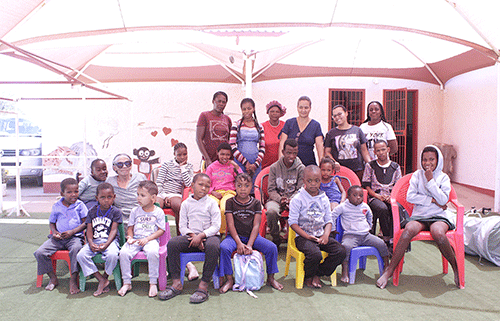
The school currently supports 33 children, split into two groups of about 17 each, attending on alternate days. Most come from homes that cannot afford transport or medical care. A donated Volkswagen Kombi picks them up each morning at 08h00 and returns them home by 12h00. They attend half-days, Monday to Friday.
What started in her mother’s house has grown into a two-plot sanctuary; one side of the plot, a building with classrooms and therapy sessions, the other for a garden fruit trees and vegetables in a green scheme. The water that nurtures the garden comes directly from the Rehoboth Hot Springs channelled through pipes to fill a small pond.
This pond acts as a cooling space fed by a constant supply of water. The pond also feeds a small concrete pool where the hydrotherapy sessions take place.
Every morning begins with physiotherapy and reconstruction neuro therapies to help children strengthen their muscles, improve coordination, and maintain posture. These sessions are guided by visiting specialists and supported by caregivers who’ve been trained through the Unam’s outreach programme.
The warm water, rich in sulphur, is not just for the plants. It’s part of therapy. Twice a week, a group of two children swim in the dam, where the mineral water helps relax tight muscles, soothes pain and regenerates muscles.
“Water therapy is one of our biggest blessings, it’s therapy straight from nature,” Hampe says, watching her pupils play nearby. “It helps them move; it helps them become stronger.”
Powered by wind and willpower
Every corner of Lebensschule shows innovation born out of necessity. The school runs on wind turbines and solar panels that power the batteries, a simple but ingenious way to cut electricity costs, a self-made system by her late husband Peter Hampe and a friend, that keeps the lights and fridges on while trying to keep costs minimal.
“When it’s windy, we have electricity,” Hampe says. “When it’s calm, we switch to prepaid.”
Parents are expected to pay a modest N$200 monthly fee, but only six can afford it. The centre survives on sporadic donations, a small monthly grant from the Ministry of Gender Equality and Child Welfare, and 25 kilograms of pasta donated by Namib Mills.
Still, Hampe refuses to give up. Her biggest challenge, however, is the day-to-day costs. Hampe leads a small but devoted team; a staff of eight earns only N$800 to N$1400 a month as incentives. Hampe’s dream is for them to one day receive a proper salary. Yet these caretakers show up daily, motivated and driven, heroes who see this work as a calling rather than a job.
“After so many years of service, they deserve stability,” she says. “This is their calling.”
Among them is Vardi le Roux, a qualified hairstylist by trade who found her heart’s work here at the school out of love.
“At first I was afraid,” she said, “but these children taught me they are just like us. They have emotions, they have dreams. They teach you patience, gratitude and pure love.”
Sandy Mariana Xamses, another longtime caregiver who began as a mother, first came to the school with a child with cerebral palsy. When her daughter passed away, she stayed on to help others.
“It’s not easy, but the journey is beautiful, every little progress gives you strength to continue,” Xamses said. “I tell parents that having a disabled child doesn’t mean your life is over. It’s a gift.”
Each story of progress keeps the centre alive, a child learning to walk again, another beginning to speak, or an adult stroke patient lifts an arm again, standing for the first time, every moment is treated as a victory.
“Every little change is a victory,” Hampe said. “That’s what keeps us going.”
Her hope now is that one day government, the community and businesses, or individuals will see and recognise what Lebensschule does for Rehoboth and not only see it as charity but as a crucial partner in rehabilitation and education.
Hampe says her dream is to expand the school to include a primary section and a facility for visually and hearing-impaired learners. Above all, she hopes for sustainability and dignity for those who dedicate their lives to others.
“Lebensschule will never close,” she said firmly.