


Rudolf Gaiseb
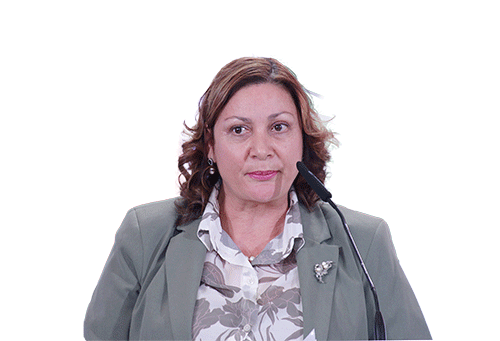
Minister of Education, Innovation, Youth, Sport, Arts and Culture Sanet Steenkamp has warned private tertiary institutions against raising their current fee structures.
She said that intitutions doing so risk being disqualified from the subsidised tertiary education model.
“We will not pay an increased new fee. We will pay what is in existence,” she told New Era yesterday.
Steenkamp had previously explained that the subsidised education is for the students, not necessarily the institutions. She, noted that the fund will be fair and just if institutions “truly pay attention to the quality improvement in both public and private institutions.”
In terms of the capacity, all public and private tertiary education institutions must ensure that student intake is within their current carrying capacities.
“If there are no spaces for specific qualifications and courses at a public institution and the private institutions are in compliance with the minimum standards and also the policy on qualifications, then there is no need for us to be unjust,” she stated.
Steenkamp, during a media engagement last week, stated any increase in enrolment beyond capacity must be avoided, whilst institutions ensure reasonable human and infrastructure capacity developments without compromising the provision of quality education and training.
However, for human resources purposes, if the private or public tertiary institution has the capacity to increase intakes for 2026 within their granted budget, “you are free to do so,” she said.
During the engagement, Steenkamp has also said that the N$17 000 non-tuition fee will be granted to students in the form of a loan. This will be done in line with the current approved Student Financial Assistance and Debt Recovery Policy and accompanying procedures. “The combined parental or guardian income threshold for funding is presently set at N$500 000. This threshold will reduce to N$100 000 and therefore caters for the neediest students,” she said.
NSFAF spokesperson Percy Tjihare yesterday explained that due to the budget allocation in the previous years, NSFAF only started funding non-tuition to students at private and vocational institutions in the 2023/24 financial year.
“They started with N$10 000, but this financial year (2024/25) the institution increased it to N$17 000 ‘across the board’ as the resources are available, and to ensure equity,” he indicated.
“This was also approved in the subsidised education model,” he said.
Meanwhile, Triumphant college’s rector Geoffrey Kiangi noted that the subsidised fee regime it is a big milestone that he said required a lot of courage to implement in terms of allocating national resources.
“We are ready to work with the government and to ensure that this good initiative really works out to lift the education levels of Namibia,” he said. “The government will help determine the rates. So, we are looking forward either to be involved in determining the rates or whatever process will be used,” he told New Era last week. Kiangi noted that the rate is very crucial because it’s from there where we are able to get both learning resources and human resources to provide good education.
He stated that “There are also mentions that we must satisfy some minimum standards. We will also be happy if the maintenance of new standards is achieved through a consultative process with us.”
“Otherwise, if those minimum standards are made too high, then it means that we will need to spend a lot to meet those minimum standards. And that cost in the end goes back to the government,” he added.
Nonetheless, International University of Management joined Triumphant college in expressing its excitement and welcomed the governments initiative.
IUM director Gerry Munyama said that the subsidised education will be a great relief to the parents and loved ones who struggle to fund their children.
“It is really commendable and really praise must be given to the government,” he noted.
Photo: Heather Erdmann