

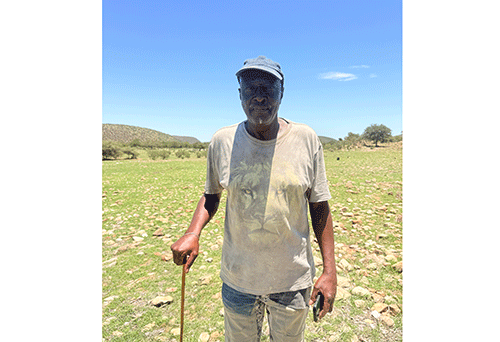

PETRUSFONTEIN – Between Kamanjab and Khorixas, northwest of Fransfontein in the Kunene region, lies Petrusfontein, a small settlement surrounded by mountains and open land.
It is a quiet place, but its history is long and heavy, carried by the people who have lived here from one generation to another.
For locals, Petrusfontein is not just a place on the map; it is home.
On most lips here, word is it is peaceful and welcoming.
When the rains fall, the land comes to life and the vast lands turn green. Resident, former lawmaker and Swanu president Tangeni Iijambo says Petrusfontein is the place where his family truly comes from. Although he was born in Windhoek, his childhood is deeply connected to this land.
“My grandparents lived here. We grew up coming here every holiday. This was home, and it’s still home,” Iijambo said, brimming with pride.
Iijambo’s grandparents were first settled in other areas such as Otjoruu and Charites. During colonial times, many Aawambo families were forced off their land as settlers demanded more space. His family, like many others, was pushed around several times.
They did not leave because they wanted to leave, but because they were pushed out, he said.
After facing discrimination in other areas, the family was eventually given land at Petrusfontein by the Swartbooi Traditional Authority. It was here that they rebuilt their lives. The land was fertile, and families planted large gardens. They reared cattle, goats, donkeys and horses.
“There was no hunger. If you wanted a watermelon, you just took one from the garden. We had enough,” he said.
This way of life continued through the 1940s, 50s and 60s. Iijambo left Namibia in 1974 and went into exile. When he returned years later, he was shocked to find that not much had changed in Petrusfontein.
If anything, the situation had worsened, Iijambo said.
He continued that more than 35 years after independence, the settlement still has no bridge. When it rains, the river becomes dangerous, cutting people off from their homes.
“People are forced to sleep on the other side of the river. It should not be like this,” he said.
Water woes
Water has also been a serious problem. For many years, the only water available has been salty. The community had to fight hard to get a desalination system. Even now, many basic services are missing.
Compounding their challenges is the absence of a medical facility or kindergarten. In the past, people relied on traditional medicine. One elder, known as August, treated wounds and sickness using local knowledge. Today, residents say modern life requires modern healthcare.
“Our children need a kindergarten. And sick people need a clinic nearby,” he said.
Iijambo wants to rename the area to ‘Ombaue’, which means ‘white stone’. What was once a settlement made up of one extended family, now has many newcomers. With that change, problems such as livestock theft have increased. He recently reported the theft of two puppies, a case that is still ongoing.
Despite these challenges, residents speak warmly about the place. Hendrette Swartbooi, who left Petrusfontein decades ago, has finally returned and describes it as peaceful and welcoming.
“The place is calm. The air is fresh, and when it rains, everything becomes beautiful,” she said. She describes it as a valley surrounded by hills. During December, many people who left to look for work return home.
“Everyone comes back. Once you are here, you don’t want to leave,” she said.
She added that, for the people of Petrusfontein, this land is more than soil and stone. It is memory, culture and identity.
“We are not asking for much, only basic services to help us live with dignity on the land our families have called home for generations,” she said.