


The term ‘parliament’ is derived from the French word ‘parlement’, meaning ‘to speak’.
The modern concept of parliament is rooted in the Westminster system of the United Kingdom, where a speaker serves as a neutral arbiter of decorum.
While Namibia’s Parliament reflects elements of this system, it operates under constitutional supremacy, rather than parliamentary sovereignty.
It is further important to highlight, in view of the office of the speaker, that decorum is a functional requirement for deliberative democracy.
The notion of representation is not foreign in Namibian communities.
Structures such as the ‘oshoongalele’ amongst Aawambo and ‘ombungarero’ in Otjiherero continue to operate to this day, of course having changed shape and form in response to the evolution of society and the nation.
A common feature of all institutions afore referred is consensus-seeking with politesse. Those privileged to represent the masses through these platforms are often regarded positive role models, and their conduct is expected to reflect the dignity of the office they hold.
As one of the three arms of the state, parliament is inherently political, composed largely of elected representatives.
Today, Namibia arguably has its most representative Parliament. Yet, paradoxically, it is experiencing slow legislative outputs.
This reality invites a more complex interpretation of recent developments, particularly the possibility that disorder may be functioning as a political instrument.
This perspective is informed by ‘Africa Works: Disorder as Political Instrument’ by Patrick Chabal and Jean-Pascal Daloz. These authors established paradigm of analysis, arguing that political actors in Africa seek to maximise a state of confusion and, sometimes, even chaos. Their assertion is that disorder in African political systems is not necessarily irrational but rather rational behavior operating within informal, uncodified and weakly institutionalised systems.
In March 2026, Members of Parliament disrupted proceedings by banging on tables, successfully forcing an adjournment.
Shortly thereafter, another shock sent waves through our young democracy following the utterance of xenophobic remarks directed at a fellow MP. Effectively, it appears that an ad hominem approach to issues pertaining to the nation has been employed, raising questions about the underlying motivations driving such conduct.
If we accept that disorder can be instrumentalised, then it becomes necessary to examine its sources.
A useful comparative case is South Africa, where the Economic Freedom Fighters (EFF) have adopted theatrical tactics within parliament.
Their use of symbolic attire, disruption and spectacle has often been interpreted as a strategy to command attention and assert political identity.
Whether one agrees with their methods or not, it is difficult to argue that such behaviour is accidental and not purposive. Chabal and Daloz further argue that many African states did not evolve organically and can, therefore, not be expected to function akin to the Weberian style, for example, which provides a useful interpretation, owing to the fact that most African democracies are premised a priori on this style.
Instead, formal structures were often superimposed, creating a disconnect between institutional design and political practice. This gap creates space for informal mechanisms, including disorder, to become tools for advancing interests. Certainly, however, a dangerous hypothesis would be one that innocently attributes this phenomenon to a mere lack of understanding or competence.
The paradigm proposed by the duo highlights the profit to be found in the weak institutionalisation of political practices. If indeed Africa works disorder as a political instrument, then the logic of the reasoning that it is utilised, more so in an organ of the state such as the National Assembly, is highly applicable.
This leads us to a sobering confrontation with our own progress. Is the current state of our August House an unfortunate byproduct of a maturing democracy or has disorder been organised as a calculated barrier to progress, serving the interests of the few at the expense of the rest?
A question that ought to be at the tip of all tongues remains: does this represent a genuine albeit uncomfortable shift towards a more robust Namibian representation or are we simply and sadly descending into the darker ages of political theatre that has long plagued the continent? If our current democratic architecture cannot maintain decorum without a two-thirds majority, what does that say about the resilience of our institutions? Are we admitting that order in Namibia is not a functional requirement of our system, but merely a luxury of total dominance?
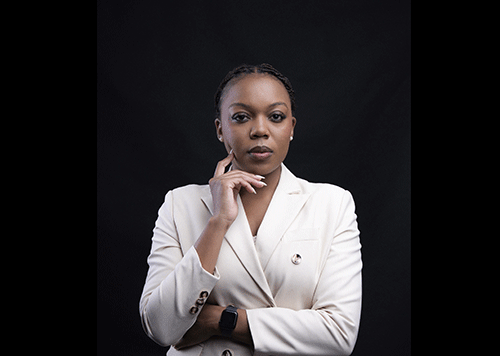
*Esther Shakela is the Founder of Kyndle by Kelilah. She is a proponent of systems literacy, advocating for knowledge of institutional mechanics as a prerequisite for effective leadership. Her work through Kyndle centres on the conviction that true impact is found at the intersection of character and competence.