

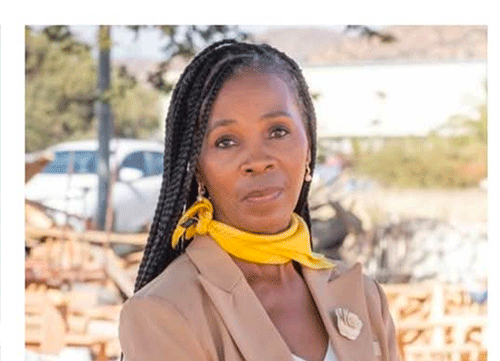
I am curious by nature; no apologies. That curiosity drives me beneath the surface, into the patterns and seasons of life where meaning often hides. I view events through a generational lens: that things are not always what they seem in the chronos of time. I am particularly drawn to the ancient story of the sons of Issachar, who “understood the times”; beyond the calendar of events, while paying attention to the deeper rhythms that shape a people.
My interest in leadership is the same: I listen for cues, study styles, and test the fit between a leader and the season they occupy.
Leadership is not one size fits all; for as the proverb goes, ‘cometh the time, cometh the man’ or in this case, the woman. I have been shaped by teachers who insist that leadership is service and soul as much as strategy. From Myles Munroe, I learned that leadership is about service, not control; from John Maxwell that a leader must “touch a heart before asking for a hand”. These lessons make me wary of purely technical definitions of power.
Humility and servanthood are often named as leadership virtues; yet, rarely do we call a leader a healer. Yet healing is a distinct and powerful attribute; relational, restorative and quietly transformative. It is evident in gestures that go beyond policy: in inclusive appointments, in how you listen, in the simple act of saying thank you. And I believe that in President Nandi-Ndaitwah, we have found a leader who heals, or is she a healer who leads? Both phrases capture her essence, and the tension between them is worth holding.
Are leaders responsible for healing?
Yes. Because we all share the lived experience of a leader who breaks more than builds. Broken leaders break others! And this adage is as true in governance as it is in personal life. When those who lead carry unhealed wounds, their decisions and demeanour can perpetuate division and pain. Leadership, therefore, carries a responsibility to seek wholeness because only leaders who are whole can create wholeness in their communities.
Healing builds legitimacy. Authority granted by office is fragile unless it is reinforced by trust. Leaders who acknowledge pain, remember contributions, and promote reconciliation forge emotional bonds that policy alone cannot secure. This legitimacy is earned in moments of recognition, in appointments that reflect the nation’s diversity, and in gestures that say, plainly, “You matter”.
“Prevention is better than cure: therefore, I am a proponent of addressing wounds in whatever shape or form they make their appearance. Addressing them reduces the risk of recurring conflict. As Paul Kagame has argued in the context of national recovery, we cannot undo the past, but we can shape a future that prevents repetition. Healing is therefore not merely remedial; it is strategic stewardship of the nation’s future.
Leadership is more than functional. It is relational and restorative, and I believe these traits are very evident in the leadership of President Netumbo Nandi-Ndaitwah.
A leader who heals
Seen through the lens of authority, our President is first and foremost a leader. She governs with pragmatism; with the Namibian people as her key priority. Healing, in this frame, is one of the tools she uses to lead.
Her speeches carry a distinctive cadence: “Namibians are too few to be poor”, a line that reframes scarcity into a call for optimal use of our resources and a shared responsibility for national prosperity. She, too, is someone with an ability to be inclusive, beyond mere rhetoric and to integrate memory into national identity. The University of Namibia’s recent honorary doctorate for Nahas Angula was more than an academic honour; it was a public act of recognition and restoration – a reminder that honouring contribution is part of nationbuilding. For to honour someone for their contribution makes us better, not weaker.
Her appointments are intentionally inclusive, and that inclusivity itself is a form of healing. By creating spaces for representation, she signals that belonging matters. We remember that she, after her election as SWAPO Party Vice President did something striking: she traversed the country from north to south to thank people for their vote of confidence.
Where many candidates seek endorsement and move on, she chose to return with gratitude. Her listening tours, (my phrase), often in remote regions where word of mouth still shapes public life, are a hallmark of leadership that understands presence as a form of care. And shall I remind you of the manner in which we celebrated independence this year, no centralisation but one with an egalitarian approach. These are not mere optics; they are deliberate acts that knit Namibia together.
A healer who leads
Yet perhaps the more authentic description is that she is a healer who leads. Leadership can unravel when the seat is occupied by a broken vessel; for hurting people hurt people. By contrast, healed people heal people.
Her leadership flows from a foundation of remembrance and restoration. She honours history, elevates contributions, and uses collective memory as a unifying force. This is not soft diplomacy for its own sake; it is the work of building social cohesion. Myles Munroe taught that “leadership is not about control, but about service.” John Maxwell reminds us that leaders must “touch a heart before they ask for a hand.” These are not abstract aphorisms for her. They are visible in the way she listens, appoints, and remembers.
Choosing the frame
Many leaders govern. Few place healing and remembrance at the heart of their leadership. For President Nandi-Ndaitwah, healing is inseparable from leadership. To the point that it is not a gimmick, but organic, because that is who she is. A person with moral authority that sustains governance. Her listening tours, inclusive appointments, and public acts of recognition are evidence that she understands leadership as both relational and restorative.
On this Mother’s Day, as we honour women who nurture and sustain life, let us also pause to reflect on leadership that nurtures a nation.
To call her a healer who leads is to recognise that the deepest work of leadership is not only to manage systems, but to mend the human fabric those systems serve. In that light, her leadership is not only political – it is profoundly maternal in its care for the body politic.
May we, as a people, embrace healing as a national ethic and hold our leaders to the standard of restoring wholeness where there has been fracture.
*Hilda Basson Namundjebo is a Communication Specialist and philanthropist, Managing Director and owner of Oxygen Communications.