


India’s High Commissioner to Namibia Rahul Shrivastava says the upcoming India-Africa Forum Summit (IAFS) represents a season of renewal for a partnership that has grown more ambitious, inclusive and future-oriented.
He stated that it aligns India’s ‘Viksit Bharat 2047’ (Developed India 2047) with Africa’s ‘Agenda 2063’, which creates a complementary roadmap for prosperity and sustainable growth.
“The India-Africa Forum Summit has served as the apex institutional mechanism for our engagement since its inception in 2008. It has evolved through a journey of constant growth and transformative achievements,” he said.
The IAFS-IV is taking place in New Delhi from 28-31 May 2026, with the business, senior officials and foreign ministerial meetings culminating in the meeting of the leaders on the last day of the summit.
Shrivastava stated that Namibia has been a stalwart participant in every single edition of the IAFS.
“Whether it was the late president Hage Geingob’s impactful presence at the 2015 Summit or the collaborative spirit shown in earlier years, Namibia has always been a key voice in shaping the Global South narrative alongside India,” said the diplomat.
The theme for 2026 is IAFS-IV ‘IA SPIRIT: India Africa Strategic Partnership for Innovation, Resilience and Inclusive Transformation’, which perfectly captures the essence of our bond.
Shrivastava said this move beyond simple transactions to a partnership, grounded in congruent ideals and enduring appreciation.
India’s relationship with Africa is anchored in centuries of civilisational linkages and a shared history of solidarity in the struggle against colonialism.
The inaugural 2008 Summit in New Delhi established the foundational Africa-India Framework for Cooperation, backed by US$5.4 billion in concessional credit and the pioneering Pan-African e-Network Project for telemedicine and e-learning.
He said: “This momentum was sustained during the 2011 Summit in Addis Ababa, which prioritised institutional building through a US$5 billion commitment, alongside a US$300 million investment in infrastructure projects and the expansion of 22 000 scholarships”.
The historic 2015 Summit in New Delhi reached an unprecedented scale by representing all 54 African nations.
Indian prime minister Modi significantly deepened the partnership by announcing a further US$10 billion in concessional credit and US$600 million in grant assistance.
“Today, this partnership has evolved into a strategic vision for prosperity through sustainable and inclusive growth. This commitment is backed by India’s expanded diplomatic presence across the African continent and a consistent push for a more representative global order – a goal most notably realised through India’s successful advocacy for the African Union’s permanent membership in the G20,” he said.
He added that, long before the formal protocols of modern diplomacy took shape, the hearts of Indians and Namibians beat in a common rhythm of liberation, hope and unyielding courage.
India’s unwavering solidarity with Namibia’s liberation struggle began as early as 1946 when India became one of the first countries to raise the issue of Namibian independence at the United Nations.
In addition, India remains a steadfast partner in Africa’s development, providing extensive concessional credit and grant assistance that supports critical infrastructure in agriculture, healthcare and education.
“India looks forward to welcoming the Namibian leadership to New Delhi once again to explore deeper integration and align our long-term development strategies. Beyond attending a summit, India and Namibia are actively co-authoring a global future defined by greater stability, fairness and prosperity for all our people,” he highlighted.
India Namibia nexus
This echoes Modi’s statement when he visited Namibia in July 2025, where he said that India and Namibia have much in common, as both nations have fought colonial rule and therefore value dignity and freedom.
“Our constitutions guide us to uphold equality, liberty and justice. We are part of the Global South, and our people share the same hopes and dreams,” stated Modi while addressing the Namibian lawmakers in parliament.
“We see great value in working together on Namibia’s Vision 2030 and the Harambee Prosperity Plan. We are working together through initiatives like the International Solar Alliance, and the Coalition for Disaster Resilient Infrastructure. Today, Namibia has joined the Global Biofuels Alliance, and the International Big Cats Alliance,” he stated.
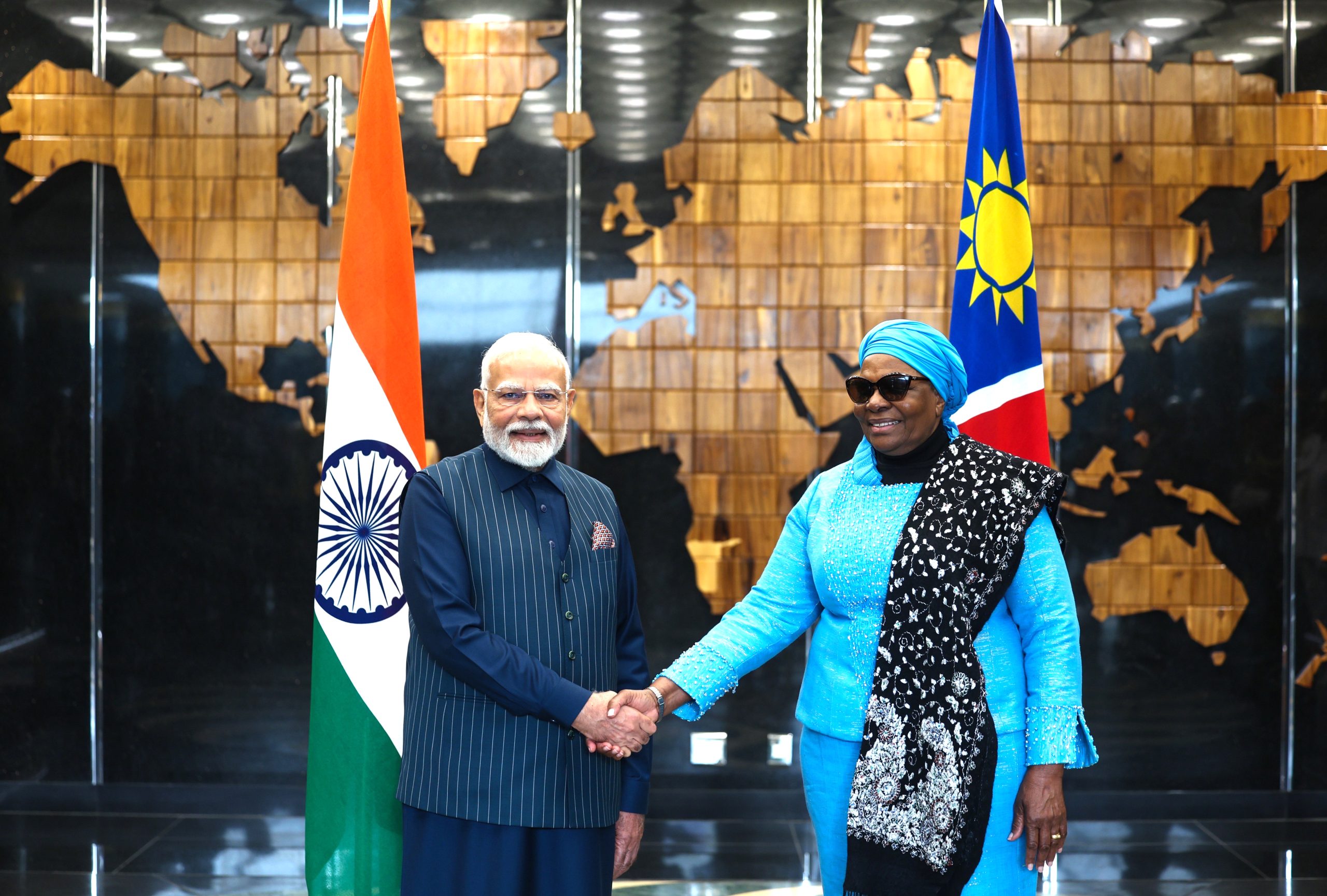
During their engagement with President Netumbo Nandi-Ndaitwah, both leaders deliberated on ways to expand bilateral cooperation across various sectors, including defence, maritime security, digital technology and UPI, agriculture, health and pharmaceuticals, energy and critical minerals. They welcomed the steady growth in trade and called for expediting discussions on an India-SACU Preferential Trade Agreement to unlock greater economic potential. Modi also assured Namibia that although the bilateral trade US$800 million, this is just a warm and more will culminate from the partnership.
Last year, India and Namibia also signed two memorandums of understanding: one to set up an Entrepreneurship Development Centre in Namibia and another to strengthen collaboration in health and medicine.
Among other key announcements, Namibia submitted letters of acceptance to join the Coalition for Disaster Resilient Infrastructure (CDRI) and the Global Biofuels Alliance.
In addition, Namibia became the first country in the world to sign a licensing agreement to adopt India’s Unified Payments Interface (UPI) technology.