


GIDUNGURI – A simple dairy cow standing inside a small shed on a green Kenyan farm may hold the answer to Namibia’s rural poverty, unemployment and food insecurity challenges.
This summation is deduced from a recent visit by a group of Namibian farmers and agricultural leaders to Kenya.
They are convinced that even households with just two cows can build sustainable businesses through cooperation, value addition and mixed farming.
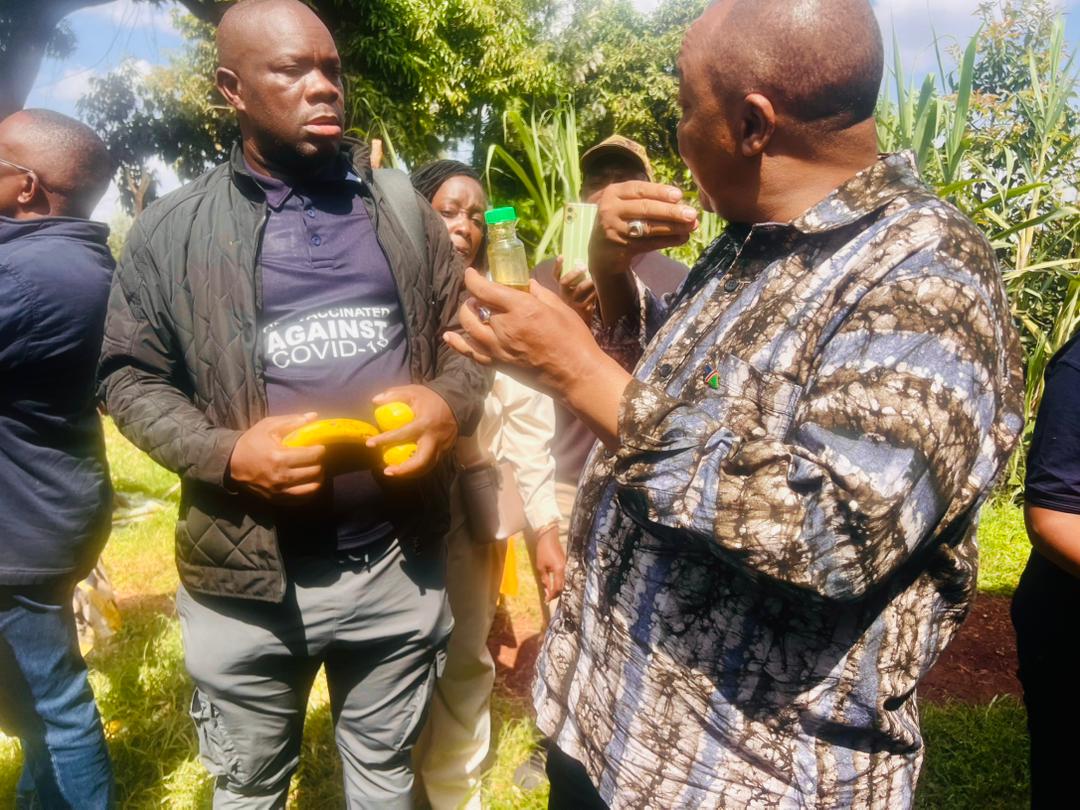
The Namibian delegation visited a mixed farming project in Gidunguri outside Nairobi last week as part of the presidential delegation to Kenya.
The farm tour brought together Namibian agricultural stakeholders, including Agribank acting chief executive officer and chief financial officer Abel Akayombokwa, Kalahari Holdings chief executive officer Etuna Nashima and Namibia’s honorary consul to Kenya, Mwangi Ali, as well as diplomats from the international relations and trade ministry.
During the visit, the delegation toured the farm of Kenyan farmer Susan Nungari, who runs a mixed farming operation combining dairy cows, avocados, bananas, maize, beans, coffee, rabbits and poultry.
“Now we are on a local farm in Gidunguri, outside Nairobi. This is a typical local farmer who does mixed farming,” Nungari said while showing the Namibian delegation around the property.
One of the biggest lessons for Namibia was the zero-grazing dairy system, where cows are kept in one place and fed crops grown on the same farm.
“If you look at the dairy cow, it’s zero grazing. It doesn’t move from here. Every farmer would have one or two cows and collect the milk, take it to the dairy collection centre and sell the milk there,” Ali said.
Avocado
The delegation also witnessed small-scale avocado oil production done manually by local women farmers as a form of value addition.
“The reason why she’s doing this is because she’s getting poor prices from the brokers. Instead of giving away a throwaway price, she would rather do value addition. And people don’t have to buy cooking oil from a supermarket. It’s so expensive,” he said.
Akayombokwa said Kenya’s cooperative system offers valuable lessons for Namibia, especially in empowering rural communities.
He said Namibia’s traditional livestock farming methods often require large herds before farmers can make meaningful profits, something that excludes many rural households.
“With this model, every household just needs to have two or three cows. It’s enough for them to generate a sustainable way of living,” Akayombokwa said.
More so, Akayombokwa said the delegation also learned that Kenyan farmers do not stop at selling raw milk but instead process it into higher-value products.
“These farmers can produce cheese. They can produce yoghurt from the same product, which fetches higher value and can even be exported,” he said.
He stressed that agriculture could become more inclusive in Namibia if small farmers are empowered and organised.
“Agriculture can be done by everybody,” he said.
The Agribank executive also highlighted the importance of locally designed livestock insurance systems, especially for drought-prone regions in Namibia.
“One thing about our challenge in Namibia is that people want to work individually. What we learned here is that cooperation makes a country move forward. United we move forward. Individually you can only move one step”, he said.
Challenges
Meanwhile, Nungari revealed how farming has become the backbone of her family’s survival despite facing serious financial and security challenges.
“This farm belonged to my late grandfather, then my dad, then my mom. I’m the one taking care of the farm now,” she said.
She also described theft as a major problem affecting productivity on the farm.
“Security is bad. Thieves are always coming here to steal avocados, bananas and even coffee,” Nungari said while showing damaged fencing around the property.
Despite the difficulties, the Namibian delegation said the visit demonstrated that small-scale farming can still sustain families and communities when supported properly.
Lessons
Nashima said Namibia could greatly benefit from adopting the same integrated farming methods.
“We have learned a lot from our fellow farmers here in Kenya. They are doing a system they call ‘mixed agriculture’ whereby you grow crops and raise livestock,” he said.
Nashima said one of the most important lessons was how Kenyan farmers use livestock manure to improve soil fertility naturally.
“The manure they collect from the livestock, they immediately put on the soil to make compost and that makes the soil more nutritious for crops,” he explained.
He said implementing similar systems in Namibia could help farmers become more self-sufficient and profitable.
“I would like to implement the same system back home so that our farmers can be self-sustained and generate more income both from livestock and crops,” Nashima said.