All of Africa, except for Saharawi, has long shed the colonial yoke which, according to the nationalists, was an impediment to development and self-determination. Yet, after decades of independence and despite abundant resources, the continent appears to be spiralling back to the conditions of the colonial era—and, in some cases, to even worse circumstances. The...
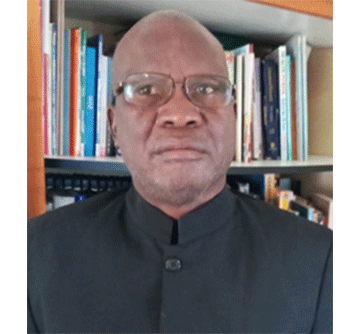
Author: Prof Makala Lilemba (Prof Makala Lilemba )
Opinion – The Kapitao freedom fighter
In 1992, during the peak of forming and organising constituencies for the first regional elections since Namibia gained independence in 1990, the national leadership of the Swapo Party assigned Jesaya Nyamu to carry out that task in what is now the Zambezi region. A few days after his arrival, the team traveled to Sibbinda, where...
Opinion – Dearth of political conscience
Politics as a dirty game is a widely held view that political arenas are often riddled with manipulation, deceit, and self-interest. While politics in its ideal form is about governance, public service, and the collective good, the phrase highlights how the pursuit of power can corrupt those ideals. But contrary to this view, there are...
Opinion – Another forgotten hero of the 1968 catastrophe
The year 1968 is one of the fiercest years in the annals of the liberation struggles in the Caprivi, recently renamed the Zambezi region. During 1968, a terrible catastrophe befell the inhabitants of the region, which was never witnessed by the people during their lifetime. The South African Security Forces swooped over the region,...
Opinion – A heroine remains standing … A story of Doreen Muhau Kuwaya
Thirty-five years after independence, Doreen Muhau Kuwaya still stands as a liberation icon and heroine from Sibbinda Village in the Sikosinyana District of the Zambezi region, remaining steadfast in preserving the Swapo membership. Kuwaya was born on 19 May 1945, into a family of four siblings — two sisters and two brothers — in...
Opinion – Politicking versus service delivery
Although service delivery varies, it should focus on how government institutions provide public services and benefits to citizens, businesses and communities. This includes everything from healthcare, education, social welfare, public safety, infrastructure, and administrative services like issuing identification cards and driver’s licences. These services should be accessible to every citizen nationwide, but in some areas,...
Opinion – A nation born into kleptocracy
During the colonial period (1885- 1989), Namibians witnessed many years in which their lives were dehumanised by the German and South African colonial masters. During this period, black Namibians were declared non-existent (fictional or imaginary human beings or mere objects) and their land declared uninhabited in keeping with the European racist arrogance. Colonisers felt that...
opinion – The demise of mother tongue culture
The demise of mother tongue refers to the gradual decline or loss of native languages and cultural identities, traditions and knowledge systems tied to them. While many languages are endangered, others are being revitalised, as the latter keep on borrowing and creating new words to fit their environment. It requires intentional action from individuals, communities...
Opinion – New era dawns for the old guard of politicians
One of the wisest men who ever lived, King Solomon, maintains in the Holy Book that there is time for everything. In chapter 2 of his book, Ecclesiastes, he points out that there is a season to be born and a time to die. In the sixth verse, he continues that there is time to...
Opinion – Laughing last is laughing best
The new Cabinet has been sworn in, and we are witnessing political and economic realities and changes. No region has been left out, unlike in previous political dispensations where other factors were considered in the formation of cabinets and other instruments of government, despite the Harambee rhetoric. By collapsing the bloated cabinet, it is assumed...