

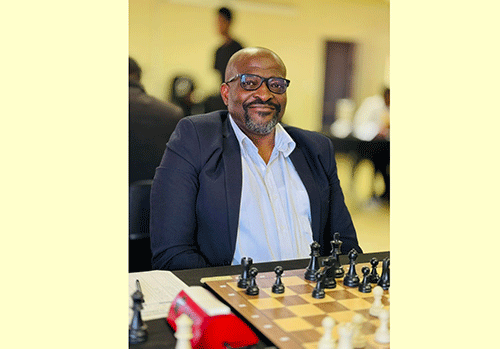

Eight-time national chess champion Charles Eichab has been elected as the new president of the Namibia Chess Federation following elections held by member clubs on Saturday.
He will be deputised by Lucia Namushinga, who assumes the role of vice president.
Eichab brings a wealth of experience to the position, both as a player and as a long-standing contributor to the development of chess in Namibia.
He began playing the game in 1991 and quickly rose through the ranks, eventually claiming his first national title in 2001.
Over the years, he has secured the championship title eight times, with victories in 2001, 2007, 2009, 2012, 2015, 2016, 2018 and 2022.
In addition to his national success, Eichab has represented Namibia at 12 World Chess Olympiads, setting a notable record for the country.
His extensive exposure to international competition is expected to play a key role in shaping the federation’s strategic direction.
Speaking on his vision for the federation, Eichab stressed the importance of growth, inclusivity and continuity.
He noted that, while the previous administration had laid a solid foundation, his leadership aims to build on that progress and expand chess’ reach across the country.
“Chess is a very visible and active sport. We want to increase our activities to ensure inclusivity,” he said.
Among his immediate priorities is ensuring Namibia’s participation in upcoming international competitions.
Eichab highlighted the importance of successfully sending a national team to the Chess Olympiad as well as increasing participation in continental events such as the African Youth Championships.
He also stressed the need to strengthen grassroots development structures.
“We have done a great deal in the last few years to bring chess to all the regions of Namibia, but now we want to go further by taking chess to the villages,” he said.
A key part of this expansion strategy involves formalising regional chess structures.
The federation plans to establish regional bodies with their own executive committees, providing them with the necessary support to run programmes tailored to their communities.
This approach aims to decentralise the sport and ensure sustainable development at all levels.
Eichab also underscored the importance of capacity building within the chess community.
The federation intends to continue its talent identification initiatives, while also investing in the training of coaches, arbiters and administrators.
With an ambitious calendar ahead, the federation is preparing for a busy year filled with tournaments, development programmes and outreach initiatives designed to increase participation nationwide.
Another major focus area will be attracting sponsorship and strengthening partnerships. Eichab acknowledged the significant role Bank Windhoek has played in supporting chess over the years and expressed optimism about maintaining and expanding such collaborations.
“We plan to attract sponsors by being more visible. By increasing our activities and outreach, we want to demonstrate that chess is a sport worth investing in,” he said.
Beyond competition, Eichab highlighted the broader value of chess, particularly in education.
“Chess is not just a sport. It is an educational tool for lifelong development. We have been trying over the years to formalise chess as a subject in government schools, but it has been a challenge. However, we remain committed to that goal,” Eichab said.