
Kaviveterue Virere
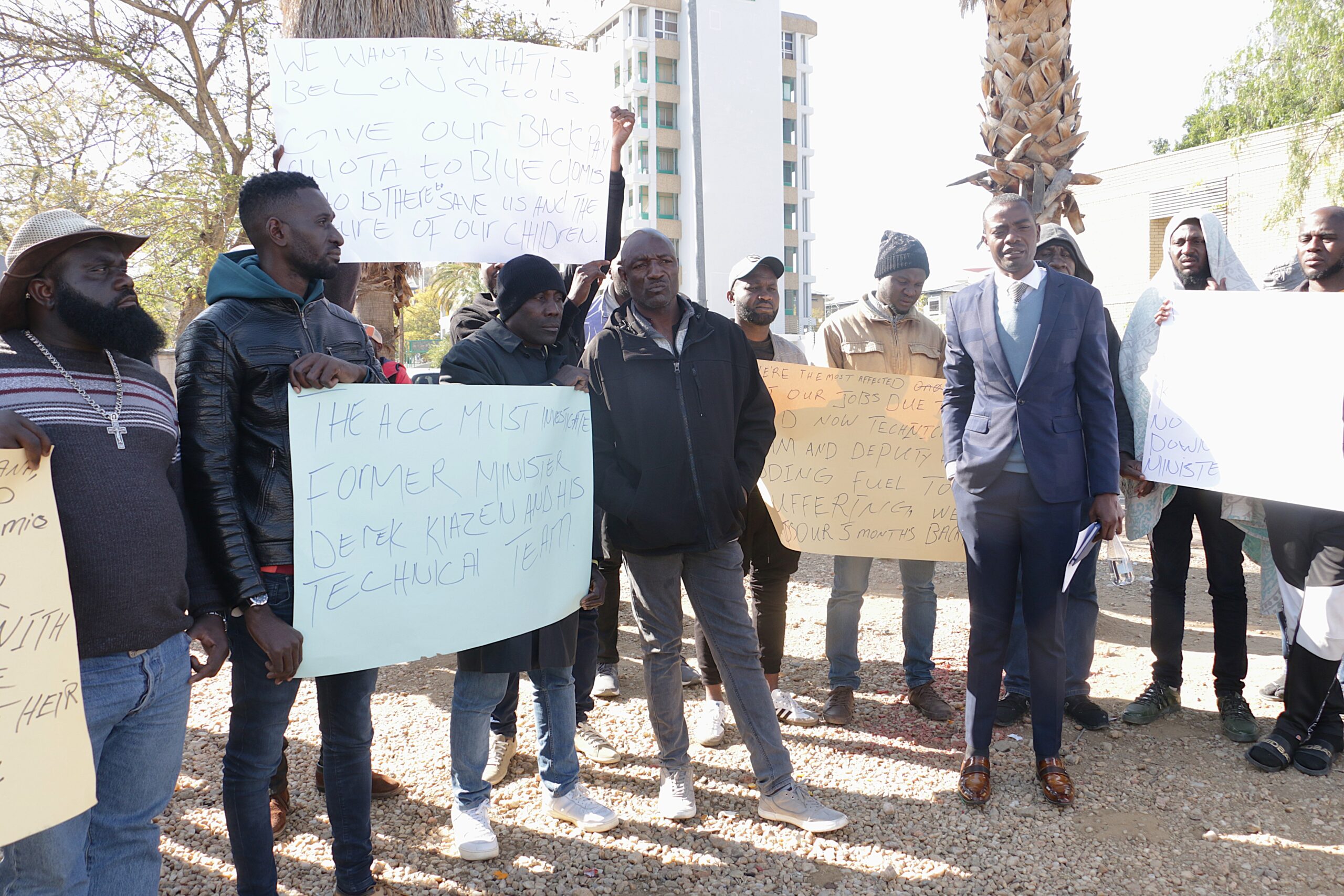
A group of former fishermen on Tuesday called for government support in securing a five-month back pay they claim is owed to them.
The fishermen were hired under the Namsov Fishing Enterprise and the Heinaste quotas. Many of them claim that they have suffered great financial loss since their layoffs in December 2022 as a result of the corruption case now infamously referred to as “Fishrot”.
The fishermen assert that they have not received the promised settlements even though they were placed under the Redress Programme, which was approved by the Cabinet and was meant to assist impacted workers.
Joseph ||Garoëb, general secretary of the Mining, Metal, Maritime and Construction Workers Union (MMMCWU), condemned government’s apparent lack of action.
“After so much patience, the fishermen now want tangible action,” he said. “While briefcase companies, none of which are active or profitable, have been given quotas worth millions, workers continue to be under “no work, no pay” contracts.
In the petition, ||Garoëb cited previous assurances from the government that haven’t been kept.
“Workers have been waiting for three months since your assurance on May 18, 2025, to resolve this matter either socially or politically,” he said.
The petition from the fishermen calls for the creation of an impartial agency to look into claims of irregularities in the quota allocation and reparation programmes. They suggest that the body comprise labour experts, the Namibian Police, the Anti-Corruption Commission (ACC) and worker representatives.
The fishermen contend that to handle quotas and the welfare of workers impacted by the Fishrot repercussions, a body of this kind is required to guarantee responsibility, justice and openness.
According to the fisherman, they would not stop demanding their rights until their complaints are resolved.
Meanwhile, a meeting was held this week to discuss the Government Employment Redress Programme (GERP), which has now been running for five years.
This programme was based on a Cabinet decision which instructed the then Ministry of Fisheries and Marine Resources and the Ministry of Labour, Industrial Relations and Employment Creation to help certain former fish workers.
The aim was to provide full-time, permanent jobs for former Namsov employees who were retrenched, and those who lost their jobs because they took part in an illegal strike in 2015.
According to Government Gazette Notice No. 74, dated 24 July 2020, certain companies were identified as “designated entities” and entered into agreements to re-employ the affected fishermen.
According to the Institute for Public Policy Research (IPPR), redress must be rights-based, not transactional. GERP’s design lacked a clear rights-based framework, reducing redress to temporary employment rather than long-term restoration of dignity, livelihoods and trust.
IPPR also states that transparency and oversight are non-negotiable. The absence of public reporting, independent audits and participatory mechanisms undermines public confidence and sets a weak precedent for future redress initiatives.
Furthermore, IPPR highlights that data-driven targeting is essential. Without clear eligibility criteria and disaggregated data, GERP failed to reach some of the most affected individuals, especially women and informal workers.
Redress should also build resilience, not just fill gaps and institutional reform must accompany redress.
Photo: Heather Erdmann