


Auleria Wakudumo
As Namibia celebrates more than three decades of independence, the story of rural development reflects significant achievements, persistent gaps, and emerging opportunities.
Across regions, the country has made progress in bringing vital services to rural populations that were historically marginalised under colonial and apartheid rule.
While disparities remain between urban centres and rural communities, Namibia’s development agenda continues to prioritise investments to transform rural areas.
These include water infrastructure, roads, schools and clinics, health facilities, agriculture, and economic empowerment, with varying levels of progress recorded across regions.
New Era spoke to the founding secretary of the National Council of Namibia and former director of planning in the Khomas region, Ben Mulongeni, who reflected on the country’s journey of rural development since independence. Mulongeni praised the government for its progress over the past 36 years, highlighting achievements such as rural electrification and the expansion of water supply, which have reached even the most remote villages.
“Despite these successes, more work still needs to be done,” Mulongeni said, noting that several areas of rural development require further improvement.
Water supply
Minister of Agriculture, Fisheries, Water and Land Reform Inge Zaamwani highlighted the progress made in improving water access nationwide during her budget presentation in Parliament on 8 May 2025.
She reported that the proportion of rural households with access to potable water increased from 91.3% to 92.85%.
Over the past five years, the government constructed 31 short pipelines and rehabilitated 14 others. In addition, 249 boreholes were drilled, 147 boreholes were installed, and 133 water points were rehabilitated. Three traditional wells were modernised, with two in the Oshikoto region and one in the Omaheke region.
Two mini-desalination plants were also constructed at Akazulu and Oshikondeilwa in Oshikoto.
Mulongeni said the government had made a deliberate decision to supply water to every corner of the country.
“I’m not saying there are no water problems, particularly in Oshikoto and other regions, but overall, there is water everywhere,” he said.
Despite these gains, the government says it remains committed to ensuring that all Namibians have access to clean and reliable water.
Plans are underway to drill new boreholes and refurbish pipeline networks in the Kunene region, where five new boreholes are set to be drilled under the 2025/2026 national budget programme.
Sanitation
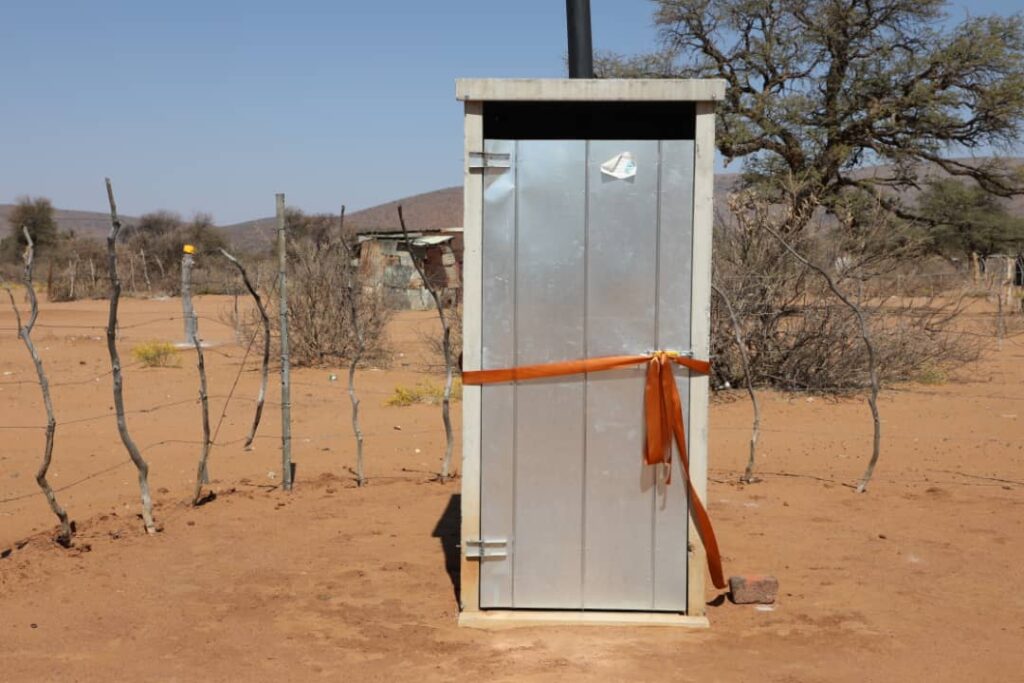
Sanitation programmes led by the Ministry of Urban and Rural Development and regional councils have improved hygiene in rural communities through household toilets and other facilities.
During the 2024/2025 financial year, 782 toilets were constructed for rural households to help reduce open defecation. The Oshana region received 161 toilets, followed by Ohangwena with 217.
Other regions that benefited include Oshikoto 112, Otjozondjupa 100, Omusati 54, Kavango West 33, Hardap 35, Omaheke 12, Kunene seven, and Kavango East five.
However, Mulongeni criticised the government for not doing enough to address rural sanitation.
“Even after 36 years of independence, some people still relieve themselves in the bushes. Proper flushable toilets are urgently needed in informal settlements and villages, particularly in public spaces such as cuca shops and shebeens,” he said.
Education
The ministry of education stated that since independence, about 419 new schools have been built, mostly in rural areas and villages, to improve access to education.
Mulongeni highlighted that most primary and combined schools were built in rural areas, while secondary schools are concentrated in urban centres.
He noted that rural areas still need more secondary schools, as some rural schools outperform those in towns.
“Many learners are forced to rent rooms in informal settlements near shebeens. This issue needs to be addressed immediately,” Mulongeni said.
He also stressed the need to address school shortages, as some learners cannot secure placements when schools are full.
Roads
The government has expanded Namibia’s road network to improve access for rural communities. Data from the Roads Authority and the Ministry of Works and Transport show that the national road network has grown from about 41 800km at independence to nearly 49 000km today.
Most rural roads are gravel, connecting villages, farms, and settlements to nearby towns. Several have been upgraded to bitumen standard, increasing the paved network from 4 500km in 1990 to more than 8 000km today.
These improvements have reduced travel time and made it easier for rural residents to access schools, clinics, and markets.
In the Ohangwena region, road upgrades linking Ongenga, Eenhana, and Ondobe constituencies have boosted travel and small-scale farming trade.
The Omusati region has rehabilitated several farm-to-market roads, helping farmers and cattle herders move safely during the rainy season.
Meanwhile, Kavango East and Kavango West regions have upgraded rural roads connecting remote villages to centres such as Rundu, Ndiyona, and Nkurenkuru.
The Zambezi region has improved roads from Katima Mulilo to inland villages, easing access to clinics and schools. In the south, regions such as ||Kharas and Omaheke continue to expand gravel roads linking remote communities and cattle posts to towns and cross-border trade routes.
However, many rural gravel roads still require frequent maintenance and are often damaged by heavy rains and floods. Limited funding, long distances between settlements, and high maintenance costs continue to slow upgrades in some areas.
Challenges persist
Despite these interventions, rural areas continue to face structural challenges. High poverty and food insecurity persist in many communities. Access to decent roads, reliable water, and technology-driven agricultural support remains patchy, leaving some residents feeling left behind.
Mulongeni criticised national development planning, noting that while anchored in Vision 2030, the rural development policy and successive national development plans, the urban-rural gap in access to services has not yet been fully closed.
However, regional councils and community leaders continue to advocate for targeted investment, stronger private-sector partnerships, and sustained policy focus on rural livelihoods.
As Namibia charts its next chapter, rural development remains central to the country’s vision of inclusive, people centred progress.
-awakudumo@nepc.com.na