

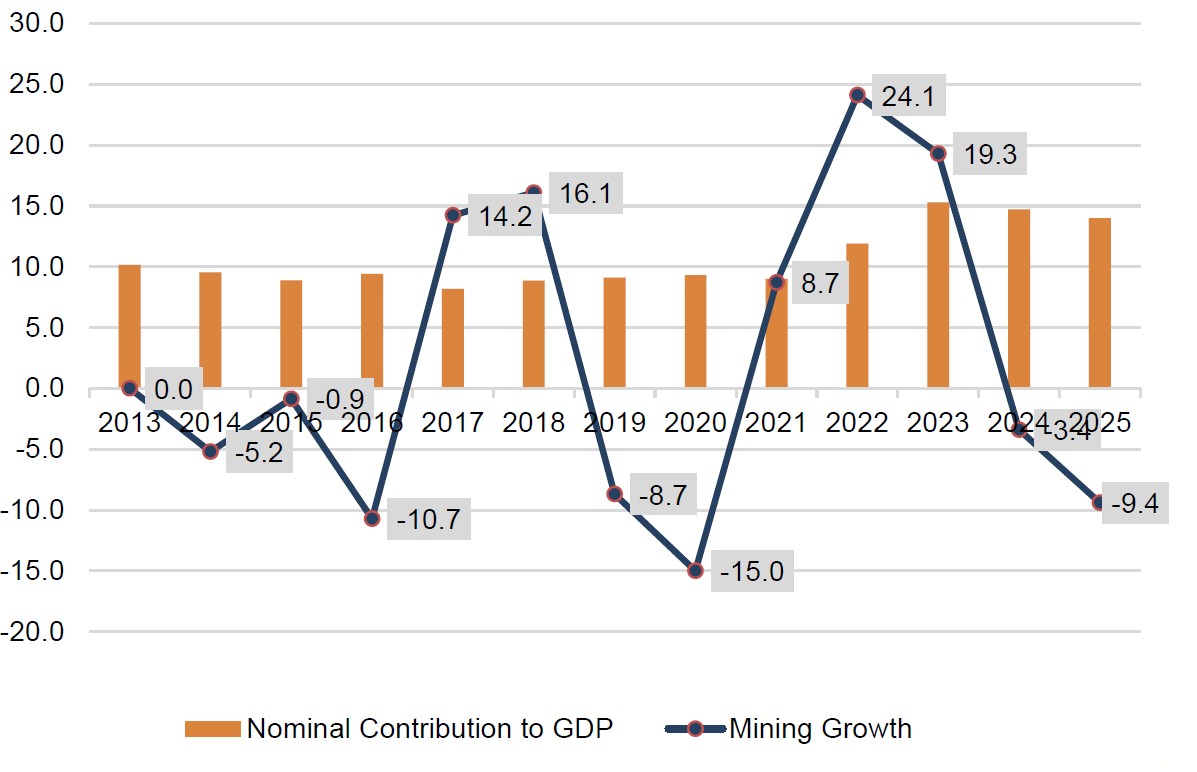
Despite a 9.4% contraction in the mining sector’s real value added during 2025, the sector remained a pillar of the Namibian economy, contributing roughly 14% to GDP and maintaining its position as the country’s dominant primary industry.
However, even with the significant contraction, the sector’s financial contribution expanded sharply as total mineral sales jumped 25% from N$51.38 billion in 2024 to N$64.18 billion in 2025, fuelled by strong gold prices and increased uranium output. This was shared at the recent 47th Annual General Meeting of the Chamber of Mines of Namibia, where chamber president George Botshiwe painted a picture of a sector simultaneously driving economic growth and battling increasing uncertainty around policy direction. Still, the Chamber remains optimistic that Namibia’s vast uranium, gold and critical minerals resources can position the country as a major beneficiary of the global energy transition — provided the country can strike the right balance between empowerment, investment competitiveness and regulatory stability. At the AGM, Botshiwe noted that during 2025, government revenue from mining also climbed substantially with taxes paid by chamber members surging 39% to N$7.8 billion, while royalties increased 9% to N$2.458 billion. Export levies almost doubled, rising 90% to N$685 million. “The trends suggest a gradual evolution in Namibia’s mining revenue base, with gold and uranium increasingly emerging as key contributors to government revenue,” Botshiwe said. Overall, the domestic mining industry delivered a powerful economic contribution in 2025, generating billions in export earnings, surging tax payments and supporting thousands of jobs. This is as Namibia lost some ground in investor confidence as witnessed in the lower rank of Namibia’s global mining competitiveness.
Moreover, Namibia’s diamond industry struggled during 2025 under weak global demand and falling prices, while uranium and gold mining delivered strong production gains, helping to offset the downturn and reshape Namibia’s mining revenue base. Uranium production surged by 20.8%, largely driven by the restart of the Langer Heinrich Uranium Mine, alongside stronger performance from both the Rössing Uranium Mine and the Husab Mine.
Gold production also rose by 1.9%, with both B2Gold Otjikoto Mine and Navachab Gold Mine exceeding production targets amid record international gold prices.
Diamonds, however, remained the sector’s Achilles heel. Global diamond prices declined by between 10% and 12% during the year due to weaker consumer demand in major markets such as the United States and China, inventory adjustments and growing competition from synthetic diamonds. Namibia’s diamond production subsequently declined by 5.6%, significantly weighing on overall mining performance.
Meanwhile, the sector remained consistent as a major employer and economic multiplier. Although total direct mining employment dipped slightly to 20 798 workers due to retrenchments at Sinomine Tsumeb Smelter and Debmarine Namibia, contractor employment rose notably as large new mining projects moved into development phases. Projects such as the Twin Hills Gold Project, Etango Uranium Project and Tumas Uranium Project created strong demand for contractors and construction workers. In Botshiwe’s President’s Report he revealed that member companies collectively employed 8 201 people in permanent positions during the year, with only 219 expatriates occupying those roles. This translates into 97% of permanent jobs being held by Namibians. In addition, the industry’s wage bill reached N$7.96 billion in 2025, while workers contributed roughly N$1.5 billion in PAYE taxes.Beyond direct jobs, mining continued to channel enormous spending into the domestic economy. The sector spent close to N$24 billion on locally sourced goods and services during the year which equates to 65% of total procurement spending and more than a third of total mining revenue. “This high level of local procurement supports small and medium-sized enterprises, strengthens domestic supply chains, promotes value creation within Namibia, and sustains employment across multiple sectors of the economy,” Botshiwe said.
The Chamber also highlighted a potentially transformative investment pipeline. According to the industry body, planned mining developments could attract approximately US$2.865 billion in investment and create more than 18 000 jobs over the next five years if policy bottlenecks are resolved.
Among the flagship developments are Bannerman Energy’s Etango uranium project, Deep Yellow’s Tumas uranium project, Osino Resources’ Twin Hills gold mine and Andrada Mining’s expansion into lithium and tantalum through its Lithium Ridge partnership with SQM. However, despite the strong investment pipeline, the chamber warned that policy instability is increasingly threatening Namibia’s attractiveness as a mining destination. Central to investor concerns was last year’s proposal by former deputy prime minister and mines minister Natangue Ithete to impose mandatory 51% local ownership requirements on future mining licences. The proposal triggered immediate alarm in international markets, temporarily suspending trading of some mining companies on the Australian Stock Exchange and contributing to a sharp deterioration in Namibia’s global mining investment rankings.
According to the 2025 Fraser Institute Annual Survey of Mining Companies, Namibia’s Investment Attractiveness Index fell from 66 to 56 points, with the country’s global ranking dropping from 30th to 51st place. Survey respondents specifically cited policy uncertainty surrounding the ownership proposal as a major concern.
The Chamber subsequently sought urgent intervention from Netumbo Nandi-Ndaitwah, who clarified that no fixed 51% ownership threshold had been formally adopted as government policy. Government later stated that it remained committed to consultations aimed at achieving “balanced, win-win outcomes”.
Botshiwe nevertheless warned that Namibia risks losing out on a global mining investment boom if policy certainty is not restored quickly. “Mining is a long-term, capital-intensive industry, and sustained investment ultimately depends on policy clarity, regulatory certainty and a stable operating environment,” said Botshiwe.