

Namibia’s annual inflation rate eased to 2.1% in March 2026, down from 4.2% recorded in March 2025, according to the latest Consumer Price Index (CPI) report released by the Namibia Statistics Agency (NSA).
Inflation measures how the prices of everyday goods and services change over time, including food, transport, rent and electricity.
A lower rate means prices are rising more slowly.
On a monthly basis, prices increased by 0.2%, compared to 0.0% in February.
Core inflation stood at 2.9%, higher than the headline inflation rate. The NSA said the latest figures show a slowdown in price increases compared to last year. “The annual inflation rate for March 2026 reflects a slowdown compared to March 2025. However, differences across zones and products continue to be observed,” said the report.
The Transport category, which accounts for 14.3% of the consumer basket, recorded a 1.7% deflation in March 2026, compared with a 2.6% increase in March 2025. This means transport costs, such as fuel and travel, were cheaper on average than a year ago.
The NSA said the decline was seen across all sub-components of the transport category.
On a monthly basis, transport recorded an inflation of 0.4% in March 2026 after a deflation of 1.2% in February.
Main drivers
The report shows that housing-related costs were the biggest contributor to inflation.
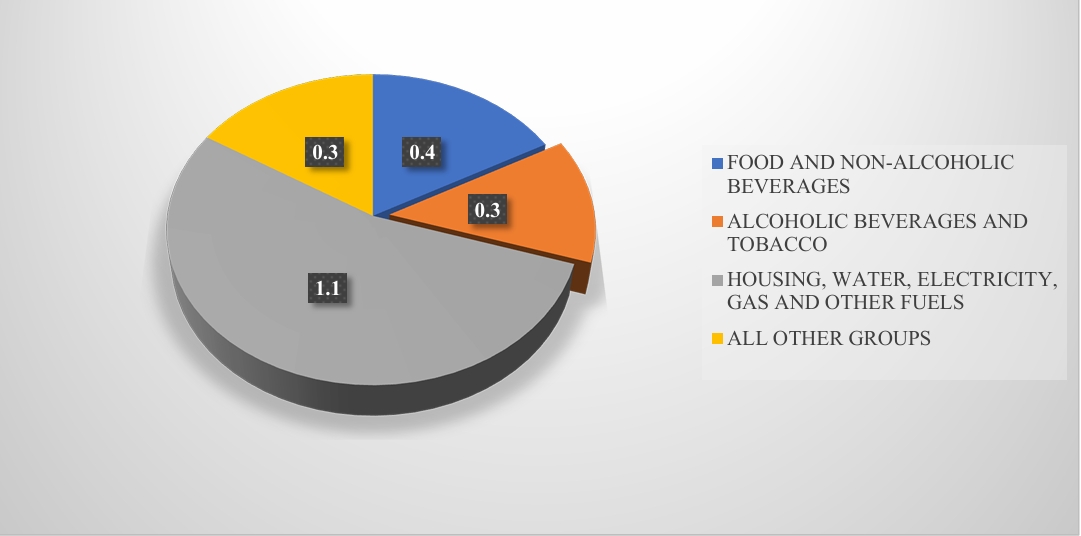
“Housing, water, electricity, gas and other fuels” contributed 1.1 percentage points to the 2.1% annual inflation rate. This was followed by “food and non-alcoholic beverages”, which contributed 0.4 percentage points. Alcoholic beverages and tobacco.
Together with all other groups, each contributed 0.3 percentage points. “Price movements continue to vary across regions and product categories, reflecting differences in local market conditions,” NSA said.
The report shows inflation is not the same across the country. Zone 2, which includes the Khomas region, recorded the highest inflation at 3.2%, above the national average of 2.1%.
Zone 3, covering //Kharas, Erongo, Hardap and Omaheke, recorded 2.0% inflation, slightly below the national average.
Zone 1, covering Kavango East, Kavango West, Kunene, Ohangwena, Omusati, Oshana, Oshikoto, Otjozondjupa and Zambezi, recorded the lowest inflation at 1.0%.
For maize meal (5 kg), Zone 3 recorded the highest price at N$69.74, followed by Zone 2 at N$69.22. Zone 1 recorded the lowest at N$66.96.
For biltong, Zone 1 recorded the highest price at N$525.87 per kg, followed by Zone 2 at N$500.83 and Zone 3 at N$408.32.
The report shows that inflation has eased compared to last year, supported by lower transport costs. However, housing and food remain the main drivers of household spending pressures.
Overall, inflation is lower nationally, but the cost of living continues to differ depending on where people live and what they buy.