
As the year comes to an end, I would like to point out that this has been a challenging year for Namibia, particularly for Namibian women. However much so, it has also been a rather beautiful year.
We have seen the inauguration of our first female President, Netumbo Nandi-Ndaitwah, and her female leaders in key positions, including Vice President Hon Lucia Witbooi, Minister of Health and Social Services Dr Esperance Luvindao, and Speaker of Parliament Saara Kuugongelwa-Amadhila.
Undoubtedly, these women have already made their strides and continue to do so. They stand as symbols of possibility and progress. Showing the nation and the world that Namibian women are capable of leading with strength, clarity, and purpose. Their achievements remind young girls across the country that leadership is not a distant dream but a real and attainable future.
Yet even with these victories, the reality on the ground remains deeply troubling. For many women in Namibia, 2025 has been marked by fear, loss, and a painful reminder of how far we still have to go. The continued rise in gender-based violence cases has cast a long shadow over our national celebrations.
Behind every statistic is a woman whose life was interrupted, a family left grieving, a community shaken. These are not isolated incidents but symptoms of a society that has not fully confronted the roots of violence, inequality, and patriarchy.
As a nation, we cannot continue to celebrate progress without addressing the deep harm that still persists. The presence of women in leadership is powerful, but it cannot substitute the safety and dignity of women in their homes, workplaces, streets, and relationships.
The rise of powerful women at the State level should inspire us to build a culture that protects women at every level of society, not only those who have made it into positions of influence.
We need stronger systems that respond quickly and effectively to cases of gender-based violence.
We need community structures that intervene before violence escalates. We need police responses that are compassionate, efficient, and accountable. We need shelters, counselling services, and long-term support that allow survivors not only to escape danger but to rebuild their lives.
Above all, we need a collective cultural shift, where men and women alike challenge harmful norms, speak out against violence, and raise boys who value and respect the voices and autonomy of women.
Namibia cannot advance if half of its population lives in fear. Progress must be measured not only by economic development or political achievements, but by the safety of the most vulnerable among us.
Protecting women should not be seen as the responsibility of government alone; it requires a united commitment from communities, families, institutions, faith groups and individuals. Every one of us has a role to play in building a safer Namibia.
With women in leadership who understand the lived realities of Namibian women, and with communities increasingly raising their voices against violence, we have an opportunity to redefine who we are as a nation. We can build a future where women do not have to choose between ambition and safety, where their dreams are not dimmed by fear, and where their lives are valued without condition.
As we step into a new year, let us carry both our celebrations and our responsibilities.
Let us honour our first female President and the many women stepping into positions of power, not only through applause but through action. Let us commit ourselves to protecting all women in Namibia. Let us ensure that the pain of unmet duties does not overshadow the beauty of progress. Our nation can and must do better, and the time to begin is now.
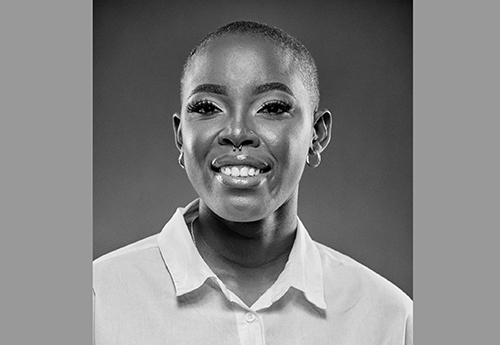
*Frieda Mukufa’s lifestyle section in the New Era concentrates on women-related issues and parenting. She specialises in editing research proposals, proofreading and content creation. – etuholefrieda@ gmail.com