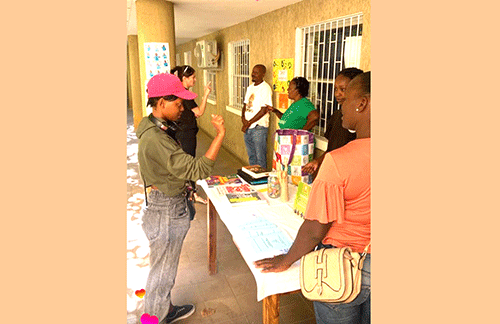

At the age of 22, Jane Muhepa has started breaking barriers and stigma by using her drive, Diversability Foundation, to create a more inclusive world for the differently abled Namibians.
The psychology student at the University of Namibia started this movement from her discovery of Namibian Sign Language (NSL).
“My initiative is centred on being an ally of differently abled individuals. It started when I decided to take NSL as a psychology module, which I firmly believe that God has chosen for me,” she told Youth Corner.
She gained knowledge about the difficulties and impediments to communication that those who are deaf and hard of hearing encounter.
“My heart was further touched when I later volunteered at Side-by-Side Namibia, a rehabilitation centre for children with disabilities. Many of the autistic kids I interacted with were non-verbal and communicated through NSL,” she added.
This made her interested in learning more about sign language as well as the broader difficulties faced by those with disabilities and the connections between different disabilities.
“In turn, I learnt about the many difficulties that people face, such as difficulty in access to education, employment and the stigma they face. My goal is to address the challenges of education that individuals with impairments encounter,” Muhepa shared.
She said educational environments are not made with their needs in mind, and many differently abled children find it difficult to get a quality education,” she highlighted.
She said the lack of inclusive teaching resources, proper infrastructure, NSL-trained teachers and knowledge about how to serve children with disabilities in communities and schools are all problems.
“I wish to remove these barriers since they can cause loneliness, low self-esteem and fewer possibilities in the future – possibilities such as a career they desire to pursue, but they can’t due to the quality of education they received. Quality education is very important for all children,” stated Muhepa.
Her goal is to provide community workshops that educate teachers, students and the public on fundamental NSL skills and disability inclusiveness.
Additionally, workshops that are focused on how to navigate university and focused on self-development are activities that she would like to tap into.
“I want to collaborate with organisations and schools to improve educational accessibility for students with disabilities and encourage higher education institutions to implement inclusive policies and provide interpreter services.
“I aim to educate people through my social media page on different disabilities and have interviews with differently abled people to have not only a learner’s point of view but somebody who is experiencing a situation,” said Muhepa.
In the long term, her wish is to start the first-ever hearing-impaired university in Africa and the second in the world, the first being Gallaudet University in Washington DC, US.
Muhepa uses beauty pageants to promote her initiative, as it allows her to share what she cares deeply about.
“Any room I enter, even one ear listening, can make a big difference. Being a finalist for Miss Non-Governmental Organisation has given me a platform to share my passion.
“I have been able to spread my advocacy to individuals from all walks of life and demonstrate how effective beauty pageants can be in bringing about change and purpose,” she said.
Muhepa added: “I have got the opportunity to engage with local leaders, spread the word about inclusiveness and encourage others to appreciate the beauty of ability and variety”.
Following the recognition of sign language as the 12th official language in South Africa earlier in July 2023, Namibians have applauded the move, urging swift action for the country to follow suit. There are no concrete figures regarding the number of hearing-impaired Namibians, although estimates stood at more than 41 000.
Disability affairs minister Alexia Manombe-Ncube had said the National Assembly is very much aware of the request for recognition of sign language in Namibia.
On 22 September 2022, she made a parliamentary statement, mentioning the importance of recognising Namibian Sign Language as an official language.
This includes all the benefits it will have for the deaf community once NSL is recognised as an official language and concerning the right to education in their mother tongue.
South Africa became the fourth African state to recognise sign language as an official means of communication after Kenya, Uganda and Zimbabwe.
-psiririka@nepc.com.na