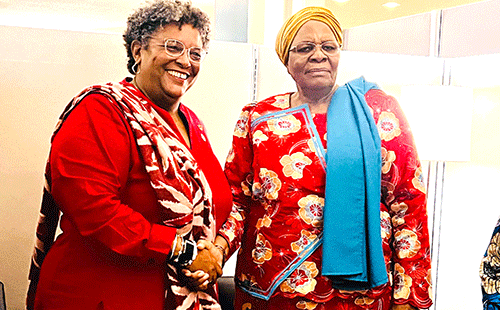

NEW YORK – President Netumbo Nandi- Ndaitwah has utilised the United Nations General Assembly (UNGA) in New York to strengthen Namibia’s relations with more than 10 countries and advocate for increased investment in the country’s economy.
Nandi-Ndaitwah has called on global investors to capitalise on Namibia’s growing opportunities in mining, energy, agriculture, logistics, tourism, and technology, promising policies that are clear, fair, and supportive of business.
Speaking at a high-level roundtable meeting in New York, hosted by the Business Council for International Understanding (BCIU), the President told international executives that Namibia was “open for business” and ready to work with serious partners who can bring both capital and skills.
“Namibia is blessed with resources, but we know resources alone do not create wealth. What creates wealth is when resources are developed in partnership with investors, with skills transfer, and with value addition inside our country,” Nandi- Ndaitwah said.
Appeal to investors
The President said Namibia is determined to move away from dependence on raw mineral exports and instead focus on industrialisation and job creation through value addition.
“For too long, Africa has exported raw materials and, with them, jobs. By exporting raw materials, we have literally been exporting labour. That must change,” she told the gathering.
She invited investors to work with Namibia in critical minerals, renewable energy, oil and gas, agriculture, and logistics. Namibia, she said, is already ranked among Africa’s top countries for safety, governance, and greenfield foreign direct investment. “Our policies are designed to create a win-win situation.
Investors must benefit, but Namibians too must benefit.
This is how we will create a sustainable partnership,” she explained.
Namibia has long been known for diamonds, but the President warned that the global shift toward synthetic diamonds has reduced their value. At the same time, she noted that the country is discovering new reserves of critical minerals vital for the global transition to digitalisation and clean technologies.
“These minerals are global wealth that happen to be in Namibia. We must be the first beneficiaries, but we are not selfish. We welcome investors to help us develop them—responsibly, transparently, and with value addition inside our country,” she said.
President Nandi-Ndaitwah also highlighted the country’s oil and gas discoveries, saying her office has taken a direct role in monitoring the sector to ensure it becomes “a blessing, not a curse.”
“History has shown us that resources can bring conflict if not managed well. In Namibia, we will make sure our oil and gas are used for national development and not division,” she stressed.
She reaffirmed Namibia’s commitment to renewable energy, including green hydrogen, while calling for a “realistic transition” that takes into account Africa’s low carbon emissions and urgent development needs.
“We believe in renewable energy, but we must balance it with development. Namibia has the sun, the wind, and the sea that make green hydrogen possible, and we welcome investors to join us in this exciting industry,” she said.
The President outlined multiple sectors where Namibia is seeking investment in agriculture; logistics and transport; tourism and industries; and healthcare amongst others.
Human-centred development
At the heart of her message, the President emphasised her vision of “human-centred development”, a principle she said was rooted in her upbringing and in Namibia’s history of reconciliation after independence.
“I grew up seeing my mother go to the field even in the rain, because she said, ‘If I don’t do it, what will my children eat?’ That spirit of human-centred development is what guides me as President,” she explained.
She assured investors that Namibia’s Constitution protects a mixed economy that values both the public and private sector.
“We know that investors need clarity and certainty. That is why I have directed that laws like the Investment Promotion Bill and the Special Economic Zones framework must be finalised without delay,” she said, drawing applause from the room.
International Relations and Trade Minister, Selma Ashipala-Musavyi, who accompanied the president, told investors that Namibia’s greatest asset is its leadership.
“Namibia is the best place to invest, not only because of the opportunities, but because of the President we have. She understands the private sector and the aspirations of our people. She is determined to balance both,” the minister said. The President ended her remarks with a direct appeal:
“Namibia is ready. The opportunities are there. Our policies are clear. What we are asking now is for investors to come, invest, and grow with us. Together we can make Namibia’s resources a blessing for all.”
The event brought together senior executives and diplomats.
Bilateral diplomacy
During two days of side meetings, Nandi-Ndaitwah held talks with a range of world leaders. Among them was Ghana’s president John Dramani Mahama. He reminded her that Ghana’s support for African liberation, as declared by Kwame Nkrumah in 1957, continues to guide his country.
“The ideals of total emancipation of the African continent remain central to Ghana’s vision,” Mahama said. The two leaders agreed to deepen cooperation between their countries.
The Namibian President also met with Sierra Leone’s president Julius Maada Bio. The discussions highlighted Sierra Leone’s past role in educating Namibians during the liberation struggle, and its present role in the African Union’s Committee of Ten on UN Security Council reform. Bio thanked Namibia for its ongoing support.
Other meetings were held with Bruno Rodríguez Parrilla, Foreign Minister of Cuba; Petr Pavel, President of the Czech Republic; Alexander Van der Bellen, president of Austria; and Mia Mottley, Prime Minister of Barbados.
Prime Minister Mottley praised Namibia for placing women in leadership, pointing out that 57% of Cabinet portfolios are held by women. She described this as an example worth following.