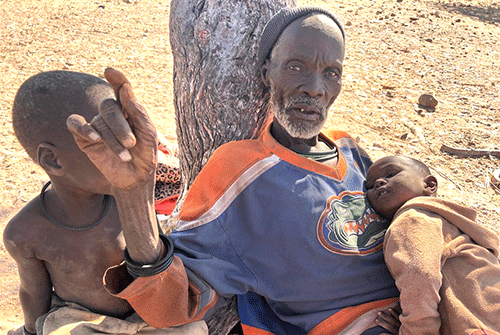

OKAPEMBAMBU – Isolated, forgotten and grieving – this is the state of affairs at Okapembambu village.
Here, residents say they have given up hope of any improvement in their way of living. For many here, faith is the only thing keeping them alive. The distance to Okapembambu is bumpy and hard, both literally and figuratively.
In fact, it is almost inaccessible. The village is located 30 kilometres from Opuwo, but it takes over two hours to reach it. There is no direct road connection to Opuwo. Residents must either make a long detour through other villages or take a shortcut through mountainous terrain and dry riverbeds, a path that is not only physically taxing but sometimes deadly.
Recently, a mother lost her unborn baby due to premature birth.
Residents say this is just the tip of the iceberg as far as the hardships of life at Okapembambu village are concerned.
Many of their struggles are tied to the lack of basic services.
Traditional leader Chief Tjikundi Tjikuro (92) said his community no longer risks carrying sick people on their backs to seek medical help after the heartbreaking incident in June.
This was after a woman lost her newborn while on the way to the Opuwo District Hospital.
“Last month, we were gathered here in my village, mourning the death of a premature baby,” Chief Tjikuro told this reporter from his house.
He continued: “The baby died on the way to the hospital. The mother was carried on someone’s back through the mountains, trying to reach Opuwo to give birth. After that, I told my people, ‘We must stop risking lives.’ We are now putting our worries in the hands of the Lord because we no longer have hope in the government”.
He said this was not the first time a life had been lost due to the village’s inaccessibility.
“This is the second time we lost someone on that route. A six-year-old girl also died on top of the mountain while being carried to the hospital,” he recalled solemnly.
“You arrive at the hospital already exhausted. There’s no direct road from here to Opuwo,” the chief said.
“You have to pass through another village, which makes the journey longer. The shorter route is through the mountains, but it’s not easy. The heat and dry riverbeds make it extremely difficult. By the time you get to Opuwo – if you make it – you are already exhausted,” he stated.
He added that he once fell ill and had to be carried to Opuwo for treatment.
He almost did not make it.
“When I got sick, they tried to carry me through the mountains. We got stuck in a riverbed. That place is now named after me because of what happened. It was very difficult to come out of there. Since then, I’ve told my people never to carry anyone to Opuwo again. We put our trust in God now,” he said.
The chief emphasised that the community’s only hope now lies in a clinic that the Pentecostal Church in Windhoek has promised to build in the area.
Once completed, the facility could save lives by reducing the long and risky trips to Opuwo.
“I am asking the government to fast-track the approval and construction of the clinic the church is planning to build. This would make a huge difference in our lives,” said the chief.
Vandalism
In addition to the lack of roads and healthcare, the community is grappling with water shortages.
Chief Tjikuro did not only blame this on the government, but on residents who allegedly vandalise the water infrastructure.
“We do not have enough water. But this problem is caused by our own people. The government brought water to us, but people are cutting the pipes. I don’t know what to do anymore. This is a serious problem that needs serious action,” he lamented.
The chief has called for the police and local authorities to intervene.
“I want the police to work with the councillor and take action against those damaging government property. People cannot suffer like this because of a few individuals,” he said.
Councillor
Responding to the situation, Opuwo Urban Constituency councillor Ngunaihe Ueutjerevi confirmed the challenges facing Okapembambu.
He said he is working to bring relief to the community, particularly by supporting efforts to establish a clinic.
“I am aware of the need for a clinic. I have already started sourcing assistance from the private sector,” Ueutjerevi said during a recent visit to the village.
“We are thankful to the Pentecostal Church for initiating the clinic project. Once the infrastructure is up, we will approach the health ministry to bring in nurses and other health personnel to staff the facility,” he added.
The councillor described the village as completely cut off from services.
“This place is like a village on its own. There’s no road passing through here. People have to carry children on their backs to get to another village – either where they came from or to Gohu- Murewe. It’s too far,” he said.
He confirmed that an application has already been submitted to name and formalise a road link between Okapembambu and Berika.
He, however, admitted that the process is ongoing and will take time.
“We are still in meetings and engaging the relevant authorities,” said the councillor.
Network
Network connectivity is another major issue in Okapembambu.
Villagers reportedly have to walk to specific spots or climb trees just to get a signal and make a phone call.
“If someone falls ill, they must know exactly which rock or tree to go to to get a network signal. Only then can they call someone with a vehicle to come assist. If that fails, then it’s the same old story – carrying the patient by foot,” Ueutjerevi said.
Isolation
A local woman, Ueritiraike Tjiposa, spoke briefly through translation, echoing the councillor’s description of the hardships faced by the community.
“She said life here is difficult. They survive by helping one another, and they rely on prayer and hope. Health services, water, roads and even the ability to make a phone call – none of those are guaranteed here,” the councillor translated.
Chief Tjikuro’s words are a sobering reflection of a community that feels abandoned.
“We have been asking for years – decades even – for basic services. Nothing has changed. We are now old. We are tired.
We have given up on the government. We give our worries to God,” he said, standing with a group of villagers beneath a mountain where too many journeys have ended in death.