
After nearly a year of tense negotiations, Namibia’s fishing industry witnessed a historic breakthrough this week. Hundreds of workers employed by NovaNam (Pty) Ltd and Lalandii (Pty) Ltd finally secured a wage agreement after 12 months of protracted bargaining.
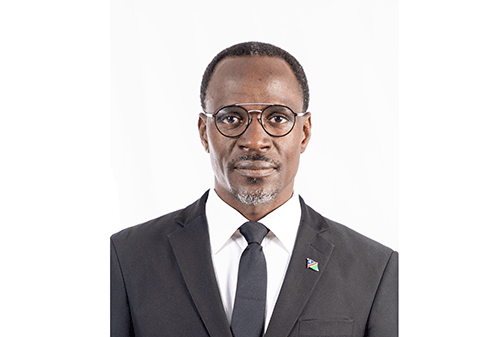
The signing of the Memorandum of Agreement, overseen by Minister of Justice and Labour Relations Fillemon Wise Immanuel, marks not just a milestone in industrial relations but also a testament to the power of dialogue and government intervention in protecting workers’ rights while balancing the needs of employers.
This week, New Era journalist Lahja Nashuuta (LN) conducted an exclusive interview with minister (FWI), who reflects on the agreement, the phased implementation of the new minimum wage, and his broader vision for justice in Namibia’s workplaces.
LN: Honourable Minister, this agreement in the fishing sector is seen as a major win for workers. Can you tell us more about how it came about?
FWI: Certainly. This agreement represents the culmination of almost a year of intense negotiations. Workers and employers had reached a stalemate, and tensions were escalating. NASAWU and the companies had been unable to find common ground. The government’s intervention was necessary to prevent industrial unrest.
We engaged with both parties over several days in Lüderitz, carefully listening to their concerns and facilitating dialogue. It was crucial that the voices of workers were heard, while employers were also given space to explain the challenges they face. The signing of this Memorandum of Agreement is a clear demonstration that social dialogue works. It protects workers’ rights, fosters fair labour conditions and creates an environment where employers can innovate responsibly.
LN: Turning to the broader labour landscape, the new minimum wage order took effect on 1 January 2025. How is this being implemented across sectors?
FWI: The minimum wage policy is designed to ensure that all workers in Namibia earn a fair wage. For most sectors, the minimum wage is N$18 per hour, effective immediately from 1 January 2025.
However, three sectors—security, domestic work and agriculture—have a phased implementation to allow employers and workers to adjust gradually.
In the security sector, wages will rise from N$13.50 in 2025 to N$16 in 2026 and N$18 in 2027. Domestic workers will receive N$12 in 2025, N$15 in 2026, and N$18 in 2027, while agricultural workers will receive N$10 in 2025, N$14 in 2026, and N$18 in 2027.
All other sectors are required to comply immediately at N$18. The phased approach recognises the economic realities of certain sectors while maintaining the overall goal of equitable pay across the labour market.
LN: How has compliance been so far? Are employers adhering to the new law?
FWI: Compliance is a work in progress. As with any new legislation, there are challenges, particularly in sectors adjusting to phased increases. Some employers have struggled to meet the requirements on time, but the ministry is actively monitoring the situation. We are addressing instances of non-compliance directly and providing guidance to ensure that every employer understands their obligations. Our ultimate goal is for all employers to make a genuine effort to comply.
It is not just about enforcing the law; it is about creating a culture of fair treatment, where employees feel valued and economic development is balanced with social justice.
LN: Since taking office, you’ve been very visible in the field. What has been your focus?
FWI: My focus has been twofold. First, we are committed to ensuring justice in the courtroom, guaranteeing that all Namibians have access to fair and transparent legal processes. Second, and equally important, we are ensuring justice in the workplace.
Harmonious industrial relations are essential for a stable economy, and these can only be achieved through dialogue between employers and employees.
Where dialogue fails, the government must step in. For instance, in the fishing industry dispute, the parties were on the brink of industrial action.
I personally engaged with both workers and employers in Lüderitz over several days, meeting continuously to mediate and bring the parties together. This hands-on approach reflects our commitment to proactive governance—solving problems before they escalate and ensuring that workers’ rights are protected while business continuity is maintained.
LN: You also called on the public to submit proposals on law reforms shortly after taking office. What has been the response, and what does it mean for legislation?
FWI: This initiative came from Her Excellency the President, who invited all Namibians to propose reforms to laws they felt required change. My role was to facilitate the process.
The response was overwhelming. Citizens from across the country submitted proposals, reflecting their concerns, priorities, and aspirations for a more just society. We consolidated these submissions into what is now called the National Legislative Agenda, which Cabinet has approved.
This agenda will guide Namibia’s legislative priorities over the next five years. It determines not only which laws require reform but also prioritises resource allocation and reflects public preference. The process demonstrates that
Namibians want to be actively involved in shaping the laws that govern their lives and shows that participatory governance can strengthen our democracy.
LN: Looking at the broader picture, what is your vision for the Ministry of Justice and Labour Relations under your leadership?
FWI: My vision is clear: justice must be accessible, transparent, and fair, not just in the courts but in every workplace and community.
This includes protecting workers’ rights, fostering dialogue between social partners, and intervening when necessary to prevent disputes from escalating. We are focused on ensuring that industrial relations are harmonious, that employers and employees communicate effectively, and that labour laws are respected.
We aim to strike a balance between economic growth and social justice—ensuring that workers are compensated fairly while businesses can thrive sustainably.
LN: Finally, minister, is there a message you would like to share with the public regarding justice and labour relations?
FWI: Justice is not an abstract concept; it is a lived reality. Every Namibian should experience fairness in the workplace, equality before the law, and confidence that their voices are heard.
We encourage employers to engage with their employees, and we encourage workers to understand their rights and responsibilities.
Where disputes arise, dialogue should be the first step, with government intervention as a supportive measure, not a punitive one.
The recent wage agreement in the fishing sector demonstrates the impact of this approach. It shows that when dialogue is facilitated effectively, agreements can be reached that benefit both workers and employers.
Our commitment is to continue this proactive engagement, ensuring that Namibia remains a country where justice is not just promised but delivered—both in the courtroom and on the factory floor, on the farm, and in every workplace.
-lnashuuta@nepc.com.na