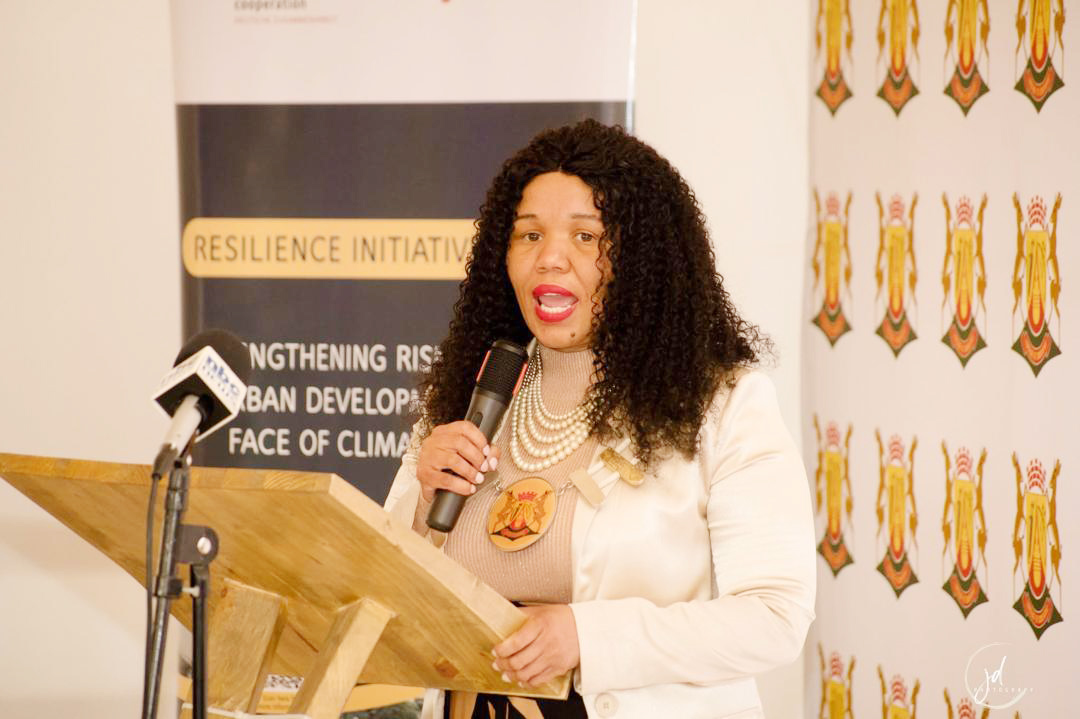

Mariental, the capital of the Hardap region, is often referred to as the “heartbeat” of Namibia’s south-central corridor. However, behind its lively community and strategic position, the town faces multiple issues, including rapid urbanisation, housing shortages, unemployment, and inadequate infrastructure.
Since assuming office, Mayor Cherien Kock has led efforts to make Mariental a model of service delivery and accountability. She is also the youngest mayor in Namibia to oversee a municipality that has received a clean audit report by the Office of the Auditor General, which she credits to teamwork and responsible management.
New Era journalist Lahja Nashuuta (LN) sat down with Kock (CK) to discuss progress so far, ongoing challenges, and her vision for Mariental’s future.
LN: When you took office, what were your main priorities for Mariental?
CK: Mariental faces the same challenges as other towns in Namibia, including poor road networks, growing informal settlements, high unemployment, and strained housing. From the very beginning, I made it clear that service delivery and uplifting residents’ lives would be our core focus.
I have always believed that transformation comes through small, consistent actions rather than big promises. Since joining the council in 2021, my commitment has been to serve with dedication, vision, and accountability.
LN: What are some of the plans your office is implementing?
CK: Our primary goal is to serve our people with dignity. Regarding infrastructure, we began by upgrading gravel roads to interlocks to enhance mobility throughout the town. The northern part of Mariental has already been upgraded, providing residents with easier access to the centre.
Housing delivery has also been a priority. This year, we constructed 56 houses for low-income residents and allocated 139 erven in Empelhem Extension 4 to members of the Shack Dwellers Federation of Namibia (SDFN).
We were fortunate to receive N$75 million from the Ministry of Urban and Rural Development (MURD) for upgrading informal settlements. This funding covers Empelhem Extensions 2, 3, 4, and 5. Additionally, the ministry allocated N$8 million to improve water, sewer, and road infrastructure for 300 erven.
Ten years ago, land grabbing was widespread in these areas. Today, we are formalising those plots to ensure they are properly serviced with electricity, water, and sanitation. Importantly, this process also provides employment opportunities for young people in construction and related services.
Another milestone is our partnership with GIZ. Together, we are creating a sanitation hub in informal settlements that will include an Early Childhood Development centre, public toilets, laundry facilities, and other amenities. This is part of our broader goal to transform informal areas into formal, fully serviced neighbourhoods.
On economic development, we have acquired land for an open market to support SMEs. Although funding is still pending, the site has already been fenced off. In the meantime, the municipality hosts monthly street markets, giving vendors, farmers, and entrepreneurs a chance to sell their products. Every October, we also host the Mariental Trade Festival and Youth Fair to showcase small businesses and promote networking opportunities.
LN: Land shortages continue to be a major issue in most towns. How is Mariental tackling this problem?
CK: Land remains one of Mariental’s biggest challenges. We are currently accelerating the transfer of 614 hectares of Farm Koichas No. 89, which was donated by the Evangelical Lutheran Church in Namibia. Negotiations are also ongoing with the church to acquire an additional 2 423 hectares, and we intend to purchase another 283 hectares for N$5 million.
But the issue extends beyond Mariental. Rural areas require more investment in schools, hospitals, and clinics. If conditions improve in these communities, residents won’t need to migrate to towns for better services. This would reduce pressure on urban housing, infrastructure, and jobs.
LN: What challenges is Mariental currently facing?
CK: Challenges are numerous, including persistent unemployment and poverty that remain stubbornly high, worsened by years of drought and the Covid-19 pandemic.
Besides that, Hardap lacks vocational training centres, colleges, and tertiary institutions, which restricts skills development for young people.
We are also seeing peri-urban migration from nearby farms. Many farmers have lost their livestock due to prolonged drought and are relocating to Mariental. This rapid influx explains why our informal settlements are expanding so quickly.
LN: Mariental is the only municipality with a clean audit. How did you accomplish this?
CK: We are incredibly proud of that achievement. A clean audit is not just paperwork; it is a reflection of accountability and good governance. It shows that every cent of public money is managed correctly.
There have been claims that councillors misuse subsistence and travel (S&T) allowances, but every trip we take has a clear purpose. For example, during a visit to Spain, I was able to secure two emergency fire trucks for Mariental. Such partnerships are vital in helping us improve service delivery and learn from others.
I also want to recognize our chief executive officer, Mr Paul Niwolepo, whose leadership and experience have been crucial in ensuring the municipality runs smoothly.
LN: Youth unemployment remains a concern. What measures are currently implemented?
CK: The municipality has introduced a short-term employment system where residents are engaged on a two-week rotational basis. This provides families with temporary income for basic needs.
Additionally, we allocated funds for youth empowerment projects. In collaboration with SMEs Compete and Rise Namibia, we trained residents in bookkeeping, tendering, backyard gardening, and soap-making. Earlier this year, 42 women completed soap-making training, and more programmes are lined up.
However, funding remains our biggest challenge. The municipality is not a profit-driven organisation. We rely on limited government funds, donors, and business partnerships. Unfortunately, some local businesses raise prices when working with us instead of supporting the municipality’s efforts.
I urge both residents and the private sector to work with us. Development is not just for the municipality but for the whole community.
LN: Any final remarks?
CK: I want to sincerely thank the people of Mariental for the trust and support they have given me. Leading this town has been both a privilege and a responsibility I take seriously.
As we near the 2027 local elections, I will run again as a councillor to complete ongoing projects and make sure development reaches all parts of Mariental.
I encourage residents to actively participate in council affairs, voice their opinions on local issues, and collaborate with us to make Mariental one of the most accountable and service-focused municipalities in Namibia. Together, we can create a town we all take pride in calling home.
-lnashuuta@nepc.com.na