
2026 has arrived. Consequently, expectations are high, from the grassroots level to the highest authorities, and from rural areas to urban areas. People await tangible change and development. There are varying perceptions and approaches today regarding what development is as a concept. In a real-life situation, development entails an increase in the material wellbeing of a nation.
A nation registering an increase in the output of goods and services, as measured by Gross National Product (GDP), was previously regarded as on the path of development.
Welfare economics, however, was quick to add that such a country is experiencing economic growth only insofar as the benefits of growth accrue to a few people.
From these two perspectives, economic growth, coupled with the distribution of benefits, constitutes development.
In Africa, too many politicians and laypeople equate the construction of roads, airports, railway lines, schools, hospitals, supermarkets, and skyscrapers with development.
Hence, it is common to hear the number of cattle dips, kilometers of roads tarmacked, and growth in the number of university students being cited as indications of development delivered by a government to a particular locality at a given period.
To the traditional anthropologist, development is perceived as a transition from so-called small-scale societies, with an emphasis on particularistic principles, to more complex societies, with an emphasis on universalistic principles.
To Marxist sociologists, development occurs when man ceases to explore fellow man in the production and distribution of economic gains. Society must overcome discrimination and other socio-economic injustices for it to claim having experienced development.
For the Christian, development is seeking first the Kingdom of Heaven, as opposed to Nkrumah, who asserted that seek ye first the economic kingdom.
There can be no doubt that the spiritual dimension is an important element in the development process. So, is there a precise definition of development that applies across the board? From the 1980s to the 1990s, a search for such a definition has been going on. Economic, social, cultural, political and environmental variables have been included in the definition of development.
Development is now viewed in terms of increased participation by all in the processes of democratic governance and the production of goods and services. In the wake of multiparty democracy in Africa, development is also being assessed against the yardstick of human rights. Freedom of speech, assembly, and the press are now concepts closely linked to development. Definition aside, development entails structural changes in economic, social, political, and cultural aspects of a people. When the whole person is transformed economically, socially, politically, and spiritually, integral development is said to have occurred.
In conclusion, the popular singer/writer John Mayer once sang, “waiting on the world to change”. My take is that sitting around waiting for the world to change will not get us anywhere, but we must be the change we want to see in the world; therefore, let us be the change agents.
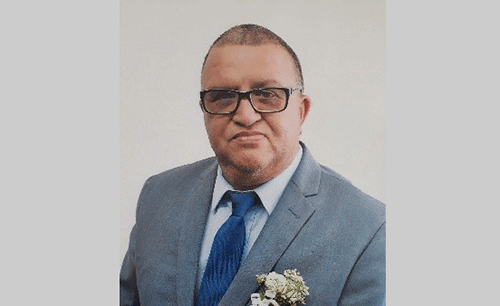
*Reverend Jan A Scholtz is the former chairperson of the //Kharas Regional Council and former !Nami#nus constituency councillor. He holds a Diploma in Theology, B-Theo (SA), a Diploma in Youth Work and Development from the University of Zambia (UNZA), as well as a Diploma in Education III (KOK) BA (HED) from UNISA.