

Every year, May 5th is a date that, to many, may pass like any other. Yet, across Namibia in clinics, health centres, and hospitals, midwives stand at the very beginning of life. This day, marked globally as the International Day of the Midwife (IDM), is more than a celebration. For midwives, it is a moment of reflection, recognition, and renewed commitment to the profound responsibility of bringing life safely into the world. This IDM was celebrated under the theme, “One Million More Midwives”. Why one million more? because every two minutes, somewhere in the world, a woman dies from causes related to pregnancy or childbirth. Every 17 seconds, a baby is lost before birth. Each year, an estimated 2.3 million newborns die within the first 28 days of life. At the same time, caesarean birth rates are rising to nearly 30% globally, often without corresponding improvements in overall health outcomes. Too many women continue to experience disrespect, abuse, and unmet family planning needs, undermining both their health and their fundamental rights. Indeed, these are not just global statistics. They echo in different forms, even within our own context, reminding us that progress in maternal and newborn health remains uneven, and in many cases, fragile. In October 2025, the International Confederation of Midwives, in partnership with the PUSH Campaign, launched the One Million More Midwives global petition. This initiative calls on governments and health leaders to grow, support, and sustain the midwifery workforce. The petition is a movement aimed at making the global shortage of midwives impossible to ignore, and aimed at placing midwives firmly at the centre of conversations with governments, civil society, and the media.
The evidence is clear: midwives are the solution. They save lives, protect rights, and improve the quality of care for women and newborns. With one million more well-trained, well regulated and well supported midwives, we could prevent up to 67% of maternal deaths, 64% of newborn deaths, and 65% of stillbirths by 2035, amounting to more than 4.3 million lives saved.
In Namibia, as in many health systems around the world, midwives are the backbone of maternal and newborn care, particularly in rural and underserved areas. Their role extends far beyond assisting births. They educate, counsel, advocate, and provide continuity of care for women and families. In many communities, a midwife is not only a healthcare provider, but a trusted presence, a source of reassurance, dignity, and strength during life’s most vulnerable moments. Yet, too often, their contributions go unseen and under supported to a large degree. Despite this disparity, midwives continue to show up because they understand the weight of their role. They show up because every safe birth matters. They show up because their commitment to women, families, and communities runs deep. But commitment alone cannot sustain a workforce.
It is therefore imperative that midwives are recognised as skilled professionals whose voices matter in decision-making spaces. Those closest to the realities of maternal care must have a seat at the table. For all the midwives reading this, this message is both a recognition and a call to action. Your work matters.
Even on the days when the system feels heavy, when resources are limited, and when outcomes are not what you hoped for. Every woman you support, every newborn you help bring into the world, and every family you reassure, these moments build healthier communities. The vision of one million more midwives must go beyond simply filling gaps; it must be about transforming the quality, equity, and humanity of care. Your work is seen. Your impact is real. Happy International Day of Midwives.
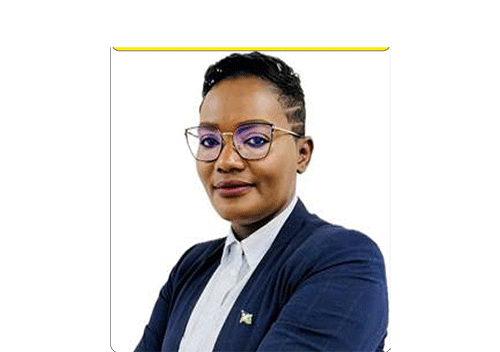
*Dr Tekla Shiindi-Mbidi is a midwife and lecturer at Welwitchia University. The views expressed here are her own and do not necessarily reflect those of her employer.