


Although some strides are being made, it is difficult to state with certainty that the current Administration is winning the war against the scourge of corruption. One of the stigmas is the persistence of remnants of the previous regime within the Administration.
Of course, some ministers are trying to wedge into that area, sometimes adapting unconstitutional methods by violating the dignity of people as per Article 8 (2) (b) of the Namibian Constitution. Against this background, political situational leadership should be applied to assess whether the Administration is on the right track.
The concept is about adjusting leadership style to the moment, not the ideology. When it is online, it usually means high stakes, crisis, legitimacy, public trust, or rapid change. In plain terms, a political leader succeeds or fails based on how well he or she reads the situation and adapts the approach, authority, collaboration, persuasion, or restraint when consequences are immediate and public.
In this case, if the politician moves too forcefully, he or she might be accused of authoritarianism, although political leadership is not about consistency; rather, it is about a calibrated response under pressure. Crises, public opinion, and institutional constraints shift constantly, and leaders who rely on a single style of leadership in today’s institutions and world, be it consultative or authoritarian, will always misread reality.
In this case, effective leaders adapt their approach to the moment while maintaining core democratic principles. Anything contrary to democratic principles may erode values and norms to which everybody is entitled, but in emergencies, delay costs lives and legitimacy. On the other hand, in polarized contexts, coercion deepens division, and in stable periods, overreach erodes trust. Political situational leadership preserves state stability, public trust, and democratic continuity by matching action to context; however, the danger arises when leaders refuse to adapt when the situation demands it. Political situational leadership emphasizes adaptability over ideological rigidity, recognising that political environments are dynamic and often unpredictable.
Leaders operate under varying conditions, crises, institutional constraints, and shifting public expectations that demand different responses. A leadership style effective in moments of stability may prove disastrous during emergencies, just as centralised authority during a crisis can become illegitimate during periods of democratic consolidation. Situational leadership does not abandon principles; rather, it appropriately and strategically applies them in ways that preserve legitimacy, effectiveness, and public trust. Consequently, political leadership succeeds not through consistency of method, but through consistency of judgment. A leader who responds in the same way to crises and to stability is neither consistent nor flexible.
Leaders may justify excessive authority or emergency powers by claiming that the situation demands it, but everything should be done in the best interest of the people, no matter how guilty they might appear. In this case, harassing staff members in the name of applying justice does not augur well for any political situational leader. Situational leadership operates within institutional constraints, time-bound authorities, legal oversight, and transparency. Rejecting adaptability because it can be abused is like rejecting laws because they can be broken. Abuse comes from unchecked power, not adaptive leadership, and great political leaders succeed because they maintain a firm, unwavering leadership style.
Even historically “strong” leaders adapted constantly, altering rhetoric, coalition strategies, and decision-making processes as circumstances evolved. Situational leadership explicitly requires reversion, emergency authority in emergencies, and restraint in stability. It protects democracy by preventing crisis governance from becoming permanent. Finally, political situational leaders should, by all means, abide by the constitutional provision rather than violate the people’s rights by publicly arraigning them in broad daylight, rather than charging them through legal means in their offices.
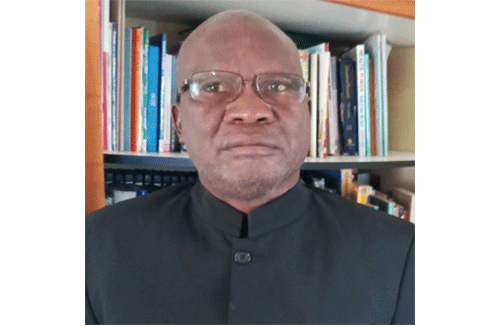
*Prof. Makala Lilemba is an academician, author, diplomat, scholar and researcher.