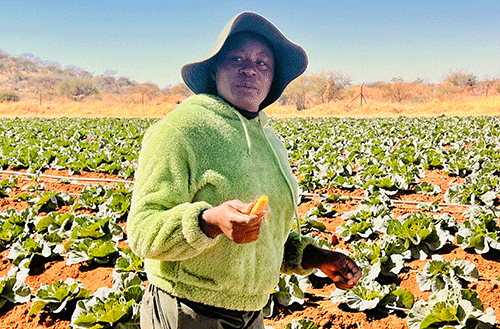

OUTJO – In the town of Outjo, green gardens are changing lives. They are not just producing vegetables, but also creating jobs, supporting schools, and giving hope to families who once struggled to put food on the table.
When New Era visited the constituency recently to assess developments and challenges in the area, two stories stood out: the Harambee Oyetu Garden, run by young people under the National Youth Service, and the community gardens that constituency councillor Antsino Johannes has been supporting across Outjo and its settlements.
Together, these gardens tell a powerful story of resilience and progress.
At the Harambee Oyetu Garden, foreman Rosalia Bollos, a student of the National Youth Service and trained horticulture specialist, proudly walked through rows of green peppers, carrots, beetroot, and cabbage.
“This garden is more than just farming. It is about growing opportunities for young people and supporting the community of Outjo,” she said.
The garden, which is under the governor’s office and the NYS, has 1,000 green pepper plants growing under tunnels, another 1 000 cabbage, and several plots of carrots and beetroot. Bollos explained that the harvests are expected to reach up to 50 tonnes of vegetables a year.
Already, the produce is being supplied to Erongo Food in town, a contract that secures a market and guarantees income for the garden.
“We are proud to know that what we grow here is feeding households in Outjo,” Bollos said.
The project is also providing training and employment. At the moment, it supports four young students on an internship, who gain practical experience in horticulture while earning an income. “We are building future farmers and future leaders through this garden,” she added.
Water struggles
But success has not come easily. Water remains the garden’s biggest challenge.
“We have a borehole, but we are not sure if the pump is too small or if the solar panels are not enough. Sometimes the borehole cannot provide all the water we need,” the horticulture specialist explained.
In these times, the Outjo municipality steps in. “We are very thankful to the municipality. They come sometimes two or three times a week with trucks to deliver water. Without them, our crops would not survive,” she said.
The garden has appealed for technical support to assess the borehole capacity and possibly upgrade the system.
“Apart from the water challenges, we are doing well. We just need this support so that the project can keep growing,” she told New Era.
Councillor
While Harambee Oyetu Garden is inspiring young people, Outjo councillor Johannes believes that food production must be spread across the community to achieve real impact.
During the interview, Johannes highlighted the community gardens his office has been supporting over the years in settlements such as Queen Sophia, Seringkop, Bellalaika, Nuhas and Nisan.
“We assist the gardens with fencing materials, pipes, barrels, and tools. We also support school gardens at Outjo Secondary School and Queen Sophia School. Our aim is to make sure children learn the value of agriculture from an early age,” said the councillor.
For Johannes, these gardens are more than projects. They are a pathway to food security and self-reliance.
“A country that grows its own food is a strong nation. We cannot keep depending on food from other countries. The more we produce and consume what we grow, the more jobs we create here at home, ”he explained.
Feeding
At schools like Outjo Secondary, the gardens provide vegetables for meals, reducing the burden on parents. In the community gardens, families are able to harvest food for their homes and sometimes sell the extra produce for income.
One resident in Queen Sophia told New Era that the garden there has not only improved diets but also created unity among families. “We work together in the garden, we share the harvest, and we know that our children will not sleep hungry,” she said.
In Seringkop, where marginalised San families live, the garden is a lifeline. Councillor Johannes said the support given there was deliberate: “We wanted to make sure that even our most vulnerable communities can feed themselves.”
Both Harambee Garden and the community gardens carry a deeper message that they are symbols of hope and dignity.
At Harambee, Bollos said the sense of pride is visible among the interns. “When the young people harvest their first crop, they smile because they see what their hands can do. It gives them confidence in their future,” she said.
At the same time, Johannes emphasised that gardens are not only about fighting hunger but also about shaping a culture of productivity. “Instead of waiting for food donations, people are learning to produce,” he said.
Challenges
The challenges are still there – water shortages, lack of resources, and limited funding. But the determination in Outjo is clear.
For Bollos and her team at Harambee, the next step is to improve the irrigation system so that the garden can expand and employ more young people. For Johannes, the dream is for every settlement in Outjo to have its own productive garden.
“Food security starts at the household level. If every family has a garden, then the whole community is secure,” Johannes said.
As New Era left the Harambee Garden, the sight of neat rows of green crops under the winter sun told a story of growth against the odds.
Outjo’s gardens may be small compared to commercial farms, but their impact is big, meaning that feeding families, employing youth, and reminding everyone that even in difficult times, seeds of hope can grow.