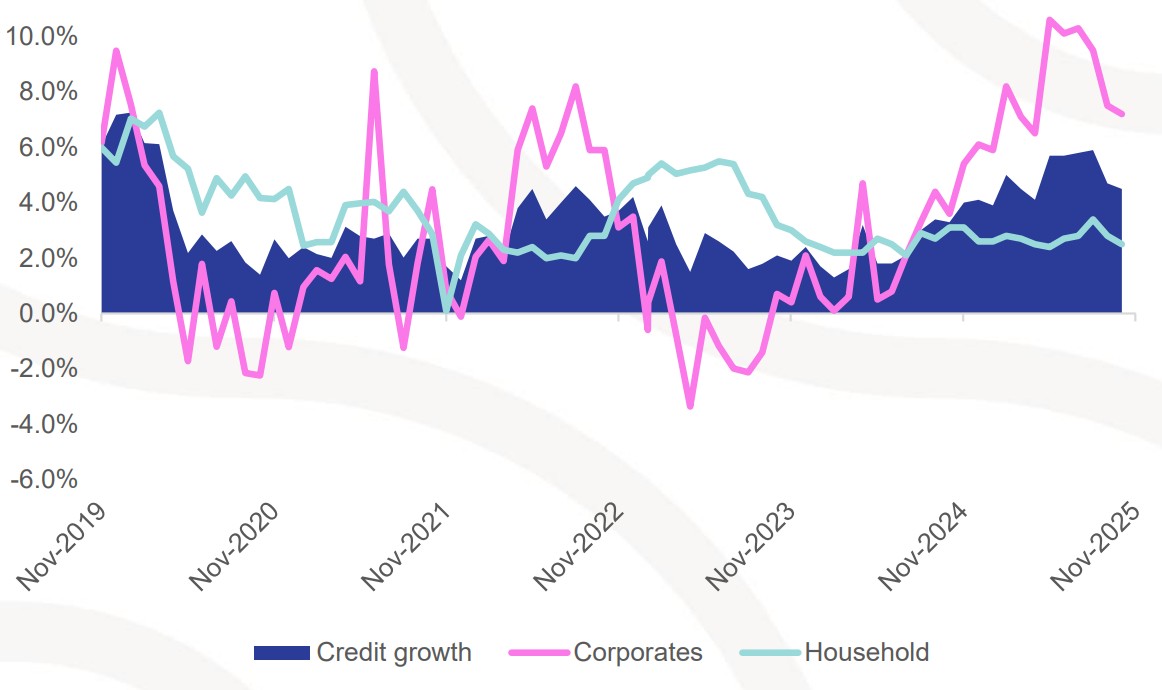

Private Sector Credit Extension (PSCE) in Namibia eased further to 4.5% year-on-year (y/y) in November 2025, down from 4.7% in October, reflecting softer borrowing by both corporates and households. Local analysts believe this reduction confirms a gradual moderation in credit momentum toward the end of 2025.
Despite this slowdown, PSCE growth is still well above subdued levels observed in 2023 and early 2024, indicating the underlying credit cycle remains supportive of economic activity. This analysis is according to financial services firm, Simonis Storm (SS), who noted that on a year-to-date basis, PSCE has averaged 4.9%, compared to 2.3% in 2024 and 2.4% in 2023.
In its latest PSCE analysis, SS points out that the moderation observed in 2025 reflects a combination of corporate repayments, cautious household borrowing behaviour, and residual liquidity effects following the Eurobond redemption, rather than a deterioration in financial conditions.
“The November 2025 credit and liquidity data suggest that monetary easing is continuing to feed through to the real economy, albeit at a more measured pace as once-off liquidity effects unwind,” the SS report states.
The firm added that PSCE growth remains materially stronger than subdued levels recorded throughout 2023 and early 2024, pointing to an underlying improvement in credit conditions rather than a cyclical reversal.
Meanwhile, SS expects PSCE to stabilise around the 4.5% to 5.0% y/y range into year-end and early 2026, supported by three key dynamics.
These are supportive, though increasingly neutral, monetary conditions; corporate credit remains the primary growth anchor; and household credit recovery remains slow and uneven.
SS further notes that corporate credit growth moderated to 7.2% y/y in November, but its composition remains constructive.
“Strong growth in instalment and leasing credit continues to reflect investment in vehicles, machinery, and productive assets across agriculture, mining, manufacturing, and logistics. At the same time, slower growth in overdrafts and other short-term facilities points to improving cash-flow management and reduced liquidity stress, rather than weakening investment appetite. Corporate borrowing remains selective but clearly investment-oriented, supporting medium-term growth prospects,” SS states.
On the household, SS states that credit growth eased further to 2.5% y/y, constrained by affordability pressures, modest wage growth, and elevated living costs.
“Mortgage lending remains in contraction, while borrowing is increasingly concentrated in asset-linked categories, particularly vehicles. This dynamic suggests that household balance-sheet repair is still ongoing, with limited scope for a broad-based consumption-led credit rebound in the near term,” SS pointed out.
Crunching the numbers, SS believes that taken together, the November data points to a constructive but more disciplined monetary and credit environment.
This means SS anticipates PSCE growth to remain moderate and stable, rather than re-accelerate sharply. Also, the firm expects inflation to stay comfortably within the 35 to 6% target band.
“The post-Eurobond adjustment is proceeding in an orderly manner, supporting external stability and policy credibility. We therefore maintain a cautiously constructive outlook for credit and monetary conditions into 2026.
While the scope for aggressive easing has narrowed, the balance of risks remains tilted toward gradual support for growth, underpinned by improving liquidity conditions and a materially stronger sovereign risk profile following the successful Eurobond redemption,” SS stated.