

Private sector credit extension (PSCE) in Namibia showed tentative signs of recovery in February 2026, but the underlying picture remains fragile, with uneven momentum and mounting downside risks as households retrench and businesses tread cautiously.
In its analysis of the latest PSCE figures, FNB Namibia noted that after four consecutive months of slowing growth, PSCE edged higher to 4.7% year-on-year in February, up from 4.2% in January and slightly above the 3.9% recorded a year earlier. While the rebound may appear encouraging at face value, a deeper look reveals the domestic economy is increasingly reliant on corporate borrowing to sustain credit growth, as household demand continues to weaken under financial strain.
In this financial environment, Namibia’s credit outlook remains delicately balanced. Corporate lending is expected to remain the primary driver of PSCE in 2026, but overall growth is likely to stay contained. With households under pressure, structural constraints in key sectors, and external risks mounting, the modest rebound in February may prove more of a pause than a turning point.
The primary driver of February’s improvement was a notable acceleration in corporate credit uptake, which rose to 7.3% year-on-year from 5.8% in January. Businesses leaned more heavily on credit, particularly in instalment sales, leasing, and short-term financing instruments, suggesting a need to maintain operations amid uncertain economic conditions rather than expand aggressively.
By contrast, household credit growth softened to 2.9% year-on-year from 3.0% in January, underscoring persistent pressure on consumer finances. Although marginally better than the 2.6% recorded a year ago, the slowdown reflects declining appetite for discretionary borrowing and a shift toward financial caution.
“Looking ahead, the household credit outlook remains constrained amid slowing domestic economic growth and ongoing geopolitical tensions, which have heightened inflation risks and are likely to weigh on real household purchasing power,” states the FNB report compiled by FNB Namibia Economist, Cheryl Emvula and graduate trainee, Ndateelela Amukuh.
“While the recent civil service wage increase was expected to provide some support to household consumption and credit demand, its impact is likely to be partially offset by elevated living costs and entrenched structural challenges”, the report added.
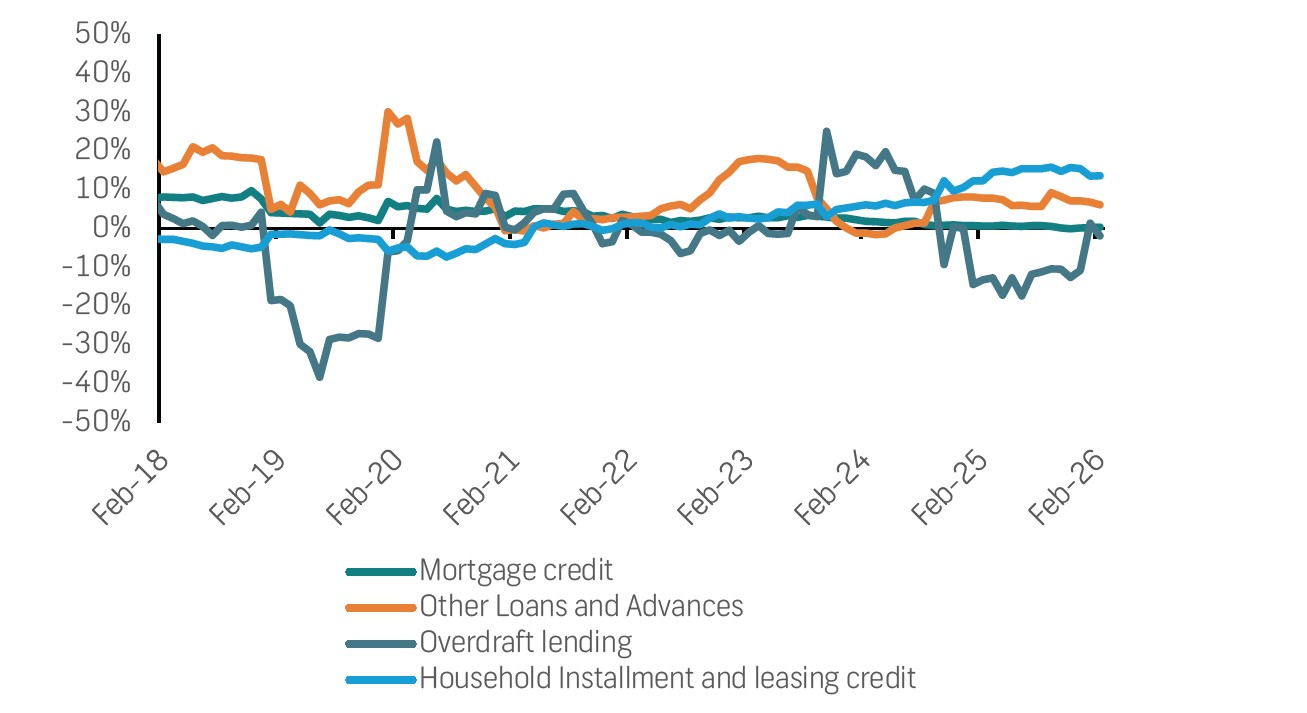
Meanwhile, a key feature of the current credit cycle is the dominance of instalment sales and leasing credit, which remains the fastest-growing category. Growth in this category surged to 20% year-on-year in February, up from 17.4% in January, driven largely by vehicle demand. Total vehicle sales reached 1 165 units during the month, marking a 4.1% annual increase. This trend points to pockets of resilience in consumer and business spending, particularly in transport-related assets.
However, the strength in vehicle financing masks broader weaknesses. Mortgage lending, typically a cornerstone of credit expansion, remains severely constrained. The FNB report notes that although mortgage credit posted a third consecutive month of marginal improvement, growth was just 0.2% year-on-year. Structural challenges in the housing market, including affordability constraints and limited supply, continue to stifle new lending, limiting the sector’s contribution to overall credit growth.
At the same time, overdraft facilities, often a barometer of short-term liquidity stress, paint a concerning picture. Growth in overdraft credit slowed sharply to 4% year-on-year in February, down from 7.2% in January, reflecting both reduced demand and increased repayments by businesses and households. Among households specifically, overdraft usage contracted by 1.9% year-on-year, reversing January’s brief recovery and signalling a pullback in consumption.
Households are increasingly prioritising debt repayment over new borrowing.
Growth in other loans and advances slowed for the fifth consecutive month to 6.2% year-on-year, while broader credit demand remains subdued despite some support from instalment financing.
Even with a recent civil service wage increase expected to provide temporary relief, rising living costs and structural economic challenges are likely to offset any gains in purchasing power.
Looking ahead, household credit growth is projected to remain weak, averaging around 2.8% in 2026.
Slowing domestic economic activity, coupled with global geopolitical tensions, is expected to sustain inflationary pressures and erode real incomes, further dampening credit demand.
Corporate borrowing, while stronger, is not without its own vulnerabilities. The uptick in credit demand appears to be driven more by short-term financing needs than by long-term investment.
Growth in other loans and advances rose to 6.9% year-on-year, indicating increased reliance on working capital to navigate uncertain conditions.
Meanwhile, corporate mortgage lending remains in contraction, and overdraft growth has slowed as firms in key sectors, including agriculture, mining, and retail, focus on deleveraging.
-ebrandt@nepc.com.na