


Bravery Kabula
Despite strong commitments from President Netumbo Nandi-Ndaitwah to create around 500 000 jobs, many young Namibians are yet to secure jobs after graduation.
In 2024, Nandi-Ndaitwah pledged that her administration would expand youth employment programmes, boost support for small and medium enterprises, and align education with labour market needs.
This is aimed at reducing unemployment and creating meaningful work for graduates and school leavers. Education and law graduates featured in this story, and countless others like them, those assurances have not yet eased the frustration of repeated applications and limited responses, leaving many qualified youths still searching for their first break in a tough labour market.
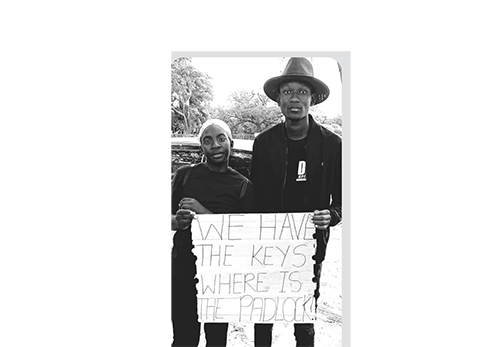
When Farren Kapule completed his law qualification with a focus on alternative dispute resolution, he believed his hard work would open doors. Instead, months after graduating, he remains unemployed.
“I have actively applied for positions advertised in government circulars, parastatals and private institutions. I attend interviews when invited and continue improving my skills, but most entry-level jobs require years of experience,” he said.
His story mirrors that of many young people in the Khomas region. According to the 2023 Population and Housing Census Regional Profile, Khomas is home to 494 605 residents, making it the most populous region in the country. Of that number, 68.6% are under the age of 35. Youth aged 15 to 34 alone account for 200 948 people.
Windhoek alone houses 486 301 residents.
While growth signals opportunity, it also places pressure on the labour market.
Census indicators show that 64% of people aged 15 and above in Khomas are in the labour force. Of those, 65.6% are employed, while 34.4% are unemployed. That means more than a third of economically active people in the region are without work.
For young graduates, the challenge is not only about vacancies but also about experience.
The law graduate said that his skills include legal research and writing, mediation, negotiation, drafting legal documents and understanding Namibian legal procedures. He believes these are relevant in government, compliance, human resources and community dispute resolution. However, he noted that many posts demand prior work experience, making it difficult for recent graduates to enter the system.
Another unemployed graduate, Mecky Malilo, has been searching for work for four months. He holds a Grade 12 certificate and a Bachelor of Education Honours degree in pre- and lower primary education. Despite his qualification, he has received no responses to his applications.
“I have a family to feed. Money for making copies and transport is already a challenge. Being unemployed has affected my life in a very bad way,” he said.
In some constituencies, unemployment is even more pronounced. In the Moses Garoëb constituency, unemployment stands at 48.4%. In Tobias Hainyeko, unemployment is 49.3%, while it is 41.5% in Samora Machel.
Both graduates suggest structured internship and graduate trainee programmes that lead to permanent employment. They also call for more entry-level positions and better alignment between education and labour market needs.
The education graduate proposed building more schools and increasing the number of teachers in junior primary classrooms from one to two per class. He also believes graduate grants should support those who are qualified but without work.
The census report describes the data as a roadmap for planning and inclusive development. However, translating statistics into jobs remains the real test.
Last week, Nandi-Ndaitwah said over 700 jobs were created during the 2025/26 financial year alone following the launch of the National Youth Development Fund (NYDF).
Nandi-Ndaitwah outlined these achievements when she tabled Namibia’s First Progress Report on the implementation of the National Programme of Action on Youth Unemployment at the African Peer Review Mechanism Forum of Heads of State and Government in Addis Ababa over a week ago.
She said the fund, which was established in 2025, serves to respond to challenges associated with access to business financing for youth enterprises.
“The fund provides loans and grants without the requirement of collateral. The fund, which is capitalised at N$500 million, saw a budget allocation of N$257 million during the 2025/26 financial year, of which N$52 million was disbursed to 110 projects, creating approximately 700 jobs,” the tabled report reads.
She added that although youth unemployment was recorded at 44.4% in 2023, Namibia has moved decisively to confront the crisis through large-scale funding, free tertiary education and structured national internship programmes.
At the moment, N$62.3 million has been disbursed to 140 projects, resulting in over 700 jobs created for young Namibians across sectors.