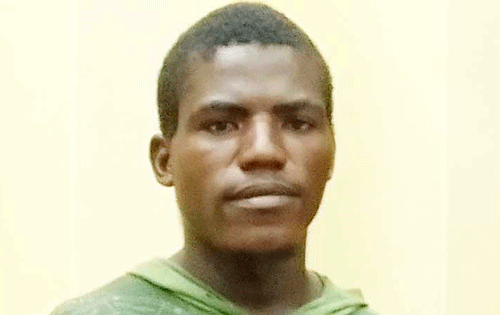

Iuze Mukube
A Rundu resident who was found guilty of hacking his biological mother with a hoe after she advised him not to rejoin a fight at a shebeen, has been sentenced to 20 years.
Jacob Sikerete Sadwere was charged with one count of murder read with the provisions of the Combating of Domestic Violence Act.
It was alleged that on 23 April 2023, at or near Ekuli village in the district of Rundu, Sadwere unlawfully and intentionally killed his biological mother, Annastasis Tjangano Likuwa, by striking her on the head with a hoe.
Likuwa died at the scene.
Sadwere pleaded guilty to the charge, admitting the form of intention under which the murder was committed as dolus eventualis.
The presiding judge, Erich Kesslau, emphasised the importance of imposing a sentence that will deter the continued onslaught of crimes committed in a domestic context against vulnerable members of society when, too often, the sanctity of life is trampled upon.
In considering the interest of society, Kesslau stated it was the duty of the court to uphold the law whilst at the same time reflect society’s resentment and aversion towards those making themselves guilty of dreadful crimes.
The court document reads that the deceased’s eldest sister testified on the impact of the murder on the members of the family.
She revealed that the deceased left behind five children, including the accused, one of whom is still a minor and has been struggling to cope with the loss of his mother.
She said the death of her sister was a painful experience for the family, who had lost a cherished member and described the deceased as a humble and obedient person who shared strong bonds with many in the community.
Additionally, she stated family members, excluding deceased children, met and agreed that the accused should be removed from society for rehabilitation for at least 30 years.
Sadwere testified that on the fateful day, he had been drinking at a shebeen when a fight broke out between him and his cousin.
He admitted that he was a “little bit drunk” and returned home shortly afterwards. When he arrived home, he told his mother, Likuwa, that he planned to return to the shebeen to continue the fight.
The mother tried to stop him from going back, and in turn, Sadwere picked up a hoe and struck her once on the head, causing her death.
Thereafter, Sadwere stated he informed others of what he had done and after his arrest, telephoned his family and begged for their forgiveness and continued prayers.
He expressed deep remorse for causing his mother’s death and told the court that he felt “very bad” about the incident.
During cross-examination, Sadwere agreed with the State that his mother had cared for and supported him throughout his life and acknowledged that her final act was to protect him from returning to a fight where he could have been harmed.
He also agreed that his mother loved him up to the end of her life and that he was supposed to be her protector.
The judge stated that the accused’s plea of guilty on his first appearance and his behaviour after the murder indicated that he was truly remorseful.
“It takes courage to own up to one’s mistakes and to face the unknown consequences,” Kesslau said.
He added that the accused will forever carry this blemish to his name as he will be known by his family and members of society as “the man responsible for the death of his own mother.”
“It goes without saying that murder is a serious crime, even more so because it was committed in a domestic context. Nothing can return the deceased to life.”
The judge added that the deceased, “in an act of motherly love, tried to prevent harm coming to the accused but was rewarded with death.”
Kesslau stated that even though the attack came without warning and was not premeditated, with the weapon used being a hoe, generally used for cultivating the land, the deceased still died of a single wound to the head.
“The fact that the murder was committed with the intention of dolus eventualis [indirect intent], will be regarded as a mitigating factor in the circumstances of this matter.”
In considering all these factors, the judge sentenced Sadwere to 22 years’ in prison, of which two years were suspended for a period of five years on the condition that he is not convicted of murder or attempted murder, committed during the period of suspension.