

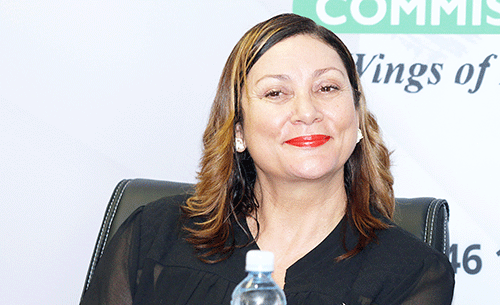

Rudolf Gaiseb
The Ministry of Education, Innovation, Youth, Sports, Arts and Culture has allocated N$4 billion to higher education.
“This budget seeks to support the phased implementation of free higher education and vocational training across all public higher education institutions and government-owned vocational training centres,” education minister Sanet Steenkamp motivated the budget in Parliament last Thursday.
“With a comprehensive and forward-looking allocation strategy, we aim to bridge historical inequalities, strengthen foundational learning, unlock opportunities for our youth, and catalyse social and economic transformation,” she said.
The ministry has distributed the funds among the country’s higher education institutions.
The Namibia Student Financial Assistance Fund, which was re-integrated into the ministry, is allocated the biggest chunk of N$2.7 billion.
The University of Namibia is allocated N$1.4 billion. The Namibia University of Science and Technology is allocated N$576 million.
The National Council of Higher Education and the Namibia Qualifications Authority are allocated N$28 million and N$62 million, respectively.
Steenkamp noted that the remaining N$11.3 million will be channelled towards the operational expenses of the Directorate of Higher Education for policy oversight.
Under the vocational education and training programme, the minister pledged to produce graduates with skills aligned and responsive to industry demands.
“This will be achieved through the establishment of new governance legislation for State-owned technical vocational training centres that will enable the separation of technical and vocational education and training (TVET) regulatory function and the national qualification framework from the training function, thereby enabling the roll-out of free vocational education without competing for resources with private training providers,” she said.
The budget allocation to vocational education and training is N$587 million, out of which an amount of N$565 million is allocated to the Namibia Training Authority.
Moreover, the ministry is capitalising on science, technology and innovation with an allocation of N$79.5 million towards the National Commission for Research, Science and Technology. The programme includes technology forecasting and opportunities’ identification for strategic use of emerging technologies for development.
Secondary education
A whopping N$5 billion is allocated for secondary education.
Under this programme, Steenkamp said the focus for the 2025/26 financial year will be on the continuous professional development of secondary teachers.
This programme aims to improve the quality of secondary education through responsive and relevant national curriculum and curriculum support materials.
It encompasses the allocation of N$27.5 million, which will be spent on capacity-building of teachers for Namibia Senior Secondary Certificate Advanced Subsidiary (NSSCAS) subjects to improve learning outcomes.
“Training needs were identified in past (2023 and 2024) examination reports as well as training needs’ assessment of teachers conducted in collaboration with the Cambridge University Press and Assessment. The following subjects will be targeted: NSSCAS [Namibia Senior Secondary Certificate Advanced Subsidiary] Mathematics, NSSCAS English Second Language, NSSCAS Geography, NSSCAS Agricultural Science,” Steenkamp said.
The ministry additionally budgeted N$59 million for the continuous professional development of teachers at the regional level.
N$129 million will be transferred to the Regional Directorates of Education to facilitate stationery procurement before the commencement of the 2026 academic year.
“The Universal Secondary Grant (USG), an amount of N$96 716 000 covered under this grant, includes amounts of N$400 per secondary learner, N$2 000 per learner for learners in resource schools/units, and N$15 per learner for seed capital for school hygiene projects,” she added.
Photo: Heather Erdmann