
Hilma Nalupe
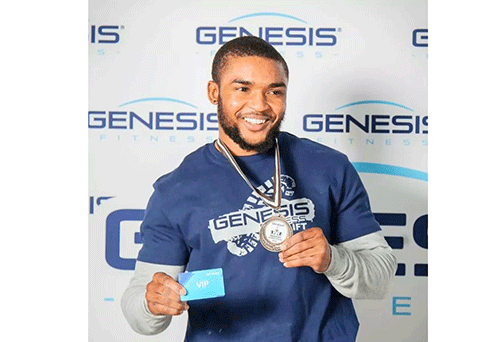
When Phillipus Shangadi first walked into a gym back in 2018, he never imagined the weights he lifted would one day carry the hopes of a nation. What began as a simple quest to gain strength and confidence after years of being bullied in high school turned into a mission to make history.
He became the first Namibian to compete at the World Powerlifting Championships, set to take place in Brazil from 22 to 26 October this year.
“I used to be very skinny and got bullied a lot. I decided to go to the gym, where people started noticing my strength. That’s where powerlifting started for me. Over time, I realised this was more than just a hobby. It was a God-given talent,” Shangadi narrated.
Since then, he has dominated local competitions and made his mark on the continent.
He ranked among Africa’s top three powerlifters.
Earlier this year, Shangadi was invited to compete in Canada, a dream that slipped away due to a lack of sponsorship.
Now, with Brazil on the horizon, he is determined not to let the same thing happen again.
His training regimen is as demanding as his ambition.
He trains four times a week, focusing on the three cornerstone lifts of powerlifting: squats, bench presses and deadlifts.
Nutrition and recovery are just as crucial.
Every Monday, Wednesday and Saturday before 7h00, he eats 10 eggs.
He also needs creatine for recovery and a proper high-protein diet to keep up with the training, which are not always easy to do.
But the biggest hurdle Shangadi faces is finances.
Competing at this level comes with steep costs: specialised equipment, entry fees, flights, accommodation and food.
He said that to achieve his goal of competing at the World Powerlifting Championships, he needs about N$100 000 to cover everything.
This includes taking his manager along, as going by himself will be very tough, especially when he knows no one there.
Despite these challenges, Shangadi remains relentless.
“This isn’t just about me. It’s about raising the Namibian flag and showing the world that Namibia can produce competitive powerlifters. I want to inspire young Namibians to believe that powerlifting is a sport where they, too, can excel,” he said.
His role models include American lifter KG74 and South Africa’s Cotton, both formidable figures in the sport.
But he believes his toughest competition is himself, pushing his own limits through discipline, consistency and hard work.
With the countdown to Brazil underway, Shangadi has a simple yet powerful message.
“I can’t wait. I know I’m going there not just to compete, but to win. All I need now is the support to make it happen,” he said.
His story is a call to action, a reminder that Namibia is full of untapped talent waiting for the chance to shine.
But without sponsorship and support, dreams like his risk being left on the training floor.
For Shangadi, Brazil is more than a championship.
It is a chance to prove that Namibian athletes belong on the world stage.