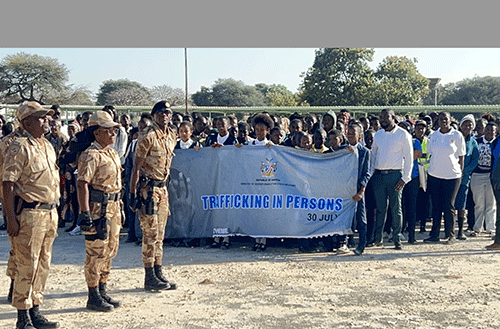

RUNDU – Inspector General of the Namibian Police Joseph Shikongo said six trafficking victims were repatriated to Namibia between June 2024 and June 2025.
He made this announcement during the commemoration of the World Day Against Trafficking in Persons (TIP).
The event took place in Rundu last Wednesday under the theme ‘Human Trafficking is Organised Crime – End the Exploitation’.
“The number of Trafficking victims that were repatriated back to Namibia was reported to have been six, which consisted of five victims repatriated from Myanmar and one from Laos, South East Asia. They were all repatriated back to Namibia,’’ Shikongo stated. He noted that the psychological effects of human trafficking make it difficult to detect and investigate, not only in Namibia but across the rest of the world. Victims are often misled or coerced into exploitative situations that can, in some cases, pose serious threats to their lives.
Investigating such crimes can be particularly challenging, especially when victims develop emotional bonds with their exploiters.
Shikongo further revealed that about four victims of trafficking were repatriated from Namibia, including two to Angola, one to Botswana and one to Zambia. “We should remember that behind every statistic is a human life, whereby a child is robbed of innocence, a woman denied her freedom and a man stripped of his dignity. Therefore, our collective response must be robust, victim-centred and rooted in justice and compassion,’’ he noted.
Shikongo said the police are leaving no stone unturned in the fight against perpetrators of human trafficking.
He stated that the Namibian Police Force, through the Criminal Investigations Directorate, the National Central Bureau-Interpol Windhoek Division and other stakeholders involved in combating transnational organised crime, has made tangible strides in identifying, investigating and prosecuting cases of human trafficking.
“The Namibian Police Force, in collaboration with our stakeholders, rescued victims, arrested perpetrators and disrupted organised crime networks involved in trafficking in persons. Yet, we acknowledge that more needs to be done, as the fight against trafficking is complex and ever-evolving,’’ he said.
Shikongo noted that the day is not only a time of remembrance but also reaffirmation.
He said it is a confirmation of shared commitment to end the cruel crime of human trafficking – a grave violation of human rights that robs individuals of their dignity, freedom and future.
“Human trafficking knows no borders. It affects women, children and men alike. It thrives in the shadows, fuelled by deception, desperation, conflict and exploitation. As a country committed to justice and the protection of human rights, Namibia cannot and will not allow this scourge to fester within our society,’’ he said. Shikongo cautioned that any country in the world can be affected as either a country of origin, transit or destination for the victims. Like other parts of Africa, the Southern Africa Region is also affected by this crime.
The number of reported and detected cases is slowly increasing in Namibia. Although not yet alarming, it remains a growing concern.
Delivering the keynote address, Minister of International Relations and Cooperation, Selma Ashipala-Musavyi, said that to enhance national coordination in the fight against TIP, Namibia established a National High-Level Committee, chaired by her ministry.
It comprises ministers responsible for gender equality, safety and security, justice, labour and other key portfolios.
“This structure is supported by a technical committee of executive directors, an inter-ministerial committee of senior officials and the national coordinating body, which brings together stakeholders from government, academia, civil society and faith-based organisations. Regular reporting to Cabinet ensures that the national response remains a priority, backed by strong political will and accountability at the highest level,’’ she said. Ashipala-Musavyi added that Namibia has made significant strides in operationalising its anti-trafficking efforts, such as the establishment of a specialised High Court unit to handle TIP cases, thereby improving prosecution and access to justice.
The costed National Plan of Action (2023-2027) and Standard Operating Procedures guide the identification, referral and protection of victims.
Additionally, a Police and Prosecutor Training Manual and TIP pocket guides have been developed to build capacity in the justice sector.
“Over 26 victims have been accommodated in government shelters, including 12 children – thanks to the operationalisation of shelters in eight regions,’’ she said.