

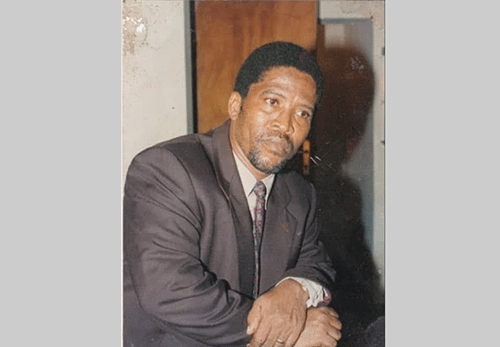

Back in the early 70s, uncompromising political activist Izaak Swarts, took it upon his tiny shoulders to singlehandedly confront the prevailing injustices and oppression by spreading the gospel of freedom to marginalised communities, encouraging them to resist and reject the puke-inducing apartheid system at all costs.
Swarts used the beautiful game of football to advocate for justice. In real life, the retired Namibian Diplomat famously known as ‘Izallo’ in football circles during his days at the Augustinem High School, was a noted footballer, school-teacher, musician and uncompromising political activist. Born in Rehoboth in 1950, ‘Izallo; enjoyed decent upbringing and valued education seriously. The athletically built speedy winger with the delicious left foot and amazing pace which always came in handy to outsmart opposing defenders despite his relatively small frame and lack of height.
Izallo was a valuable squad member of exciting Katutura outfit Ramblers Football Club (‘Ramkat’) where he enjoyed success with the gold and maroon stripe outfit playing alongside the dribbling wizard Petrus !Nerab Gariseb, Doc Naobeb, Maxu Engelbrecht, Sigab Williams, Andries Bekeur and acrobatic shot stopper Japhet ‘The Cat’ Isaacs.
Ramblers came in to life after Rocco Swallows management failed to persuade Jungle Boys’ ball juggler /Noas Gariseb to cross the floor. The only solution to bring the crowd favorite on board was to have the merger between the two teams in order to form one strong team that could challenge and bring the dominance of Orlando Pirates and Pirates (Dolam) to an end.
Izallo was among very few fortunate footballers to have the chance of rubbing shoulders with one of Namibia’s most gifted footballers of all time.
During an in-depth interview with the former educator in 2013, he told New Era Sport how authorities tried by all means to silence him by transferring him from his hometown Rehoboth to Windhoek to keep him out of school politics. Truth be told, modern football has somehow lost its spark and this is because there are just no more personalities in the domestic game as compared to the good old days when football had genuinely committed young men as obedient servants who could go to the length of sacrificing their livelihood just for the beautiful game. As with many left-footed or left-handed human creatures, Izallo was a genius in many aspects of life and everything he had ever dared to lay his tiny hands on would turn in to gold. The stocky winger started playing street football with his buddies using plastic balls and tennis balls but the beautiful game could not contain his undying desire to hit balls on the tennis courts.
Izallo loved tennis so much that his buddies would always struggle to drag him off the tennis courts to play football with them. “Apart from the popular street football, we used to play competitive football while at primary school in Mariental against schools from Stampriet, Goachanas, Maltahöhe and Aranos,” recalled the humorous Izallo.
Izallo grew up knowing that he wanted to be a great tennis player when he moved from his adopted hometown Mariental to Windhoek in pursuit of proper education that would equip him to advance his political aspirations in a properly thought-out articulated fashion.
“When I arrived at Augustineum in 1968 I only played classroom football but mostly concentrated on tennis because it was my first love,” he said. However, it was not long before he found himself at the Welwitschias High School in Khorixas where he continued to play football for the school’s first team.
A bird of passage, Izallo was soon back in familiar territory at Augustineum HS. He joined Southern Empire, a football team comprising of in-takes from the southern part of the country. Luckily for him, the sports crazy Meester Tsuseb was on hand to encourage him to continue playing tennis without any hindrance. “Football was always going to be my second priority but for some strange reason I changed gear and started playing football seriously to the extent that I was included in the school’s first team where I played alongside legendary goalie Japhet Hellao,” he said. Izallo held fond memories of his club football at Augustineum. “Those were the good old days and I sincerely wish one could turn back the clock. I remember one particular match we played against Windhoek City at hostel with Hellao in goal for them. That man was immortal and a marvel to watch between the sticks thwarting each and every goal attempt. We played four consecutive draws in the final of the popular top-four knockout tournament,” he said. School football was very competitive in those days and many of the leading clubs drew the bulk of their star players from students’.
Izallo singled out former Brave Warriors mentor and Black Africa’s midfield general Rusten Mogane as a special baller. “I used to admire that boy he was a genius and liked the casual fashion in which he went about his business on and off the field. He was always an easygoing happy jolly fellow who used to crack lots of jokes but a real menace on the football pitch that I even named my second son after him,” said Izallo.
Upon completion of his secondary education, Izallo retreated to his adopted town Mariental where he took up employment as a school-teacher whilst continuing his football career with Shoe Shine Boys FC before short spells with Bee Bob Brothers, Life Fighters and Black Maroko Chiefs. He formed a very good relationship with Laurence Boois, winning few knockout cup competitions. However, his constant flirtation with politics did not sit well with the masters of apartheid. Izallo was moved to Windhoek to occupy the portfolio of subject advisor in an effort to give perpetrators some breathing space, or so they thought.
Upon his arrival in Windhoek, the free scoring forward joined Ramblers in Katutura playing alongside a galaxy of stars. Ramblers was a much-adored unit by hundreds of football revelers as team played the most attractive football in the business, while showing lots of promise. Regrettably, the club for some strange reason folded under mysterious circumstances, an unfortunate scenario which Izallo blamed on poor leadership.
“We had a great squad consisting of highly talented ballers but the main obstacle was the lack of leadership with a clear vision to steer the club in to the right direction. We used to beat the big teams but somehow we just could never lay our hands on major trophies,” he said. He also had a stint with coastal outfit Eleven Arrows before wrapping up an otherwise flawless football career with and finally wrapped up his football career at Pirates (Dolam). “It was the same old story at Pirates the discipline facto. Every time we were scheduled to play a league match, preparations would be preceded by unnecessary infighting over the usual administrative shenanigans,” he said.
“The club was constantly made to fork out large amounts of money in outstanding fines being sanctioned almost every week – ranging from our chairman’s non-appearance at the weekly compulsory meeting or either Moles Owoseb would fail to turn up to officiate at a league match. Nonetheless, I enjoyed my football and will always cherish my countless tussles with former Black Africa midfielder Lucky Boostander. He was in a class of his own but the likes of Albert Louw, Doc Hardley, Pius Eigowab, Oscar Mengo, Haban Adams, Pius Hummel, Terry Cooper, Garincha Hupita and the Chelsea trio of Richo Francis, Pieces and Orlando Damaseb were all exceptional footballers,” he said.
A self-taught multi-instrumentalist who mastered the finer points of how to effortlessly fiddle with the ivories (keyboards), Izallo was equally at home with brass instruments, indeed a Jack of all trades, he excelled in Karate.
He trained 400 young Karatekas during his time at Augustineum. Izallo was rewarded for his fight against the evils of apartheid with a diplomatic position of second secretary for finance and administration. He served in various Namibian High Commissions in Botswana, Nigeria, and Zambia with distinction before retiring in 2012.