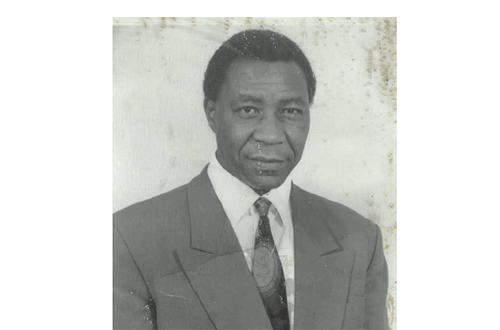

Born at Windhoek’s Old Location in 1952, Fanuel Ngatangue Tjingaete, famously known as ‘Fanie’ in social circles was always destined for greatness from day one. Growing up in harsh conditions at Windhoek’s Old Location, it was imperative for many young boys from the disadvantaged Bantu community to be streetwise.
It was a life full of unpleasant battles, from fending off bullying from bigger boys during the hotly contested dice throw gambling to maneuvering their way through the dangerously life-threatening waters of the Van Rhyn Dam, aka ‘Ondende’, holed up opposite the Concordia College.
A proud product of the revered St Barnabas Native School ‘Jo Veripate’, it was not until he enrolled at the St Joseph’s Secondary School that the athletic built Fanie was introduced to boxing. He teamed up with fellow pupils Joe Topoti Murangi, Matheus Shalundu, and other boys to form a boxing club at the school hostel.
The light middleweight rookie opened his account in the dog-eat-dog business of trading leather with a date against the tallish well-built Manase Katjivena at the Augustineum Secondary School Hall. His next victim was Manase’s elder brother Butise Katjivena who was subjected to the same fate of losing to the emerging light middle weight rookie boxer.
Mission accomplished; Fanie won his debut bout on points. His next fight was at the Katutura Community Hall against the imposing bulky Nehemiah Hijandama Tjahikika. Blessed with amazing hard knuckles, speed and accurate jabs and upper cuts, Fanie made short work of his more celebrated opponent – beating Tjahikika hands down via a convincing points victory. With a pair of triumphs from the same number of bouts, Fanie was growing in confidence and next made short work of the more experienced Uararere Tjirare at the Kuisebmund Community Hall in Walvis-Bay. Fanie stylishly sent his out-of-sorts opponent to the canvas in the second round with a devastating right hook that knocked the steam out of Tjirare.
His next stop was across the Orange River in neighbouring South Africa where he came out unscathed against formidable opponents in Inter-Provincial tournaments staged in East London, and King Williams Town,
Regrettably, that was the end of an otherwise flourishing boxing career. Upon completion of his secondary education at the Augustineum Secondary School in Windhoek, Fanie enrolled at the iconic Fort Hare University in Alice in the Eastern Cape in South Africa for further studies.
Here, he was reunited with fellow countrymen and women flanked by the late astute politician Mokganedi Thlahabanello, Johnny Akwenye, Dr Kalumbi Shaghula, Lucia Hamutenya, John Tjirare, Kanyama, and George Rukoro, among others.
Sadly, his academic aspirations were shattered when a student uprising over the much-despised Bantu education intensified, resulting in his hasty retreat to his homeland. Fanie briefly continued from where he left off returning to the boxing ring sooner than expected. He confronted the strongly built Abiud Tjivikua from Opuwo in the great Kunene region.
Once again Fanie had little trouble dispatching his opponent on points before squaring up against the streetwise heavyweight boxer from Khomasdal Heinrich Gol Schroeder. The contest ended in a draw. “Eish…Gol was a tough character, very strong and tricky, but I was happy not to be on the losing side because it (the fight) could have gone either way,” Fanie recalled with a wry smile.
Admittedly, even though his academic aspirations were cut short, Fanie still had ambitions to further his studies and resolved to skip the border into Botswana in 1974. He found himself confined at the refugee camps in Maun where he spent a frustrating nine months before being relocated to Francistown and then being shipped out to Lusaka, Zambia.
He found refuge with the UNIN for two solid years before he landed a scholarship that saw him dispatched to Berlin, Germany. During his decade long stay in Deutshland, Fanie read for a doctorate in Monetary Policy.
Upon expiry of his study visa, he was obligated to vacate ship and gladly returned home in 1986. Equipped with the necessary qualifications, the brother carved himself a decent employment with the Department of Finance shifting in the portfolio of Senior Economic Policy Officer.
He went on to occupy several high-profile portfolios in the economic sector that included lecturing at the Windhoek Academy as Head of Department (HoD), Dean of faculty Economic, Management and Science, Management.
A bird of passage, Fanie developed itchy feet and exchanged the city of bright lights (Windhoek) with the freezing weather at the Atlantic Ocean. The brother accepted a tempting offer to occupy the plum position at CDM in Oranjemund, justifiably installed as the designated corporate communications manager, auditor-general logistics.
When Namibia finally gained her much anticipated freedom from racial segregation in 1990, the sporting landscape started to undergo major shake ups and boxing was not to be outdone either. It was time to establish an autonomous umbrella body overseeing professional boxing. The appointing authority needed someone with expertise and did not look further than Dr Fanuel Tjingaete.
He was rightfully identified as the suitable candidate to steer the ship into the unchartered territory. Fanie took over the reins as the inaugural chairman of the newly established Namibian Professional Wrestling and Boxing Control Board. “It was a rocky journey putting the puzzles together, as we were new in the business but somehow managed to weather the storm with the assistance of Stan Christodolou, Dingaan Thobela, and few others that lent a helping hand to lay the foundation,” concluded the now retired PhD holder.