

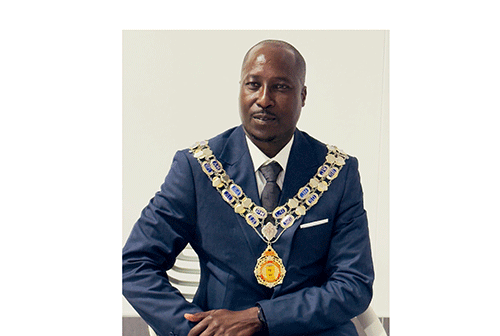

Adolf Kaure
Newly elected Windhoek mayor Sakarias Uunona said that implementation of the Windhoek Municipal Council’s plans needs a modern approach that is aligned to governmental plans.
The Swapo councillor said this during the City of Windhoek (CoW) office bearer’s elections recently held at the CoW council chambers. According to Uunona, the economy of Windhoek must continue to grow the targets outlined in the NDP6 (2025–2030) to build a robust economy for a stable, modern and productive city. “For this vision to succeed, policy and enforcement must speak the same language,” he said. “Too often, social programmes, businesses and project implementation are being suffocated not by government policy but by ground-level enforcement that may be outdated and completely misaligned with national interest,” he said.
Uunona also highlighted the need for the Municipal Council to do an introspection of its existing systems, processes and frameworks for a clearer picture of its achievements and remaining challenges.
This is in light of CoW’s Strategic Plan Cycle of 2022 – 2027, which is drawing towards its completion and makes the 2025/2026 period crucial for the plan.
“Over the last five years, Windhoek navigated economic uncertainties, infrastructural pressures, and the growing demands of a rapidly expanding population. Yet, amid these challenges, we have also witnessed innovation, strengthened governance, and a rising determination among our residents to participate in shaping the future of their livable city,” he said.
According to the Namibia Statistics Agency (NSA) 2023 Population and Housing Census, Windhoek’s population was 486,169, with a density of about 95 people per square kilometre. The 2011 NSA Population and Housing Census revealed that the population of Windhoek was 342,141. This equates to a very high population growth rate of 29.6% mainly attributed to urbanisation. With Namibia holding one of southern Africa’s highest unemployment rates at 36.9% (NSA Housing and Population Census), it may be a contributing factor to urbanisation as many flocks to the capital city, Windhoek seeking for greener pastures.
Uunona further underscored the importance of cultivating “an impactful leadership and a unified political will as a Municipal Council to place the interest of residents at the centre of decision making as well as to meaningful stakeholder engagement”. The mayor also cited financial sustainability as another key priority that will enable Council to deliver on its promises and respond to the needs of its residents. Swapo councillor, Albertina Amutenya was sworn in as the new deputy mayor of Windhoek. The Windhoek Municipal Council management committee is made up of Austin Kwenani (chairperson) Queen Omagano Kamati, Fransina Kahungu, Demetreo Beukes, and Matheus Shoongo.
The other councillors sworn in are Toini Ambambi, Ricardo //Garoëb, Jesaya Ikali, Maitjituavi Kavetu, Ignatius Semba, Ivan Skrywer, Ndeshihafela Larandja, and Werner-Meck Tjihuiko.
-akaure@nepc.com.na