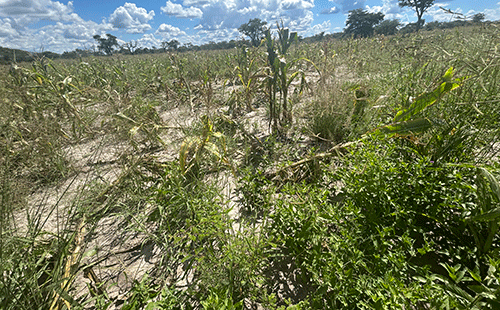

Minister of Agriculture, Water and Land Reform Inge Zaamwani on Wednesday announced an outbreak of African migratory locusts in Zambezi region.
She made the announcement in the National Assembly, noting that the affected areas include Kasaya, Nakabolelwa, Luhonono, Bukalo, Kabbe, Muyako, Masokotwani and Linyanti.
“I must bring to your attention a serious outbreak of African migratory locusts reported in the Zambezi region,” she said.
The minister stated that the floodplains of Muyako and Old Masokotwani have contributed to the rapid spread of the insects, as these are known breeding grounds for the species.
“The outbreak has reached both the hopper and flying stages, posing significant challenges to our control efforts,” she added.
Zaamwani said the ministry has deployed three ground teams equipped with three Land Cruiser vehicles, seven vehicle-mounted sprayers as well as hand-held mist blowers and spraying machines.
“To supplement these efforts, the ministry has mobilised additional vehicles from the Directorate of Veterinary Services and the Programme for Communal Land Development. However, the scale of the outbreak demands broader support,” she noted.
The minister called on other government institutions, regional councils, local authorities and the private sector to join efforts in containing the locusts threat.
“We also urge our traditional leaders and communities in affected areas to take precautions, including avoiding contact with sprayed dead locusts and refraining from consuming or using them for any purpose,” she appealed.
Zaamwani emphasised that the persistent locust outbreaks highlight the importance of vigilance, preparedness and cooperation in safeguarding Namibia’s agricultural sector.
No outbreak
Chairperson of the Zambezi Regional Council Matengu Simushi has, however, dismissed reports suggesting that the Zambezi region is facing a new locusts outbreak.
This follows the ministry of agriculture’s deployment of teams to spray fields across the region ahead of the rainy season.
This is a period when most farmers begin preparing and ploughing their crop fields.
Simushi said the current spraying activities are purely precautionary measures targeting locusts that hatched from eggs laid during the previous rainy season, as well as migratory locusts crossing over from neighbouring countries.
“There is no locust outbreak in Zambezi,” Simushi stated.
“Teams are spraying the fields because locusts have hatched, but how can there be an outbreak if there are no crops in the fields?” he questioned.
He stressed that as the chairperson of the regional council, he is fully aware of all activities taking place in the region.
“I know everything happening in Zambezi. So, I can confirm that there’s no outbreak in the region,” he added.
While Simushi downplayed current concerns, he acknowledged that the Zambezi region remains prone to seasonal locust infestations, which in the past have destroyed thousands of hectares of farmland.
The ongoing spraying operations are concentrated in the floodplain areas, including Kasaya, Nakabolelwa, Luhonono, Bukalo, Kabwe, Muyako, Masokotwani and Linyanti.
Authorities hope the early intervention will prevent any potential outbreak and protect farmers’ fields once the rainy season begins
-anakale@nepc.com.na
-Additional reporting Nampa.