

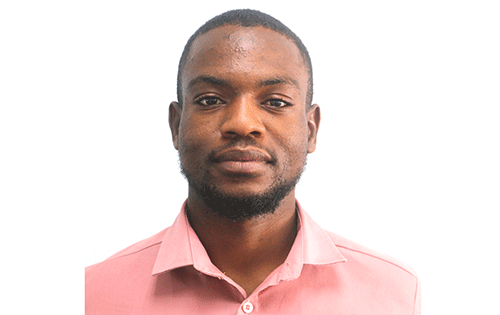

Rudolf Gaiseb
If guns or bombs are your go-to weapon in this age, you are old school. Today, all a person needs is a keyboard, Wi-Fi connection, and someone they disagree with. Yes, a war of words that kills more painfully than bullets.
Social media is the arena, and like every soldier, the comrades chant from the sidelines, “Finish him.” “They are instigators. “Are you going to let him talk to you like that?” However, content is king, and we are its servants, drenching our own individualism, eroding our humanness.
Free speech was a right; now it’s a meme, nay, a weapon, an opportunity to attack those we hate. Sadly, the youth are particularly the combatants: the keyboard warriors and the victims of this war. At supersonic speed, social media quickened and advanced our connectivity. But its advent also exacerbated social division.
As users, we can all attest to how social media polarises us along gender, education, class, religion, race, and tribal lines. But ironically, artificial intelligence (AI) bots and algorithms that monitor these platforms learn from us. These divisive behaviours are learnt, embedded, and in turn used against us to fight each other, and we are all heading the same direction. They monitor what we type, like, comment and share, then recommend content we are less likely to disagree with: filter bubbles and echo chambers. In 2025, on the technological front, the most pressing issue that warrants the nation’s attention is cyberbullying.
Aside from the blue-batched few, our social media profiles’ messengers, including comment sections, are flooded with DMs; unwanted attention. Among these are hate speeches, insults, and attacks on targeted individuals.
Meme culture is creative and funny, but there is toxic culture hitting our profiles and cyberspace that affects our mental, emotional and physical health, directly and indirectly. But first, let this sink in: “We are first human before we are anything else. The information war cannot be our end.
Social media’s subtle insurgence in the 1990s: an ordinary man could not predict how much it would change the world. The excitement was rampant, not only because the human race was going to be more connected but also because the human spirit found something else to celebrate.
It is right to say we took a new leap in the never-ending exploration of knowledge, evolution, and innovation because we can hold meaningful interactions and conversations across physical borders.
However, cyberbullying grew like a weed in the once-flourishing utopia. It is like the biblical story, but while everyone was sleeping, the enemy came and sowed weeds among the wheat. Doomscrolling has become the norm, even when interpersonal interactions falter. But cyberbullying takes centre stage on the same revolutionary platforms that brought our interconnectedness and individual expression: Facebook, Instagram, Snapchat, and TikTok, to name a few.
According to a 2023 article, 80% of teenagers in the United States said peers cyberbully because they think it is funny. Students are almost twice as likely to attempt suicide if they have been cyberbullied, and 59% of US teenagers have experienced bullying or harassment online, while 37% of bullying victims develop social anxiety.
These lead to the exorbitant cases of suicide globally. BBC writes, cyber-bullying of well-known figures is a big issue in South Korea and several celebrities have killed themselves.
The impact of hurtful, abusive, or threatening messages, images, or videos sent via messaging platforms has lasting effects on individuals and society as a whole. Cyberbullying manifests as impersonating someone and sending mean messages to others on their behalf or through fake social media accounts.
Furthermore, cyberspace creates opportunities that breed sexual exploitation. In 2025, with the rise of artificial intelligence, engaging in sexual harassment or bullying using generative AI tools is particularly pertinent. Locally, university students testify that sexual exchanges between students and lecturers are often for grade favours. Where students fail or perform unsatisfactorily in their grades, ghost marks are provided in order to pass by the same lecturers.
Older victims of sexual exploitation report that the culprits are their bosses. These boil down to harassment and sexual favours in the corporate spaces. They are paid to shut up. Inappropriate sexting. Nude exchange. Extortion: these are all characteristics of online harassment.
Cyberbullying is reported to take place on messaging platforms, gaming platforms, and mobile phones too. According to the United Nations Children’s Fund, the behaviour is aimed at scaring, angering, or shaming those who are targeted. Among those targeted are also boys (as young as 11) and the LGBTQ+ community.
In our communities, it is reported the scorn starts on social media with a DM and manifests in workplaces, school grounds, campuses, and homes. Namibia’s digital society is becoming particularly toxic because of the ungoverned online space; there is no social media regulation, and the anti-cyberbullying law has not been passed. Another toxic trait of modern media in Namibia is the reinforcement of stereotypes. Some remarks by politicians slamming their counterparts are harmful, as they enforce certain beliefs about certain groups in their followers.
Where carelessly spoken or planned, it carries divisive nuances. Like the popular phrase, monkey see, monkey do, young minds adopt these traits and practise with their peers tribalism, racism, and religious division, harming diversity and healthy debate.
What is crippling is the spirit of justice, which is that those who hold the power in their hands are involved. If he whom you report to is corrupt, in whose hands lies the onus of justice? But should the actions of the uncontrolled bound the nourishment of our communities?
For centuries, our survival has been at the expense of others freedom. The 19th century was the perfect epitome, imbued by first-world colonising of peripheries for their resources, leaving them bare and ruined.
We are not simply matter, occupying space; we live, age, and are buried and then decay. We are first humans and stronger in unity. The sanity and coherence of our society hinge on the morality of our institutions. And this morality depends on that of those who run them.
When tertiary, knowledge-based institutions operate on academic fraud, the power of these institutions is undermined and the purpose of these crucial institutions is washed away. It broods unqualified and unprofessional human resources into our society, and we don’t want that. We don’t want stunted growth. Both public and private institutions must maintain public trust by upholding ethics and morale. If they don’t, their numbers drop, they shut down, join counterparts, become a conglomerate, and fight for relevance.
All in all, combating cyberbullying should be a collective action to ensure a clean digital space and not use it to destroy each other. The onus is everyone’s; it starts with a thought. You choose to act or let it die.