

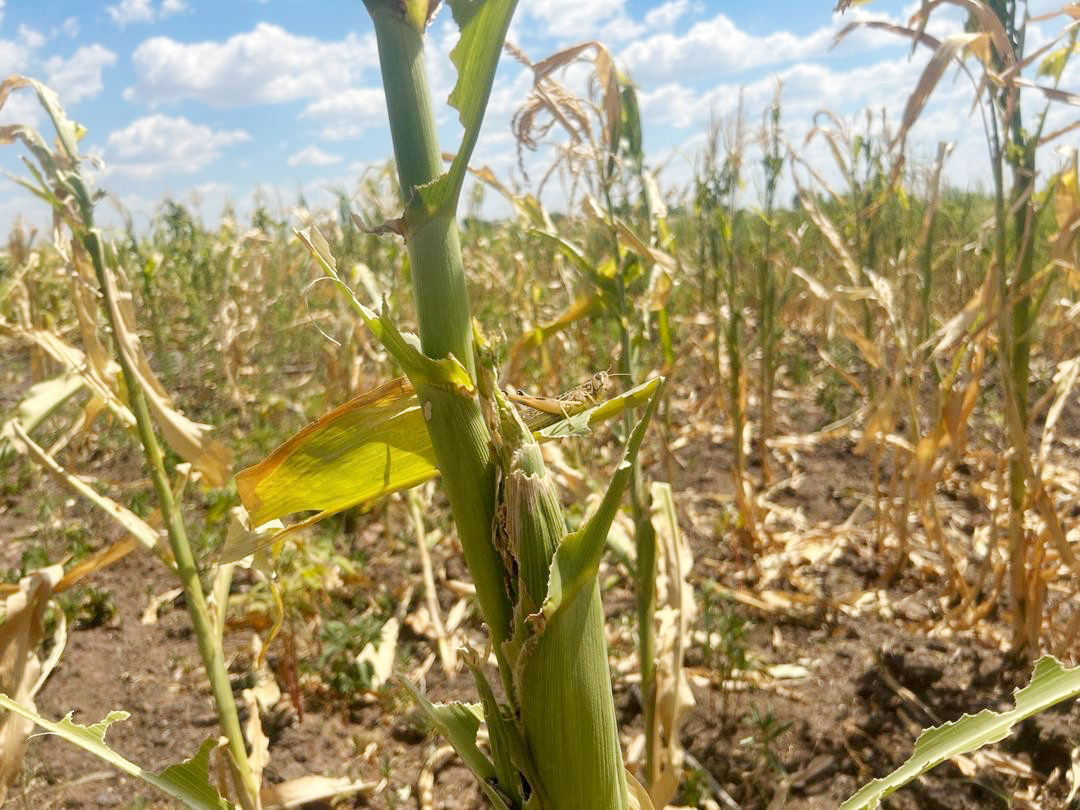

LAKE LIAMBEZI – Maize farmers around Lake Liambezi are facing mounting losses as African migratory locusts and fall armyworms continue to ravage crop fields, prompting urgent calls for faster and more effective government intervention, including aerial spraying.
According to Roderick Maswabi, chief agricultural scientific officer in Zambezi, the 2025/26 farming season has already recorded three separate locust infestations – between April and June, November and December, and now again in January 2026.
“The current infestation is still at an early stage, consisting mainly of hoppers and some flying locusts,” Maswabi said.
He confirmed that outbreaks have been reported in Muyako, Old Masokotwani, Kweha, Lusu, Chinchimani, Kapani, Sangwali, Choi and Kasheshe, with areas around Lake Liambezi among the hardest hit.
At the same time, fall armyworms are also destroying maize crops, particularly in fields that were not weeded early.
“Grass becomes the host and breeding area for these pests,” Maswabi said.
While the fall armyworm was first detected in Namibia in 2016 and considered an exotic pest, Maswabi said there is no definitive answer as to where the current outbreaks originate from. However, he pointed to prolonged rainfall, warm temperatures, delayed land preparation, and poor field sanitation as key drivers behind the surge.
“The pests deposit their eggs in the soil. Once conditions are favourable, they hatch and start feeding,” he said.
“Locusts reduce the plant’s chlorophyll by feeding on leaves, while fall armyworms attack the growth point of the maize, directly affecting yields,” he added.
Govt response
Maswabi said the ministry of agriculture has activated rapid response measures, including surveillance, inspections, and pest control operations. Control teams have been deployed, supported by 10 vehicles with mounted sprayers and mist blowers, currently operating from camps in Muyako, Masokotwani, Chinchimani and Kapani. “The spraying exercise started in January 2026 and is ongoing,” he said, adding that farmers are urged to maintain good field hygiene, plant early where possible, and report sightings immediately.
Farmers’ nightmare
Despite these efforts, farmers say the scale of infestation around Lake Liambezi is overwhelming.
Kevin Sikalumbu, a farmer from Kweha, said heavy rains had raised hopes for a good harvest until locusts arrived.
“We have enough rain that could give us a good yield, but the problem is the locust,” Sikalumbu said. He went on saying, “Only individual fields are being sprayed. Around Lake Liambezi, it’s vast land. If they spray my field and not the neighbouring ones, it doesn’t help.”
He warned that vehicle-based spraying cannot keep up with the spread.
“They still have a very big job to do, especially around Lake Liambezi,” he said.
In Muyako, farmer Brandon Kabuku described the situation as “tense”, saying locusts have increased rapidly since December.
“The maize is growing well and becoming big, but now it’s the locusts damaging it,” Kabuku said.
“Cars and foot spraying are not effective. Aerial spraying would be better before it’s too late,” he said.
Similar concerns were raised in Old Masokotwani, where Mwanagombe Mweti said locusts continue to reappear despite spraying.
“They lay eggs in the soil. Even when you spray, they come back. Cars cannot reach some areas. An aeroplane can finish the whole system in a few weeks,” Mweti said.
Furthermore, Maswabi acknowledged farmers’ concerns and confirmed that aerial and drone spraying are being considered.
“Drone or aerial spraying is more effective because it saves time and labour and covers a large area per hour compared to vehicles or human labour,” he said.
For now, the ministry says the situation is actively managed, urging community vigilance and early reporting to prevent further crop losses. “The government remains committed to safeguarding food production and national food security,” Maswabi said.