

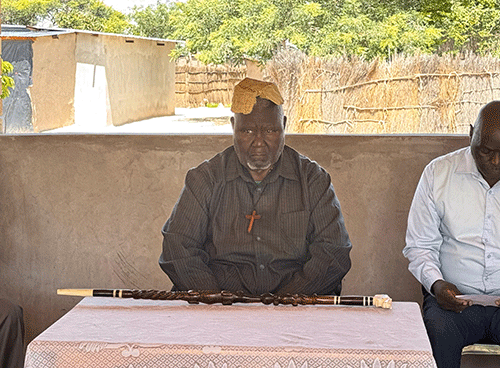

KATIMA MULILO – Newly appointed Masubia Traditional Authority Ngambela (prime minister), Raphael Mbala, says restoring financial stability and uniting a divided community will be his immediate priorities as he settles into office.
Mbala (77), a former Kabbe councillor before it was split into two, namely Kabbe North and Kabbe South, was inaugurated as the new Ngambela of the Masubia Traditional Authority in February 2026, replacing Albius Kamwi.
The process for appointing a new chief involves village headmen submitting candidates to the Bukalo Khuta (traditional council), which are then submitted to the chief.
In an interview with New Era last week, Mbala revealed that the Traditional Authority is currently facing financial challenges following nearly four years without a substantive chief.
“As it stands, the traditional authority is in a very poor financial status,” Mbala said.
He said the prolonged chieftaincy succession process not only divided the royal family and community, but also affected administration and financial oversight.
“We took almost four years before a chief was finally installed. During that time, the royal family divided itself into four groups. Each group wanted its own nominee,” he said.
According to Mbala, the absence of stable leadership created administrative gaps that now require urgent attention, including restoring transparency and strengthening governance systems.
“We are waiting for proper auditing processes so that we understand exactly where we stand. Without financial clarity, it becomes difficult to plan and serve the people effectively,” he noted.
Mammoth task
Beyond financial recovery, Mbala acknowledged that rebuilding unity within the Masubia community remains a “very mammoth task.”
“To unite them is not something that will happen overnight. You need first to sit down with the council – the traditional leaders and Indunas – and decide on how you will approach it. It is easier said than done because people are divided,” he said.
He admitted that divisions cut across both the royal family and ordinary community members.
“It is my duty to try my level best to find ways on how I can bring these people together. Even the chief himself – some do not want him. Even myself as Ngambela, some do not want me. But leadership is about building trust,” Mbala said.
He stressed that unity efforts will begin with strengthening communication structures from the Khuta down to village level.
Fighting tribalism
Mbala also emphasised the need for cohesion among traditional authorities across the Zambezi region, saying collaboration is key to fighting tribalism.
“It is not about imposing my idea on other Ngambelas. First, you must build cordial relationships. You must understand each other’s feelings,” he said.
He noted that some divisions stem from boundary disputes and historical misunderstandings.
“We do not have fixed borders that say this chief ends here and that one ends there. That is where people must start – to see the real causes of division,” he said.
Mbala praised the unity efforts of former Zambezi governor Lawrence Sampofu, who previously advocated for regional cohesion.
“To fight tribalism, we must communicate openly. Once we identify what divides us most, we can manoeuvre wisely. Unity cannot be forced. It must be cultivated,” he said.
Clarification
Gilbert Muhongo Mutwa was inaugurated as the chief of the Masubia Traditional Authority.
on 23 May, 2025, at Bukalo, he ended a four-year leadership vacuum following the death of Chief Kisco Maiba Liswani III in 2021. Mutwa is the son of the late Chief Joseph Moraliswani II. The succession involved a prolonged dispute and legal challenges before the Ministry of Urban and Rural Development approved his designation.
Addressing the root cause of the recent divisions, Mbala clarified that Masubia chieftaincy succession follows two established cultural principles.
“The first scenario is that the reigning chief appoints his successor before he dies,” he stated. He cited historical precedent under Chief Moraliswani II, who publicly declared his younger brother (the late Kisco Maiba Liswani III) as successor.
“The second scenario is when no appointment was made. Then the tribe looks at lineage and goes for the eldest and most senior,” he said.
Mbala said misunderstandings around these principles contributed to the prolonged succession dispute.
“We have books and formulas from the past. Succession must follow culture, not emotion,” he said. He emphasised that traditional structures – including the Natamoyo (chief advisor) and Indunas (headmen) – play advisory and mediation roles to ensure decisions are collective rather than unilateral.
As he assumes office, Mbala says restoring financial accountability, strengthening traditional governance, and rebuilding trust will determine the future stability of the Masubia Traditional Authority.