


In recent weeks, the tone and direction of debate within the Parliament of Namibia have shifted from the substantive to the superficial, raising profound concerns among the citizens who look to this institution for leadership.
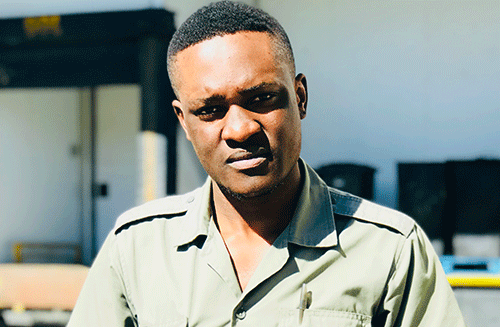
Parliament is intended to be the ultimate arena of democratic engagement, a space where our nation’s representatives confront the most pressing challenges of our time with intellectual maturity, evidence-based arguments, and actionable solutions. However, what many Namibians have witnessed instead is a troubling and regressive pattern: the deliberate and repeated targeting of Education Deputy Minister Dino Ballotti through personal attacks, rather than through constructive engagement with his ideas or policy contributions.
This brand of politics is not only counterproductive; it is archaic. It belongs to an era of division and hostility that Namibia fought a long and bloody struggle to leave behind. To see it resurfacing within the halls of our legislature is a betrayal of the progress we have made as a sovereign, unified state.
Our country faces urgent socio-economic challenges: a strained economy, high youth unemployment, and communities calling for pragmatic leadership over political theatre. In such a demanding moment, Parliament should be the engine room of national progress. Instead, we see precious time and energy squandered on character assassination and personal vendettas, while the issues that truly matter to the Namibian people remain unaddressed.
Political leaders must recalibrate and follow civil discourse: focus on policies, not personal attacks. Flawed proposals should be challenged on merit and supported by better data. When discourse turns personal, the nation suffers. This behaviour weakens institutions, distracts from governance, and sends a damaging message about leadership and democratic limits.
My reflections are rooted in a personal experience, a moment of national mourning that redefined what it means to be Namibian. I recall feeling overwhelmed with grief while joining thousands to say goodbye to our Founding Father, President Dr Sam Nujoma. As we left Independence Stadium, the atmosphere was heavy with history and sorrow.
Amid collective heartbreak, a quiet unity emerged as people from all walks of life stood shoulder to shoulder, holding the Namibian flag high and waving reverently, reflecting their deep love for the land.
I saw elders who survived the darkest years of the liberation struggle, their faces weathered, alongside young professionals representing our future. Also present were workers, students, and mothers with infants, all silently witnessing the leader’s casket passing nearby.
What struck me most was a sight many might not expect, but it was the most beautiful testament to Namibia we built. Among mourners were young white people and children, waving flags with raw emotion. Some children clung to their parents, crying as the procession passed. In their tears, there was no race or heritage dividing them; only the shared pain of losing a father.
As I looked at the casket of our Founding Father, I felt a dialogue within myself.
I said: “This is the Namibia you are leaving us with, the Namibia you fought for.”
Dr Sam Nujoma did not just bring independence; he unified us. He believed that a post-colonial state’s survival depended on National Reconciliation. He fought to ensure that Namibia of tomorrow would not mirror the segregated Namibia of yesterday. That scene I saw was a realisation of that dream: a Namibia not divided by colour, tribe, language, or background, but united by shared history, grief, and hope for the future.
The current hostile tone in Parliament is deeply unsettling. When leaders target Ballotti based on personal identity rather than his legislative record, it risks reopening old wounds and dismantling the unity many sacrificed to build.
Let us be honest about the stakes. If some politicians believe that attacking an individual based on their background or race will garner them cheap popularity or “populist points,” they are severely underestimating the wisdom of the Namibian people. Our citizens are far more discerning than they are often given credit for. They can distinguish between principled political disagreement and opportunistic scapegoating (opportunism).
Ballotti has made visible contributions to our society, from community-driven initiatives to active engagement in national development debates. One may agree or disagree with his specific views, that is the very essence of a healthy democracy, but any attempt to erase his contributions through personal dehumanisation will not succeed in swaying a public that values substance over vitriol.
The real crisis facing Namibia today is not the presence of any one individual in our legislature. The real crisis is an economy that is bleeding and in desperate need of a strategic mend. Businesses are shuttering, young graduates are searching in vain for the dignity of work, and rural communities are still waiting for basic infrastructure, clean water, and sustainable development. These are the realities that should be dominating the parliamentary agenda day and night.
Namibia needs collaborative systems created through shared effort and synergy among government, opposition, private sector, and civil society. Together, they must design solutions to strengthen the economy and citizens’ livelihoods. Recovery depends on policy innovation, strategic partnerships, and accountability, not shouting across parliamentary benches.
Namibia needs lawmakers to strengthen diversified economic growth, foster entrepreneurship and job creation, overhaul education for a modern economy, modernise public institutions for efficiency, and attract foreign investment while protecting national interests.
Namibia’s young democracy has achieved peaceful coexistence of diverse groups under one flag. This delicate balance must be nurtured and protected. Hate speech, racial insinuations, and political bullying threaten it. We must reject them as strongly as we rejected colonial oppression.
Our leaders must lead by example, showing vigorous disagreement can coexist with respect. They serve the entire nation, not just a faction.
The image of children on the road, united in love for our Founding Father, guides our national direction. It reminds us Namibia is stronger than divisions exploited for gain. That spirit of unity, shown by ordinary citizens in vulnerability, must guide our politics.
Namibia’s future depends on cooperation and shared progress, not anger or character destruction. We urge lawmakers to honor our legacy: debate passionately, challenge rigorously, but remember our humanity and unity.
That is the Namibia we must protect. That is the Namibia our Founding Father left for us. Let us eradicate hate speech and turn our collective gaze toward the solutions that will build a prosperous nation for all.
*Hosea Shishiveni is a Namibian scholar and researcher. He can be reached at hoseasn8@gmail.com