


Bravery Kabula
For many, the mortuary is a place avoided in conversation and feared in reality, but behind its doors, it is a space of routine, structure and care where trained attendants work around the clock to manage death with dignity while helping families find closure.
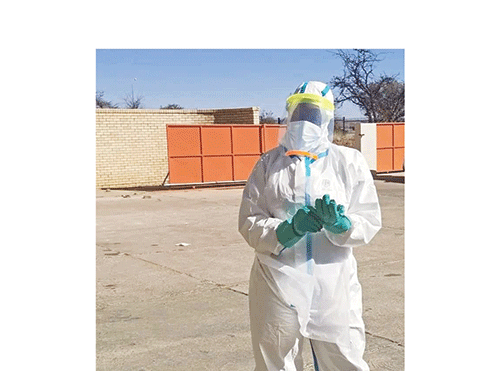
At the centre of this work is Nyanyukweni Loini Nelenge, a mortuary attendant who has spent nearly seven years in the role after joining the ministry of health in September 2019. Inspired by a relative in the forensic field, she entered the profession with curiosity that has since evolved into commitment.
“I was always inspired by the work she did and I told myself that one day I want to enter that field,” Nelenge said.
The mortuary operates on a 24-hour shift system, with teams rotating between morning, afternoon and night duty. Each shift begins with a handover and briefing to ensure continuity. Staff check records, prepare documentation and ensure essential supplies are in place before attending to incoming cases. “It is a very normal thing to me because you wake up, come to work, make sure everything is in place and continue with the day,” she said. Beyond the routine, the work is deeply human. Mortuary attendants are responsible for receiving bodies, storing them and preparing them for identification by family members. This process is handled with care to ensure that families are not confronted only with trauma, but with a recognisable image of their loved one.
“We try by all means to make the bodies identifiable and we do not only give them a picture of trauma but a picture of the person they know,” she said.
The mortuary also works closely with other institutions, particularly the police. While State mortuary teams collect bodies from public hospitals, police forensic units handle cases from outside medical facilities. The two systems often intersect, especially in cases requiring autopsies or further investigation.
Despite the technical aspects of the job, Nelenge said the role is largely built through experience rather than formal training.
“It is an on-the-job skill because you learn as you go and your experience also comes on the job,” she said. She added that personal qualities are more important than qualifications. “You need to have a strong mind and a beautiful heart because sometimes you have to put yourself in the shoes of a mother who has lost a child,” she said.
In terms of requirements, she explained that the minimum entry level includes a Grade 10 certificate with a pass, along with a valid driver’s licence, as attendants are responsible for collecting bodies from facilities. “Before anything else, you must have passed Grade 10 and you must have a licence because we are all licensed drivers here,” she said. The emotional demands of the job are significant. Staff regularly encounter grieving families and must provide support while maintaining professionalism. To cope, teams rely on both formal and informal systems, including counselling services, peer support and regular debriefing sessions.
“We do a lot of offloading sessions where we talk and if I see someone is not okay, I speak to them or refer them to someone who can help,” she said.
Health and safety are also central to daily operations. The mortuary is divided into different zones, each requiring specific protective measures. Staff wear gloves, masks and protective clothing when handling bodies, particularly as decomposition begins soon after death.
“As soon as you die, decomposition begins, so when you are working with a body, you need to protect yourself,” Nelenge said.
One of the most challenging periods in her career came during the Covid-19 pandemic, which brought an overwhelming number of cases shortly after she started working.
“Covid-19 dealt with us here because seeing so many bodies day and night was very hard at the beginning, but with time, we got used to the situation,” she said.
Outside the workplace, mortuary attendants often face stigma. Nelenge recalls initially hiding her profession due to negative reactions from others.
“When you tell people you work at the mortuary, the way they react is as if they think something is wrong with you,” she said.
However, she has since become more open about her work, noting that perceptions are slowly changing. “Working at the mortuary is not really that scary and it is just like any other job,” she said.
Despite the misconceptions, the role remains essential. Mortuary attendants serve as a crucial link between death and burial, ensuring that processes are handled efficiently and respectfully. For Nelenge, the greatest sense of purpose comes from being part of what she describes as a person’s final journey.
“My pride is being part of someone’s last journey to give them dignity and to help their family find peace,” she said.
She believes the public needs a better understanding of mortuary work, not only to reduce stigma but to recognise its importance in society. “This is a place for all of us because one day we will all end up here and it is not something to fear, as it is part of life,” she said.
In a space often associated with silence, mortuary attendants continue their work quietly, offering care, structure and humanity at the end of life’s journey.
-mathebravery@gmail.com