

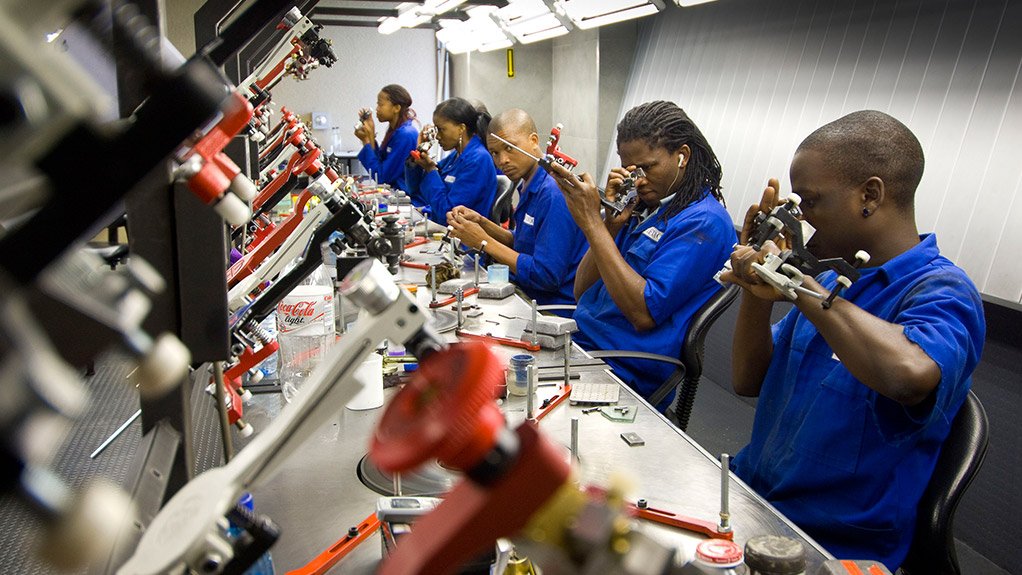

The Mineworkers Union of Namibia (MUN) recently engaged mines and energy minister Modestus Amutse, to raise concerns about ongoing sector-wide retrenchments as well as other alarming developments within the diamond cutting and polishing industry.
MUN’s acting president Poco-key Mathew Mberiuana and his executive team also told the minister that key policy and regularity issues such as the pending Diamond Bill and other legal provisions that undermine due process and worker protection, must urgently be addressed.
The union warned that recent retrenchments at Almond Diamonds and Dash Diamonds points to a growing prevalence of precarious employment conditions in the sector, which begs for urgent policy and regulatory reforms.
“We welcomed the opportunity to present our position and reiterate the importance of recognising the Mineworkers union as a strategic partner in shaping the future of Namibia’s mining and related sectors. Central to our submission is the call for institutionalised tripartite engagement, trade union-inclusive licensing frameworks, and ministerial oversight in sight-holder allocation to safeguard employment and sustain beneficiation,” said MUN’s general secretary George Ampweya.
MUN also raised concern that the continued absence of the Diamond Bill makes it very difficult for the union and other sector key stakeholders to enforce due process and worker protection when it comes to labour matters.
The Diamond Bill aims to update and replace the Diamond Act 13 of 1999. This new bill is a high-priority draft aimed at increasing local participation and modernising the regulatory framework for the diamond industry.
On his part, Amutse welcomed the union’s proposal to work closely with his ministry to address challenges facing one of the country’s biggest and highly lucrative industries.
The minister promised to urgently look into the concerns raised and said, if need be, his office will initiate site visits to the operations of various entities in the coming weeks.
The engagement placed special focus on key developments within the country’s diamond cutting and polishing sector, which the minister said is of high importance to the country.
Global player
Diamond mining has formed an extremely important part of Namibia’s economy ever since the discovery of the first gem quality diamonds near the southern ghost town of Kolmanskop in 1908.
Over the past decades, Namibia has ranked as one of the top ten diamond mining producing countries in the world with the highest value per carat by a wide margin.
According to figures by the Kimberley Process, Namibia was in 2024 the eighth largest rough diamond producing country in the world by carats and the fifth largest by value. When measured by average value, the quality of Namibia’s rough diamonds is exceptionally high compared to other countries.
Under the auspices of the Ministry of Industrialisation, Mines and Energy, the Diamond Board of Namibia is classified as a non-commercial State-Owned Enterprise with its own board of directors.
The Diamond Board exists to implement and regulate policies towards the diamond industry including the diamond mining and diamond cutting and polishing industries.
-ohembapu@nepc.com.na