


KATIMA MULILO – The education ministry announced urgent plans to relocate hundreds of learners affected by severe flooding in Zambezi.
The move follows last week’s high-level assessment by President Netumbo Nandi-Ndaitwah and other senior government officials in the Kabbe North and Kabbe South constituencies.
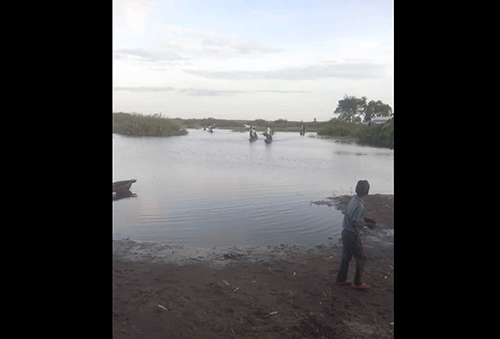
Since last week, the Zambezi region has been experiencing significant flooding, with levels at Katima Mulilo surging past 6.9 metres, drastically higher than the 2025 level of 4.41m for the same period. Additionally, the Zambezi River is overflowing into the eastern floodplains, submerging villages, disrupting schools, and forcing residents in areas like Kabbe North and South to use dugout canoes daily.
The crisis is more dire for learners in these flood-affected areas of Kabbe South and Kabbe North who risk their lives daily in pursuit of education as they navigate dangerous waters filled with snakes, crocodiles and hippos. Speaking after the visit, education minister, Sanet Steenkamp yesterday said the intervention forms part of a coordinated whole-of-government response to the disaster, which has disrupted schooling and displaced both learners and teachers.
“We came to make an assessment with a team, building on the preliminary report already compiled when the Head of State and the Office of the Prime Minister visited,” the minister said.
The ministry has identified two schools – Muzii Combined School and Mpakano Primary School – for immediate relocation to higher ground at Lusese. Together, the two schools account for 339 learners and 20 teachers.
However, the relocation effort is facing serious infrastructure challenges. “The reality on the ground is that Lusese urgently needs fencing, improved sanitation facilities, and adequate food supply for learners,” the minister explained.
Beyond these two schools, the broader crisis affects at least 519 learners who will need to be relocated as floodwaters continue to rise. In the meantime, seven schools have been turned into temporary camps where learners remain under the supervision of parents, creating additional pressure on food distribution and basic services.
The minister highlighted the dire situation observed during school visits, particularly at Nankuntwe Combined School, where floodwaters have submerged teachers’ homes.
Learners and staff from Nankuntwe will be moved to Schuckmannsburg, where existing facilities are being assessed for refurbishment and expansion.
Authorities are also working to support displaced teachers, many of whom have expressed a preference to remain close to their learners despite the difficult conditions.
Additional interventions include food aid, toiletries, mosquito nets, blankets, and water purification supplies.
However, transport remains a major challenge, particularly for schools cut off by floodwaters.
“One of the major requests is the provision of boats for the seven schools currently camping. We have instructed that quotations be sourced so we can address this urgently,” the minister said.
The ministry is also reviewing its emergency response framework to establish clearer standard operating procedures for future disasters, including guidelines on relocation and minimum requirements for affected schools.