


“The ANNA project is not merely a transmission line. It is a strategic instrument that will connect our economies, strengthen our institutions and improve the lives of our people.”
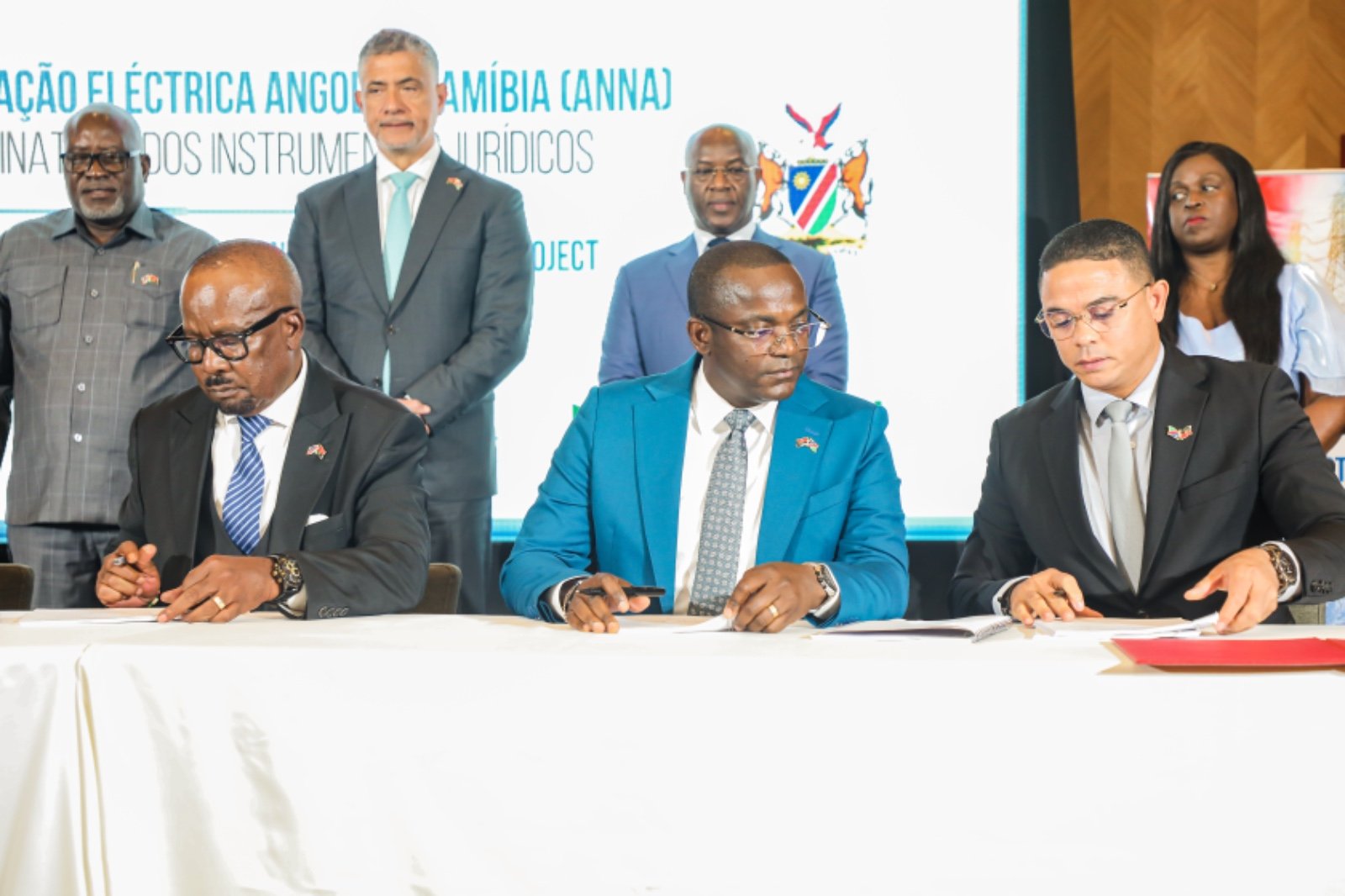
This sentiment was expressed by Minister of Industries, Mines and Energy Modestus Amutse, marking a significant milestone in regional energy collaboration as Namibia and Angola officially formalised agreements this week.
These agreements focus on jointly developing a cross-border power interconnector, promising to reshape the electricity supply landscape in southern Africa.
Speaking at the signing ceremony in Luanda on Tuesday, Amutse highlighted the urgency and strategic importance of an Angola-Namibia Power Interconnection Project (ANNA).
He described it as a cornerstone of Namibia’s long-term energy security ambitions.
“As a country with growing energy demand, securing a reliable, affordable and sustainable electricity supply remains a national priority,” he said.
“The ANNA project will play a key role in diversifying our energy mix, reducing supply risks and supporting long-term economic development,” he added.
The agreements, signed by Namibia’s national power utility, NamPower and Angola’s transmission operator Rede Nacional de Transporte de Electricidade, include a joint development agreement (JDA) and a power purchase agreement (PPA).
Together, they establish the technical, institutional and commercial framework required to bring the ambitious project to life.
Amutse highlighted that the milestone cooperation follows high-level engagements between the neighbouring countries earlier this year, including a presidential mandate from President Netumbo Nandi-Ndaitwah to fast-track negotiations.
“I am pleased to witness today that the commitments and timelines we agreed upon are already being realised,” said Amutse, pointing to the rapid progression from diplomatic discussions to binding agreements.
Network reinforcement
At its core, the ANNA project will see the construction of a 166-kilometre, 400 kV transmission line linking the Kunene region to Cahama in Angola.
It is supported by additional infrastructure, including substations, transformation capacity and a static VAR compensator, a device used in power systems to control voltage and improve electricity flow on transmission lines.
A further 270-kilometre transmission line between Omatando and Otjikoto is planned to reinforce the network, creating a vital transmission corridor between the two countries.
Beyond infrastructure, the project carries significant regional implications.
By connecting Angola to the Southern African Power Pool (SAPP), the interconnector is expected to unlock cross-border electricity trade and improve grid stability across southern Africa.
“By linking Angola to the Southern African Power Pool, the project enhances regional connectivity and unlocks the full potential of cross-border electricity trade,” Amutse said.
“At the same time, it creates an opportunity for Angola to further leverage its significant generation capacity, particularly from renewable and hydro resources, for the benefit of the region,” he added.
NamPower managing director Kahenge Haulofu described the partnership as a practical response to rising energy demand and supply constraints in the Southern African Development Community (SADC).
The project, estimated at N$941 million (US$52.3 million) for the interconnector component, is expected to be completed by 2029.
However, broader infrastructure and associated network investments, particularly on the Namibian side, are expected to significantly increase the overall capital outlay.
Meanwhile, Amutse noted that Namibia’s Cabinet has already approved substantial funding support for the initiative.
“On 10 February 2026, the Cabinet of the Republic of Namibia approved the funding of NamPower’s capital contribution to the ANNA project,” he said.
“This funding, amounting to approximately N$4 billion, is aimed at supporting the Engineering, Procurement and Construction scope from Cahama in Angola to Kunene in Namibia, including the associated network infrastructure within Namibian borders,” he added.
This funding will be mobilised through the National Energy Fund, aligning with government efforts to invest in infrastructure that enhances energy access and affordability.
Despite the celebratory tone, Amutse issued a clear warning that the real work lies ahead.
“Signing these agreements is merely the beginning,” he stressed.
“Our focus must now move to implementation… I encourage all parties to maintain momentum, ensure effective coordination, and strictly follow the agreed timelines to successfully deliver this project,” he added.
He emphasised that projects of this scale are critical to achieving broader regional goals. “Regional cooperation in energy is not optional. It is essential to addressing our shared challenges of energy security, economic development and climate resilience,” he said.
Strategic roadmap
The ANNA project is also aligned with Namibia’s Integrated Resource Plan and forms part of NamPower’s 2026-2030 strategic roadmap, which prioritises energy diversification and regional integration.
For Namibia, which remains a net importer of electricity, and is vulnerable to external supply shocks, the interconnector represents a strategic shift toward greater resilience. Angola offers a pathway to monetise surplus generation capacity and strengthen its role within the regional energy market.
As both countries move toward the next phase, expected to include a formal groundbreaking by the respective heads of state, the success of the ANNA project hinges on sustained political will, efficient execution and continued collaboration.
“It is my sincere hope that this partnership continues to demonstrate what can be achieved through unity of purpose and a shared vision,” Amutse added.
“We look forward to the successful implementation of the ANNA project and to witnessing its positive impact on our economies, our industries, and, most importantly, our people,” he remarked.
If delivered on schedule, the ANNA interconnector could mark a turning point not only for Namibia’s energy security, but for the broader southern African region’s quest for a more integrated, reliable and sustainable power system.
-ebeandt@nepc.com.na