

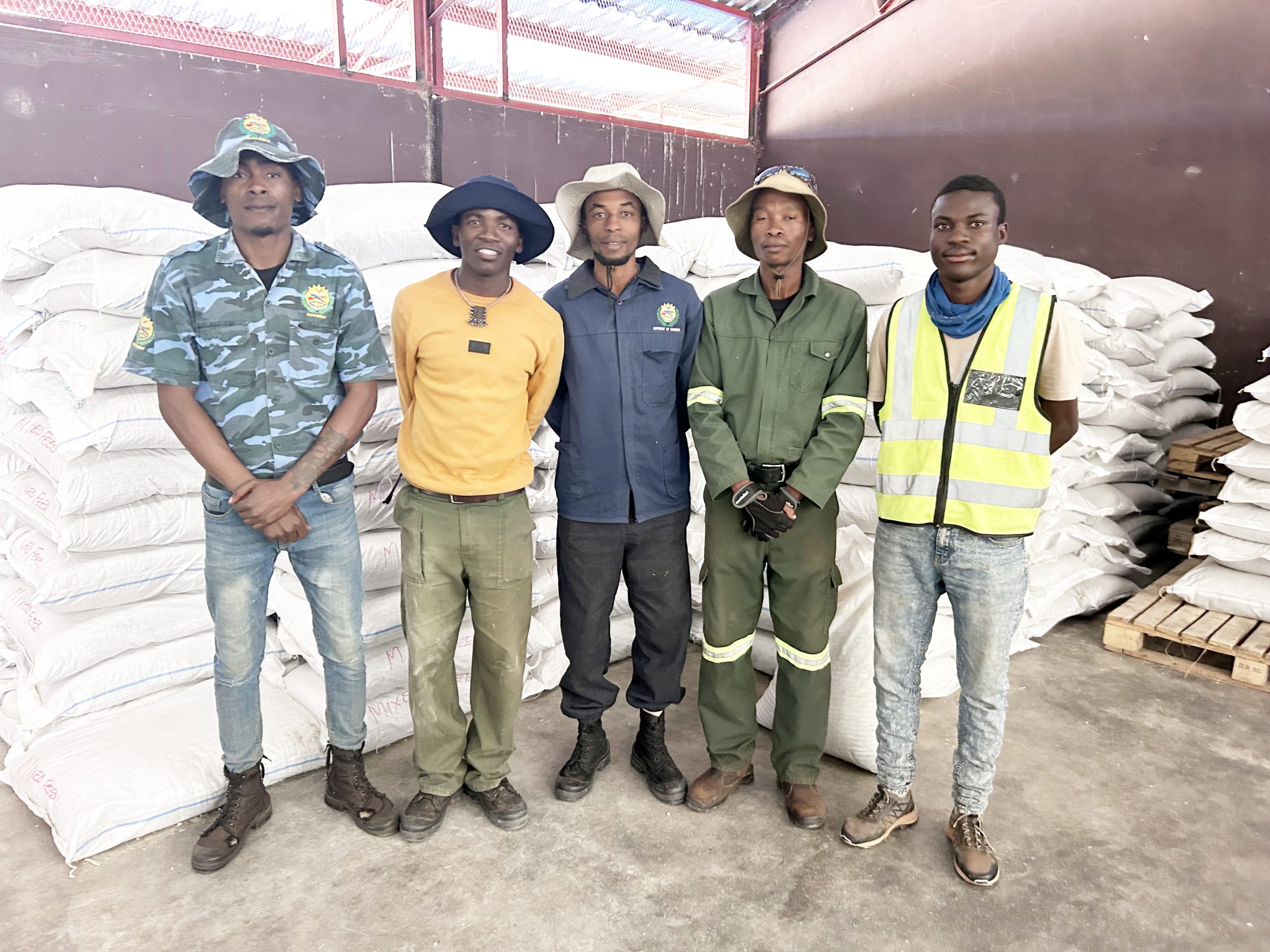
RIETFONTEIN – Namibia’s National Youth Service is facing mounting pressure to secure operational support as rising agricultural input costs, agricultural infrastructure shortages and limited storage capacity threaten its ability to maximise its agricultural production and sustain one of the country’s most important youth training pipelines.
The NYS, established under the National Youth Service Act 6 of 2005 to provide skills development, national service and employment pathways for young Namibians, has continued its impressive intake for 2026. This year alone, the institution enrolled 486 recruits into its Technical, Vocational Education and Training (TVET) programme, while another 400 recruits were accepted into the Voluntary Service Programme, where they are deployed to national priority projects.
But while demand for the programme continues to grow, the institution’s operational burden is escalating just as rapidly.
Speaking during an exclusive interview with New Era at the NYS Rietfontein Training Centre in the Otjozondjupa region, Lt Ndatega-Mekondjo Iithete, Executive: Head of the Centre, said the centre remains fully functional and continues to provide accommodation, meals and training for recruits at no cost.
However, she warned that sustaining these services is becoming increasingly difficult.
“We are facing an operational shortfall due to the rising costs and limited capacity of our feeding scheme,” said Iithete.
The Rietfontein centre has increasingly positioned itself as a self-sustainability hub, using agriculture both as a revenue stream and as a practical training platform for recruits. Yet surging global commodity prices, combined with geopolitical instability, are now placing severe strain on production costs.
“Inputs such as diesel, fertilizer and seeds are becoming more expensive and due to global geopolitical instability, the prices are increasing at an astronomical rate,” Iithete explained.
The centre’s agricultural ambitions are extensive. Currently, NYS farms 100 hectares of maize at Rietfontein, another 100 hectares at Berg Aukas and 100 hectares of pearl millet (Mahangu) at Omauni in the Ohangwena region. At Rietfontein, Horticulture production is supported through centre pivot irrigation systems covering 20 hectares, 10 hectares and four hectares of gardens respectively.
The institution also operates a lucerne production project funded through the Namibia Training Authority (NTA), which has emerged as one of its strongest agricultural performers amid soaring market demand.
“We need some support to expand our irrigation system,” said Iithete, appealing to both private and public sector partners to assist with scaling lucerne production capacity.
Yet operational bottlenecks continue to undermine output.
According to Iithete, the centre lacks adequate harvesting equipment, making harvesting labour intensive, slower and more expensive. Storage facilities shortages are adding further complications.
“This lack of storage capacity severely limits us to harvest what we can safely store and minimise losses on perishable produce,” she said.
The facility is also in urgent need of a bigger cooler truck to transport produce and agricultural products efficiently. In the interim, the NYS occasionally source for assistance from Namibia Defence Force when the transport demand rise.
Despite these challenges, the NYS remains one of Namibia’s most significant youth development institutions. It offers a unique training programme packaged into three phase of training namely ; National Service Training, Voluntary Service programme and Skills Training programme with focus on Technical Vocational Education and Training ( TVET ) occupations.It currently offers 12 accredited programmes endorsed by both the Namibia Qualifications Authority (NQA) and registered with the NTA, covering fields ranging from technical trades to non- technical trades such as Hospitality and Clothing Production.
The National Service training programmes are also closely linked to the country’s national security cluster, with the Namibian Police and the Namibia Defence Force and Correctional Service relying on the NYS for skilled recruits who meet strict operational standards.
In December last year alone, the NYS graduated more than 1 000 recruits.
However, the financial realities facing the institution are now influencing operational decisions. Iithete revealed that the latest cohort of recruits will be deployed on voluntary service programme for three months only, significantly shorter than the traditional six-to-12-month deployment cycle.
She said the accelerated deployment timeline was necessitated largely by resource constraints, as the NYS continues to fully absorb the costs of accommodation, food, training and recruit upkeep allowances.
“The idea is for the NYS to become self-sustainable in terms of food production and provision of training materials for students,” said Iithete. “We are making some notable progress in terms of self-sustainability.”
Meanwhile, support from development partners has played a critical role in sustaining that progress.
The Social Security Commission previously assisted with infrastructure for the NYS poultry enterprise, which now supplies eggs to large parts of the country.
Also, through the United Nations Development Programme’s Namibia Integrated Landscape Approach for Enhancing Livelihoods and Environmental Governance (NILALEG) programme, the NYS received tractors, trucks, equipment and renovations to key infrastructure at the centre.
The NILALEG programme is a US$10 million initiative funded by the Global Environment Facility and implemented alongside the Namibian government to combat environmental degradation while improving rural livelihoods.
“These agricultural activities are used as practical training for NYS recruits,” explained Zebaldt Katjiteo, the NYS manager for livestock and wildlife.
For the NYS leadership, however, the long-term objective extends beyond agricultural expansion.
“The plan is for us to be able to feed all our students,” said Katjiteo.
As youth unemployment remains one of Namibia’s most pressing socio-economic challenges, the growing pressure on the NYS highlights the broader question of whether the institution will receive the financial, infrastructural and private sector backing necessary to fulfil its national mandate.