

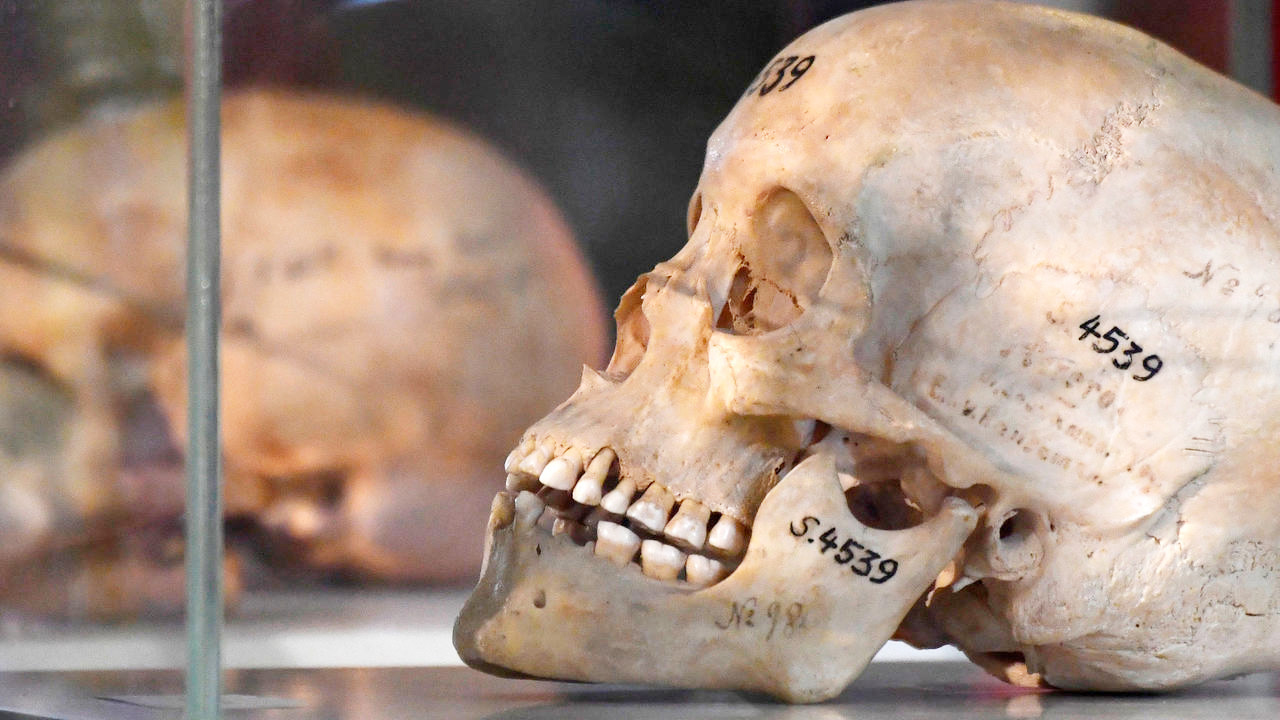

The University of Strasbourg in France is widely regarded as one of the most prestigious, biggest and oldest public research universities in Europe.
However, behind the university’s rich history lies a dark, horrifying and haunting story that can be traced back to Namibia.
In 2023, the French University of Strasbourg kickstarted the process of identifying and verifying the origins of its various collections of human skulls, bones and other 19th and 20th century artefacts.
The primary aim of this exercise is to return artefacts whose origin can be traced back to Namibia, which followed the university’s admission and acceptance to return the human remains to Namibia after years of sustained pressure from the Ovaherero Genocide Foundation (OGF).
Established in 1538 in the northeastern town of Strasbourg, the university remains a great part of the history of the Franco-German War of the 1800s, which saw the rise and fall of German emperor Kaiser Wilhelm II.
In 1872, Germany established a German university in Strasbourg during the same period that coincided with imperial Germany’s occupation of territories from 1884 in what is now known as Namibia – and from 1885 in what is now Tanzania.
The Kaiser-Wilhelm-Universität incorporated human remains from these two colonies into the University of Strasbourg’s anatomical collections.
The OGF has for years demanded and called on all European museums and universities to return human skulls, bones and other objects that were taken from Namibia during the colonial era.
The university later agreed to set up a Scientific Council to catalogue the collections of African human remains, provide scientific information to respond to requests, and review the relevant legal considerations.
The Scientific Council submitted its report on 12 June 2024, and the university is in dialogue with Namibia and Tanzania regarding the handling of the human remains.
In 2020, the Moshi District Council of Tanzania followed in the footsteps of the OGF, and asked the University of Strasbourg for a precise inventory of human remains from the Wachagga populations of the Kilimanjaro region in Tanzania to support a planned restitution request.
Equally, the OGF requested a precise inventory of human remains from the Herero and Nama people, who were victims of the 1904-08 genocide.
The Wachagga people of Tanzania were killed during the same era of German rule after resisting colonial oppression.
Pseudoscience psychosis
At the time, the Germans collected skulls and bones to support a pseudoscientific theory that supposedly prove the supremacy of the Caucasian or white race over African or black people.
This narrative was based on the idea that skull shape and size were indicators of ethnic origins and mental abilities.
Mathieu Schneider, the vice president of the University of Strasbourg and chair of the Scientific Council, shared with Radio France Internationale (RFI) that holding on to objects and human remains obtained during colonisation has proven to be a problem, especially in ensuring peaceful dialogue between Europe and Africa.
“Approximately 30 of them come from Tanzania, especially from the Wachagga tribes, and we may have two or even more skulls from the Ovaherero. The process of gathering more information on the remains will be a lengthy one. We need to have detailed information on each human remains. We have an existing catalogue, telling us that such skulls come from either Namibia or Tanzania. But we must verify everything,” Schneider stated.
The University of Strasbourg has over 110 human artefacts, skulls and bones in its collection that were obtained during Germany’s colonisation of Africa in the late 19th and early 20th centuries.
Schneider fully believes and agrees that Strasbourg University needs to confront the most difficult parts of its history.
“In the last five years, we have undertaken important work to find out what exactly happened within the walls of the university when the Nazis were there during the Third Reich in the 1940s.
We also need to confront our colonial past, especially the 19th century when the Germans colonised parts of Africa. We have traces of that period in our collections, so if we want to write a truthful history of our university, we need not only to face the period of the Third Reich but also the period before that,” he added.
– ohembapu@nepc.com.na