


Namibia’s current account deficit widened to N$10.4 billion (14.5% of GDP) during the final quarter of 2025, according to the Economic Association of Namibia’s (EAN) Q1 2026 Quarterly Review.
The EAN noted that increased service payments and income outflows drove the deficit, overshadowing strong revenues from gold and uranium exports.
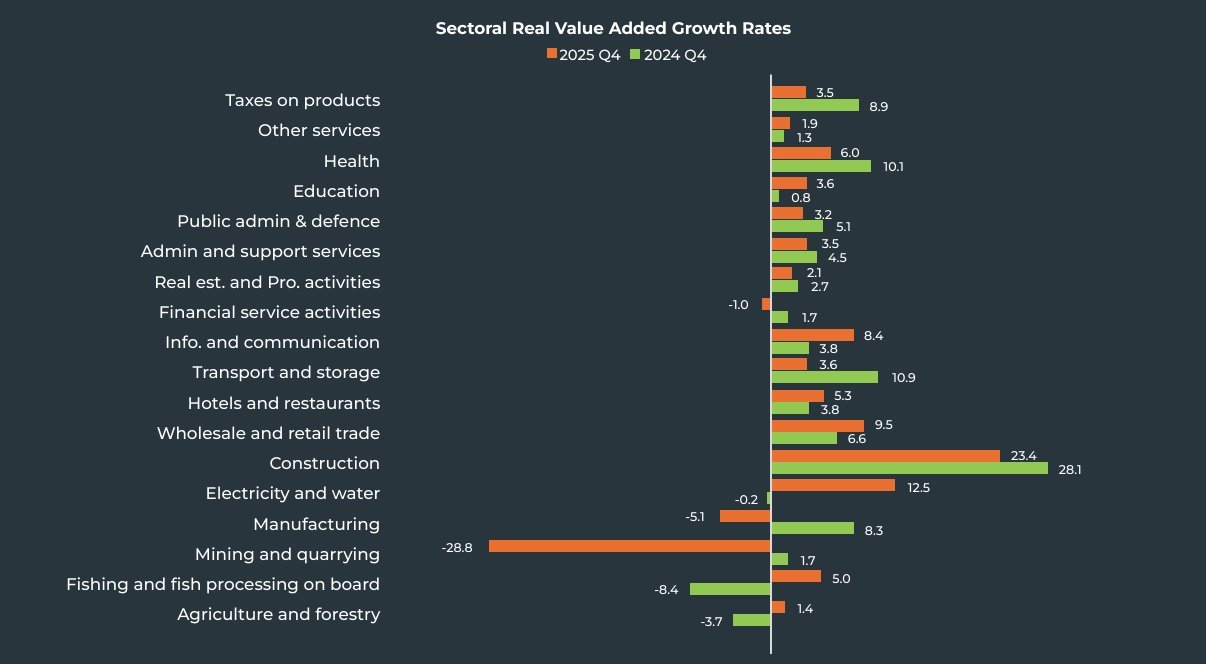
Concurrently, the domestic economy shrank by 0.5% in Q4 2025 as slumps in mining and manufacturing erased gains in construction, agriculture, and fishing. This downturn follows growth rates of 2.6% in Q3 2025 and 3.8% in Q4 2024.
According to the EAN report, mining activity declined by 28.8% during the quarter, while manufacturing output fell by 5.1%.
“The economy continues to demonstrate resilience, but with increasing exposure to volatility and limited diversification,” the report states.
Mining, one of Namibia’s largest economic sectors, recorded a sharp decline despite strong uranium exports. Manufacturing also came under pressure as production slowed in several industries.
Construction was among the strongest-performing sectors, growing by 23.4% due to continued investment in infrastructure projects. Agriculture recorded growth of 1.4%, while the fishing sector expanded by 5%.
The report notes that the domestic economy remains heavily dependent on a few key sectors. Mining contributes 14.1% to gross domestic product (GDP), followed by wholesale and retail trade at 12.4% and manufacturing at 9.9%.
Inflation remained relatively low at 3.4%, helped by slower food price increases. However, housing and transport costs continued to rise.
Moreover, the Bank of Namibia reduced the repo rate to 6.5% at the end of the first quarter, bringing the prime lending rate down to 10%. Despite lower borrowing costs, private sector credit growth slowed to 4.4% as demand for loans from businesses and households weakened.
Also, the government continued several economic reforms during the quarter, including tabling the N$81.3 billion operational budget for the 2026/27 financial year, efforts to strengthen tax collection, and progress on the Investment Promotion Bill.
The review also highlights initiatives such as Universal Health Coverage, procurement reforms to support local manufacturers, and the Bank of Namibia’s decision to diversify its foreign reserves through gold purchases.
In addition, investment in digital infrastructure and renewable energy projects continued to gain momentum. These include broadband expansion, the rollout of 4G and 5G networks, instant payment systems and green hydrogen developments.
However, the report noted several challenges continue to weigh on economic growth.
“Rising housing costs, elevated unemployment, drought-related losses and persistent skills mismatches remain key constraints on economic development and labour market absorption,” it states.
The EAN stated that Namibia needs to broaden its economic base and strengthen sectors outside mining to reduce its vulnerability to commodity price fluctuations.
The association further recommends investing mining revenues in infrastructure, education and healthcare, while improving access to finance for small and medium-sized enterprises to support investment and job creation.
-pmukokobi@nepc.com.na