


Lahja Nashuuta
As Namibia marks five years this Thursday since the German government publicly announced the conclusion of a joint declaration with the Namibian government on the OvaOvaherero-Nama genocide, some descendants of genocide victims maintain that the reported agreement cannot bring closure to the long-standing debate because it excluded the genuine participation of the affected communities.
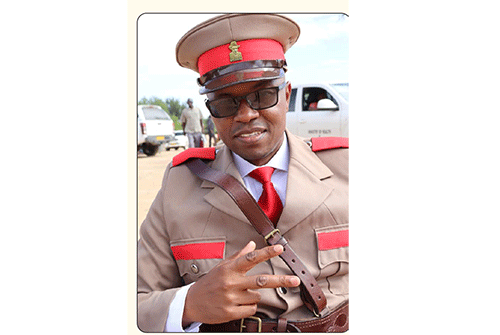
One of the descendants of genocide victims, Yarukeekuro Ndorokaze, told New Era that the process would remain incomplete unless representatives chosen by the OvaOvaherero and Nama communities are formally invited to participate in the discussions.
“To avoid any confusion or deliberate attempts to distort the genocide debate with broader atrocities committed by Germany in Namibia, the basis of the genocide claim remains the extermination orders issued in 1904 and 1905 against the OvaOvaherero and Nama people, respectively,” he said.
Ndorokaze stressed that references to “affected communities” within the genocide context specifically refer to the OvaOvaherero and Nama communities.
“If the reported joint declaration is truly intended to bring closure to this matter, then one major step is still required: an open, genuine and inclusive invitation must be extended to representatives selected and appointed by the OvaOvaherero and Nama people themselves,” he said.
According to him, no process of reconciliation or settlement can be regarded as legitimate without the direct and free participation of the affected communities.
“It is my view that any process can only be concluded through the open and meaningful participation of the affected communities, namely the OvaOvaherero and Nama people. Without that, I do not see any real closure in sight,” Ndorokaze added.
He argued that some leaders and commentators have reduced the genocide discussion to a debate purely centred on financial compensation.
“The process cannot be completed without the affected communities having the opportunity to tell their own lived experiences both historical and present-day, and to articulate how those injustices can be addressed. That responsibility cannot be outsourced to third parties,” he said.
Ndorokaze warned that excluding the affected communities would only prolong the impasse. “Let the OvaOvaherero and Nama choose their own representatives and conclude the deal. Otherwise, another five years will pass, and the joint declaration will remain half-baked,” he stated.
He added that the issue of reparations should not be narrowly reduced to development aid or monetary value alone but should first acknowledge the scale of suffering and historical impact experienced by the affected communities.
Key demands
Speaking on the key demands of the affected communities, Ndorokaze said these are anchored in a three-pronged framework: recognition, apology and reparations.
“Firstly, there must be formal recognition that what occurred was intentional, targeted and systematic intentional. While there is growing agreement on this, we demand that it be acknowledged unequivocally, unconditionally and without reservation,” he said.
Secondly, he said a sincere apology must follow.
“Not symbolic gestures, but a clear and public acknowledgment of wrongdoing offered without preconditions. That is where true reconciliation begins,” Ndorokaze stressed.
Thirdly, he said the affected communities continue to demand reparations.
“No one is asking for the impossible. We understand that the dead cannot be brought back. But there are ways to repair what was broken. Land reform, economic restoration, cultural revival and institutional support are among the areas where reparative justice can be meaningfully implemented,” he said.
This year, the commemoration is being observed countrywide, with various ministers and key national leaders expected to address gatherings in different regions.
The Genocide Remembrance Day honours the tens of thousands of the OvaOvaherero and Nama people killed by German colonial forces in the early 1900s, in what is widely regarded as the first genocide of the 20th century.
Although Germany has acknowledged the genocide committed against the OvaOvaherero and Nama communities between 1904 and 1908, the issue of reparations remains unresolved.
Last year, while addressing the commemoration event, President Netumbo Nandi-Ndaitwah once again called for reparations for the at least
70 000 indigenous people who were killed by German troops during that period. – lnashuuta@nepc.com.na