


For many young Namibians, boredom has become something to fear. The moment silence appears, phones emerge. Taxi rides become scrolling sessions. Study breaks become TikTok marathons.
Even brief pauses in conversations are quickly filled with Instagram notifications and online distractions.
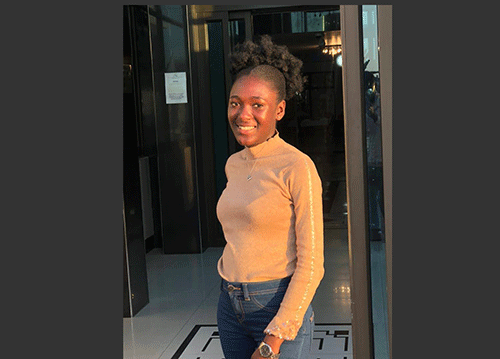
Young Namibian writer and student Hileni Ndinaomukumo Amukugo said this constant need for stimulation reflects a deeper crisis affecting today’s youth, the pressure to continuously perform, impress and prove success online.
Amukugo, who hails from the Ohangwena region and is currently studying transport and logistics at the International University of Management, believes many young people are exhausted from chasing unrealistic standards created by social media culture.
“I realised we are terrified of boredom because we’ve been taught that stillness equals wasting time,” she said.
“As a student and working youth in Namibia, I feel the constant pressure to be exceptional and to prove my life online,” she added.
Her reflections come at a time when many Namibian youths are navigating unemployment, financial hardship and uncertainty about the future, while simultaneously facing growing pressure from digital platforms that often portray curated, unrealistic lifestyles.
Amukugo argued that social media has distorted the meaning of success by linking excellence to visibility and popularity, rather than purpose and personal growth.
“The result is anxiety, depression and burnout. We sacrifice sleep and relationships only to find the goalposts keep moving,” she said.
However, she believes boredom itself may hold part of the solution.
Drawing on research by Dr Sandi Mann at the University of Central Lancashire, Amukugo cites studies showing that boredom can enhance creativity and problem-solving abilities.
The study found that participants who completed monotonous tasks later performed better in creative exercises because boredom activates the brain’s “default mode network”, responsible for reflection, imagination and making new connections.
For Amukugo, this research mirrors her own experiences.
“When I put my phone away for 20 minutes, I start writing, planning or asking deeper questions,” she explained.
“We rob ourselves of that space when we fill every gap with digital noise,” she said.
She believes many young people have lost the ability to simply sit with their thoughts, cautioning that constant digital stimulation is eroding authenticity and emotional well-being.
Instead of pursuing meaningful growth, she said, many youths now feel pressured to build online personas designed to impress strangers.
But Amukugo insists true excellence has never depended on public validation.
Referencing historical figures such as Nicolaus Copernicus and Vincent van Gogh, she noted that many influential individuals were not celebrated during their lifetimes, yet their passion and dedication allowed their work to outlive them.
“Success should mean growth over fame, service over status and integrity over impressions,” she said. She stressed that ordinary work done with care and consistency remains the backbone of Namibia’s development.
“Namibia is built by ordinary people doing excellent work, the teachers in Eenhana, the nurses in Katutura, the truck drivers moving goods from Walvis Bay…,” she added. “If we teach youth that brilliance means care, consistency and courage in ordinary life, we will raise a generation that is mentally healthy and ready to build the country,” she said.
Amukugo also encouraged young people to adopt healthier habits to reduce social media pressure, including scheduling time away from phones, curating social media feeds, and focusing on personal growth rather than seeking online approval.
“Balance starts when we decide our peace is worth more than our profile,” she said.