

Rudolf Gaiseb
The recently tabled national budget is highly responsive to social protection and poverty reduction, allocating over 60% of the total budget to social sectors.
This is the opinion from Twilight Capital Consulting Economist, Mally Likukela.
The analyst this week shared his opinion that the budget is broadly regarded as a “pro-poor” tool but faces pressure from tight fiscal conditions and high debt servicing costs.
On Tuesday, the Friedrich-Ebert-Stiftung Namibia hosted a panel discussion on budget analysis alongside the Budget and Finance Parliamentary Standing Committee and other stakeholders to assess the extent to which the 2026/27 national budget addresses social inequalities in Namibia.
Likukela highlighted that, having evolved and expanded since the early 2000s, social protection schemes have contributed to economic emancipation. Social spending has reduced poverty, contributing to a decrease in the Gini coefficient (inequality) from 0.63 in 2003/04 to 0.56 in 2015/16.
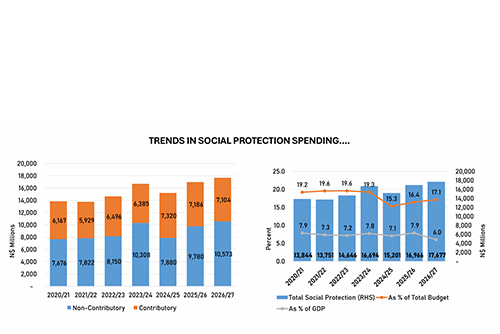
Furthermore, public spending on social protection has increased significantly between 2021 and 2025.
Over that period, total social protection spending averaged 7.1% of the Gross Domestic Product. On average, more than 50% of all social protection spending goes toward social safety nets. At this point, for instance, in-kind transfers in health and education account for about 78.2% of poverty alleviation, the economist noted.
“The budget prioritises non-contributory social protection (old-age pensions and child grants) and recognises high levels of food insecurity, while it made significant provisions (approx. N$700 million) for drought relief to mitigate poverty in vulnerable rural communities,” said Likukela.
The current budget includes N$1.5 billion in funding for veteran affairs.
But despite this positive outlook, Likukela highlighted social protection spending in Namibia is largely skewed towards the elderly. This raised concerns about its overall contribution to early childhood development, and he suggested that efforts be directed towards investing in youth.
In the 2026/27 budget, about 40% (N$3.6 billion) of non-contributory social protection spending is allocated to old age grants.
“When combined with the veterans’ benefits (10.9%) plus all in kind benefits for war veterans, which directly benefit the elderly, total spending for the two accounts for more than 50%, compared to less than 18.0% for the Child Grants,” he added. Other drawbacks outlined include high unemployment and a low tax base, creating pressure on the long-term sustainability of these social programmes.
The economist recommended that despite high spending, the impact on reducing inequality is considered modest by some, pointing to a need for better targeting and improved efficiency in service delivery.
“There is a need for better linkages between cash transfers and other services like nutrition, Early Childhood Development (ECD), and sanitation to address multidimensional poverty,” he said.
Meanwhile, chairperson of the Parliamentary Budget and Finance Committee, Hilaria Mukapuli, during her speech said, “As the second most unequal country in the world, Namibia’s wealth and resources remain concentrated in the hands of a few, and the 2026/27 national budget must be a tool to confront this disparity head-on.”
“It must answer a fundamental question: does it actively work to dismantle the structures of inequality, or does it merely manage them?” she said.
Mukapuli added that the examination of the budget must track the resources allocated to mitigate local issues.
As a body that ensures that the funds appropriated by Parliament are used legally, effectively, and for the purposes intended, she added that for this scrutiny to be effective, it must be informed by the lived experiences of our people and the expert analysis of stakeholders.
Meanwhile, Labour Resource and Research Institute executive director Benediktus Ikefelwa, analysing the budget with a perspective on the labour issues from a gender lens, said that
that female unemployment remains significantly higher than male unemployment in Namibia.
Women comprise 53% of informal workers, and the informal economy contributes 26.5% of GDP (Bank of Namibia, 2025).
“34.1% of workers earn below N$2,000 per month, with women more likely to fall in the lowest income brackets (NSA, 2023),” he said.
He added that persistent horizontal and vertical occupational segregation limits women’s mobility into higher-paying sectors and leadership roles.
He underlined that the budget focuses on growth driven by oil and gas, green hydrogen, and infrastructure expansion.
And professional, scientific and technical activities employ only 2.9% of the workforce, while mining employs 2.6% (NSA Census 2023).
“These sectors are historically male-dominated and skill-intensive. The budget provides no funded pathway for women’s entry into these high-growth industries. The risk involved is that growth may expand GDP without expanding gender inclusion.”
Resident Director Hajo Lanz highlighted that the budget is the most powerful tool available to the government in reducing these social inequalities.
He noted that social democracy goes beyond economic growth; it must be inclusive, provide opportunities, reduce disparities, and promote social cohesion.