


Heather Erdmann
Namibia’s inclusive education framework continues to show a gap between policy and implementation, with stakeholders warning that limited data, uneven access, and persistent barriers are shaping the lived reality of children with disabilities.
Children with disabilities are still facing uneven access to education and support in Namibia, as policy commitments, lived realities in classrooms, and community-based survival systems continue to diverge across the country.
This emerged from a high-level dialogue in Windhoek at the UN House, where stakeholders said the country must move from policy recognition to practical inclusion in schools, communities, and public systems. The 2023 National Population and Housing Census estimates that about 4.4% of Namibia’s population lives with some form of functional disability, with higher prevalence among women and in rural areas.
Deputy executive officer in the Office of the Vice President, Nicolaas Davids, speaking on behalf of Vice-President Lucia Witbooi, said inclusion must be treated as a societal responsibility beyond policy frameworks.
“Inclusion must be understood as a societal responsibility that goes beyond policy frameworks,” Davids said, adding that exclusion of children with disabilities “limits both individual potential and national development”.
Ambassador of Finland to Namibia, Katja Kalamäki said Namibia has made progress in advancing inclusive education through national frameworks, including the National Policy on Inclusive Education. She said, “Inclusive education is not seen as a separate project but as a guiding principle across the entire system” and warned that “continued efforts are needed to close implementation gaps between policy and practice.”
Additionally, minister of Gender Equality and Child Welfare Emma Kantema said children with disabilities must be seen through dignity and equal opportunity, not pity. “Children with disabilities do not need pity. They need access. They need support. They need protection. They need quality education,” she said.
She added that inclusion must move from policy to practice, where children are “not merely admitted, but welcomed; not merely present, but fully included”
Kantema also pointed to legal and social protection frameworks, including the Children’s Act and disability grants, as important foundations, but said these are not sufficient on their own.
Early intervention specialist Huipie van Wyk of Side by Side Early Intervention Centre said inclusion must begin at birth through individualised planning.
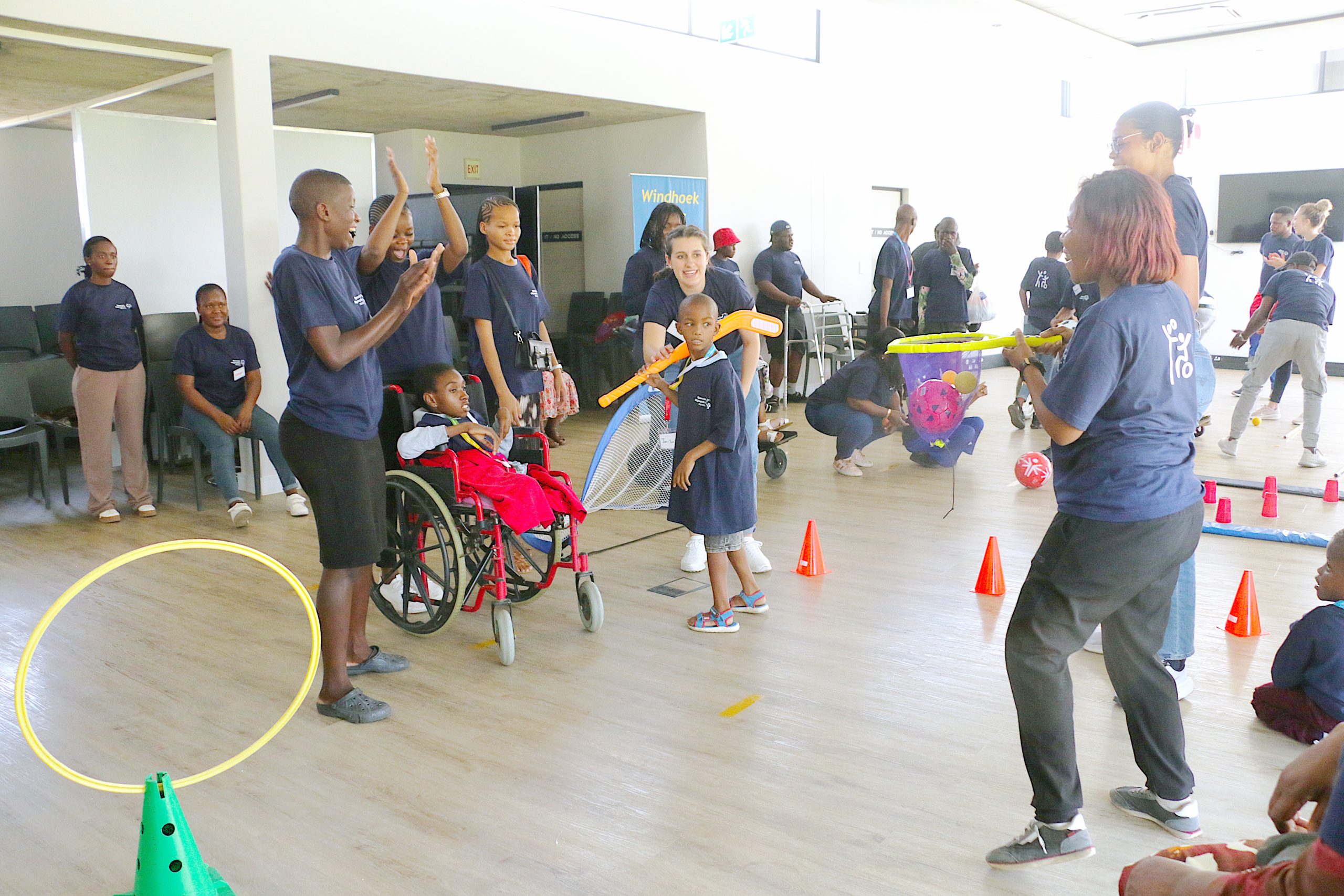
She asked whether schools are truly prepared for diverse learners, questioning: “Are our schools ready for the impact of inclusion?” Additionally, disability advocate Levien Smit, CEO of Special Olympics Namibia and mother to a child with an intellectual disability (Down syndrome), said disability is often misunderstood as a single category.
“Disability is not a one-size-fits-all disability,” she said, adding that intellectual and developmental disabilities are often overlooked.
She called for greater inclusion of “children whose disabilities are not seen by the eye” and said many of them “have very little voice”.
Young participant Hileni Gebhard said inclusion is most effective in mainstream education settings. “We all need to be mingled together so we get used to everyone,” she said, adding that segregation limits confidence and belonging.
Meanwhile, Professor Earl Taylor challenged societal perceptions of disability, arguing that people are too often defined by limitation rather than ability.
“Society needs to understand that these are not people with disabilities. They have abilities,” he said, calling for a shift in how disability is understood and described. A key concern raised across the dialogue was the lack of detailed disability data in the education system. Disability and data expert Josua Amukwaya of the United Nations Population Fund (UNFPA) said data remains central to addressing exclusion.
“Without quality and reliable data, experiences and inequalities will remain invisible,” he said.
He added that while enrolment figures exist, “we don’t really have data on experiences such as bullying, school belonging and accessibility barriers.”
Policy
Beyond the policy space, examples from across Namibia highlight how inclusion is being experienced unevenly.
In Rehoboth, the Lebensschule centre provides rehabilitation and learning support for children and adults with disabilities, operating largely on donations and limited grants, reflecting gaps in formal systems. In Windhoek, wheelchair users recently participated in a self-defence training programme aimed at improving safety and confidence in public spaces, highlighting that inclusion extends beyond education into everyday life and mobility. Together, these realities point to a persistent gap between policy and practice, with stakeholders calling for stronger implementation, improved data systems, and more consistent inclusion across all sectors. Disability and data expert Josua Amukwaya of the United Nations Population Fund (UNFPA) said data remains central to addressing exclusion.
“Without quality and reliable data, experiences and inequalities will remain invisible,” he said.
He added that while enrolment figures exist, “we don’t really have data on experiences” such as bullying, school belonging and accessibility barriers.
Beyond the policy space, examples from across Namibia highlight how inclusion is being experienced unevenly.
In Rehoboth, the Lebensschule centre provides rehabilitation and learning support for children and adults with disabilities, operating largely on donations and limited grants, reflecting gaps in formal systems.
In Windhoek, wheelchair users recently participated in a self-defence training programme aimed at improving safety and confidence in public spaces, highlighting that inclusion extends beyond education into everyday life and mobility.
Together, these realities point to a persistent gap between policy and practice, with stakeholders calling for stronger implementation, improved data systems and more consistent inclusion across all sectors. -herdmann@nepc.com
Photo: Heather Erdmann